
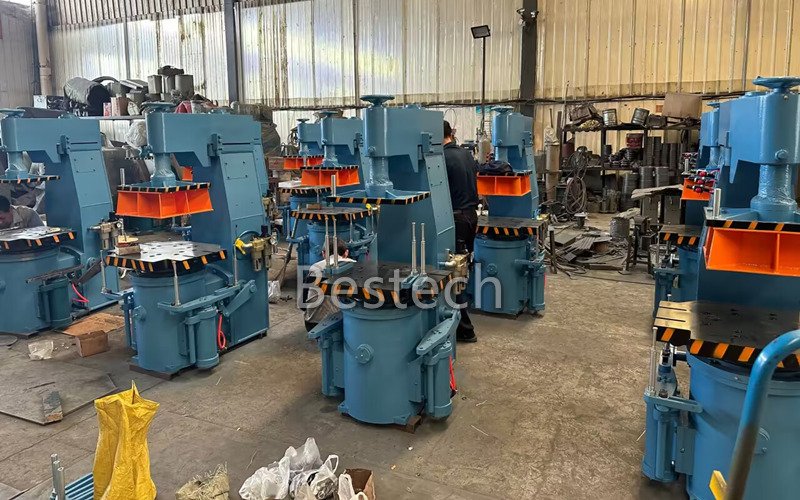
Jolt squeeze molding machine is used in foundries for producing sand molds efficiently. It combines two key operations—jolting and squeezing—to compact molding sand around a pattern to create a mold cavity.
What is a jolt squeeze molding machine?
Jolt Squeeze Molding Machine is suitable for mass production of single moulding plate or single moulding box of medium and small-sized castings, which can produce cope or drag.
Pneumatic components have a long service life and are convenient for operation, improving production efficiency.
Optimized structure design. The square box frame structure significantly improves the rigidity of the machine body.
The micro-vibration compaction process can significantly improve compaction strength and surface roughness to stabilize product quality. The hardness of sand moulding can reach above HB90.
The shocking part is equipped with a buffer spring to effectively reduce the machine’s impact on the foundation.
The pattern stripping mechanism adopts the cylinder, the crank, the connecting rod, and the synchronous shaft to realize the synchronous lifting.
Fully adopt pneumatic parts to achieve the overall function of the control part, easy operation, and convenient maintenance.
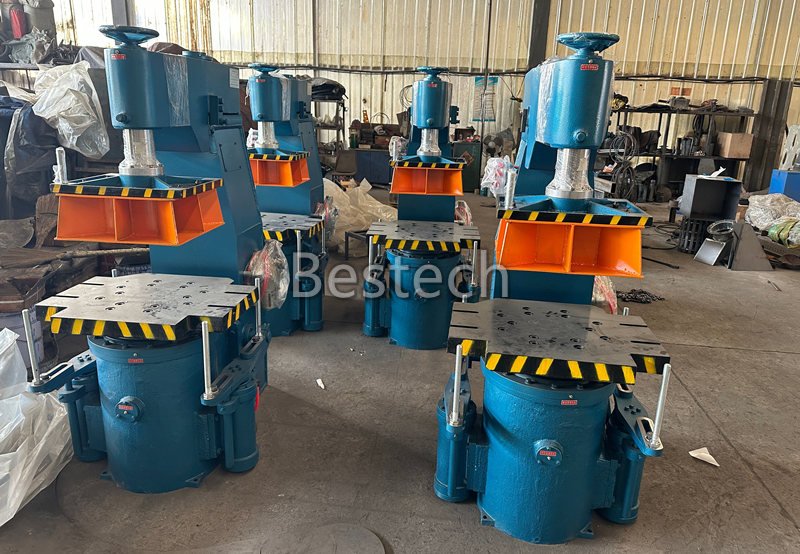
How jolt squeeze molding machine works?
- Setup Phase
The pattern (a replica of the object to be cast) is placed on a pattern plate.
A flask (a box-like container) is placed over the pattern to hold the molding sand.
Sand is poured into the flask to cover the pattern. - Jolting Operation
In the jolting stage, the machine lifts the pattern plate and flask assembly and drops it multiple times against a hard surface or on a vibrating table.
This repetitive jolting action settles and compacts the sand around the pattern, particularly in the lower regions of the mold.
How it works:
The machine uses compressed air or a mechanical system to lift and release the mold assembly.
The impact of the jolts causes sand to flow down and settle densely.
Purpose: To ensure that sand is tightly packed around intricate and deep parts of the pattern.
- Squeezing Operation
After jolting, the squeezing process begins.
A squeeze head (a mechanical plate or pneumatic piston) comes down and compresses the sand from the top.
This additional compression ensures that the sand is uniformly dense throughout the mold, particularly near the top.
How it works:
The squeeze head applies pressure either through hydraulic, pneumatic, or mechanical force.
Purpose: To further increase sand density and strength, ensuring the mold retains its shape during pouring.
- Final Mold Removal
Once the sand is compacted, the flask and sand mold are carefully removed from the machine.
The pattern is carefully withdrawn, leaving behind a cavity in the sand that corresponds to the shape of the pattern.
The mold is then ready for core placement, assembly, and the metal pouring process.
Jolt squeeze molding machine feature
- Combined Jolting and Squeezing Action
Jolting: Compacts the sand by lifting and dropping the flask and pattern assembly multiple times.
Squeezing: Provides uniform compaction from the top using a squeeze head.
This dual action ensures high mold density and better surface finish. - Compact and Rigid Design
The machine is designed to be sturdy and durable to withstand repeated jolting and squeezing operations.
Ensures minimal vibration loss, maximizing the compaction force. - Ease of Operation
Simple controls make it user-friendly, requiring minimal operator training.
Typically equipped with pneumatic, hydraulic, or mechanical systems for smooth operation. - High Efficiency
Produces molds quickly and consistently.
The combination of jolting and squeezing ensures better mold strength in less time, improving productivity. - Uniform Mold Compaction
Jolting settles sand in deep cavities and around intricate shapes.
Squeezing ensures even sand density, especially at the mold’s surface and top, preventing mold defects.
Conclusion
The jolt squeeze molding machine offers a balance between affordability, efficiency, and quality. Its combined jolting and squeezing features ensure that molds are compacted uniformly, making it a valuable choice for improving mold strength and accuracy in the casting process.