
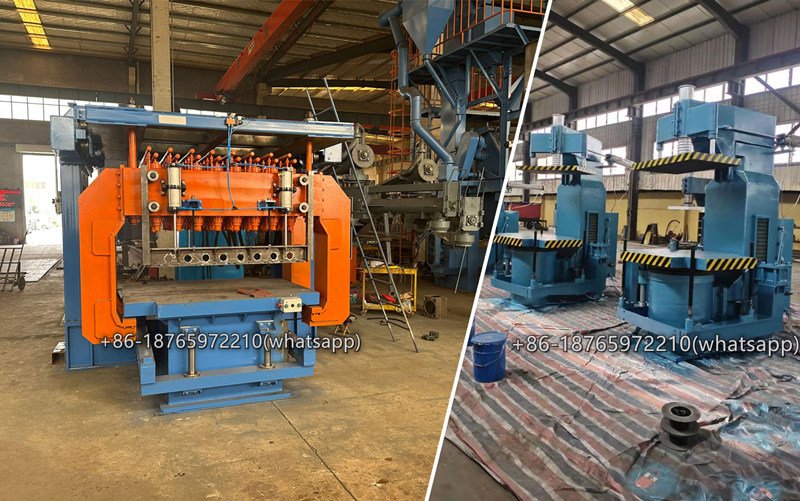
The main difference between a Jolt Squeeze Molding Machine and a Multi-Piston Molding Machine lies in their operation principles, molding process.
Jolt Squeeze Molding Machine
This type of machine is commonly used for traditional sand molding processes in foundries.
Working Mechanism:
Jolt Phase: The mold box (flask) is jolted vertically to compact the sand by ramming it into the flask.
Squeeze Phase: After jolting, a squeezing mechanism applies pressure to compact the sand further and achieve uniform density.
Features:
- Single compacting mechanism (jolt and squeeze).
- Simple design, relatively low cost, and easy operation.
- Suitable for small to medium-sized molds.
- Often used for making molds with patterns that have simple designs and less intricate details.
Applications:
- Ideal for manual or semi-automatic production lines.
- Best suited for small-scale foundries or casting non-complex parts like machine bases, simple automotive parts, and pump casings.
Multi-Piston Molding Machine
This machine uses multiple pistons for compacting the sand, ensuring better density and precision in the mold.
Working Mechanism:
Multi-Piston Action: Multiple pistons apply pressure simultaneously to different sections of the mold. This results in uniform sand compaction, even for large molds with complex geometries.
Features:
- Superior compaction due to multi-point pressure application.
- Can handle larger and more complex molds with intricate details.
- More advanced and efficient, suitable for automated systems.
- Higher cost and more sophisticated design compared to jolt squeeze machines.
Applications:
- Suitable for large-scale foundries or industries requiring high-quality castings.
- Commonly used for producing intricate automotive components, aerospace parts, and other high-precision molds.
Summary
Jolt Squeeze Machines are simple, economical, and ideal for basic sand molding needs.
Multi-Piston Machines provide superior mold quality for complex shapes and are preferred for high-precision and high-production environments.