
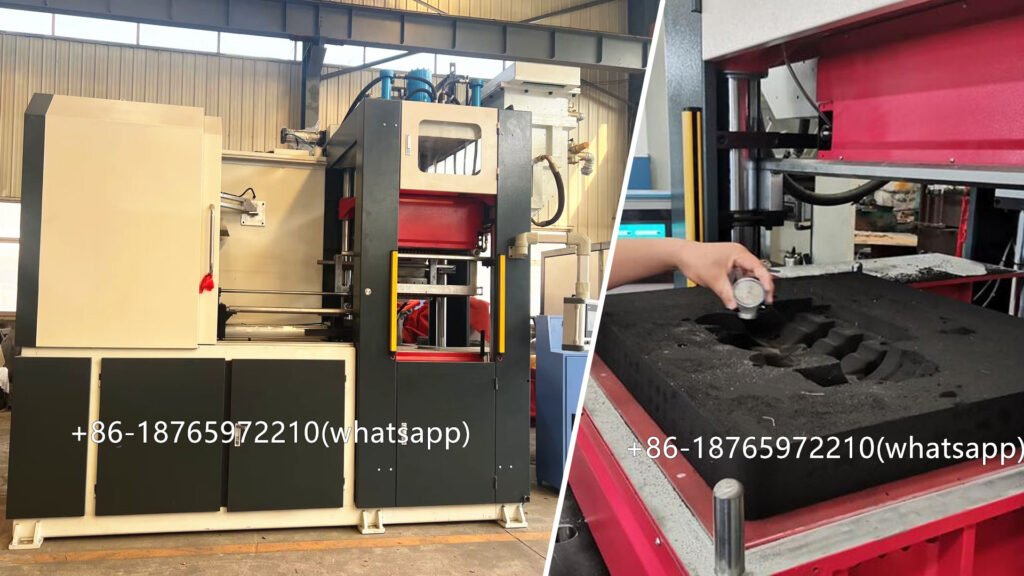
Green sand molding solutions, particularly flaskless molding machines, offer an efficient and automated approach to producing high-quality castings. These machines eliminate the need for traditional flasks, making the process faster, more precise, and cost-effective.
What Is A Flaskless Molding Machine?
A flaskless molding machine is an automated casting machine that forms molds without the use of traditional flasks (rigid outer frames that hold the sand mold). Instead of relying on separate flasks, these machines create and support the mold halves within the machine itself, making the process more efficient and streamlined.
How Flaskless Molding Works
A flaskless molding machine automates the sand molding process by eliminating the need for traditional flasks (rigid frames). It efficiently forms and joins mold halves within the machine, improving productivity and accuracy in metal casting.
- Sand Filling
A mixture of green sand (sand, clay, and water) is loaded into the molding chamber.
The sand is evenly distributed over the pattern to ensure proper mold formation. - Sand Compaction
The machine compacts the sand using hydraulic, mechanical, or pneumatic pressure to form a solid mold.
The pattern (a replica of the final part) is pressed into the sand, creating the mold cavity. - Pattern Removal
The pattern is withdrawn, leaving behind an impression (cavity) in the sand mold.
A release agent may be used to prevent sand from sticking to the pattern. - Mold Halves Handling
Flaskless molding machines create two mold halves without using separate flasks.
These halves are held within the machine structure for stability. - Mold Assembly
The machine automatically aligns and joins the two mold halves.
Proper alignment ensures a precise casting cavity. - Pouring of Molten Metal
The assembled mold is ready for molten metal pouring.
The metal fills the cavity and solidifies into the final casting shape. - Cooling & Mold Breakout
After cooling, the solidified casting is removed from the mold.
The used sand is reclaimed and recycled for the next cycle.
Advantages of Flaskless Molding Machines
- Higher automation and reduced labor costs
- Faster mold production and cycle times
- Improved dimensional accuracy and repeatability
- Reduced sand and material waste
- More compact footprint compared to traditional flask-based systems
Flaskless molding is commonly used in industries like automotive, machinery, and heavy equipment manufacturing due to its efficiency in high-volume production.
Why Green Sand Molding Widely Used in Foundry
Green sand molding is one of the most widely used casting processes in the foundry industry. It involves using a mixture of sand, clay, water, and additives to create reusable molds for metal casting. This method is known for its cost-effectiveness, versatility, and suitability for high-volume production.
Key Components of Green Sand Molding Solutions
- Molding Machines – Forms the mold by compacting sand.
- Sand Preparation & Reclamation Systems – Conditions and recycles used sand.
- Pattern Equipment – Creates the mold cavity.
- Core Making Machines (if needed) – Forms internal cavities.
- Pouring & Cooling Systems – Handles molten metal and solidification.
Advantages of Green Sand Molding
- Cost-Effective – Sand is reusable, reducing material costs.
- Fast Production – Suitable for high-volume manufacturing.
- Eco-Friendly – Green sand can be recycled and reused.
- Versatile – Works with ferrous and non-ferrous metals.
- Good Mold Strength – Provides excellent casting accuracy.
Green Sand Molding Process
- Sand Preparation
The green sand mixture (silica sand, bentonite clay, water, and additives) is prepared in a sand mixer.
The sand must have the right moisture content and bonding strength for mold stability. - Pattern Making
A pattern, which is a replica of the final casting, is placed inside a molding box (flask).
Patterns can be made from wood, metal, or plastic. - Mold Formation
The prepared green sand is packed around the pattern using compaction methods like:
Jolting – Vibrating the sand to settle it.
Squeezing – Applying pressure to compress the sand.
Blowing – Using air to fill the sand into the mold.
Once compacted, the mold retains the shape of the pattern. - Pattern Removal
The pattern is carefully lifted out, leaving behind a cavity that will be filled with molten metal.
Cores may be placed inside the mold for hollow sections in the casting. - Gating and Riser Design
Channels (gates and runners) are created to allow molten metal to flow into the mold.
Risers are added to compensate for shrinkage as the metal cools. - Mold Closing & Assembly
The two halves of the mold (cope and drag) are aligned and securely clamped together.
Proper alignment ensures casting accuracy and prevents metal leakage. - Pouring Molten Metal
Molten metal (iron, steel, aluminum, etc.) is poured into the mold cavity through the gating system.
The metal fills the mold, taking the shape of the casting. - Cooling & Solidification
The metal cools and solidifies inside the sand mold.
Cooling time depends on the metal type and casting size. - Shakeout & Casting Removal
Once cooled, the sand mold is broken apart, and the casting is removed.
The used sand is recycled and reconditioned for the next batch. - Finishing & Quality Inspection
The casting undergoes cleaning, grinding, and finishing to remove excess material.
Inspection methods like X-ray, ultrasonic testing, and visual checks ensure quality.
Conclusion
Green sand molding process is one of the most commonly used casting methods in foundries. It involves forming molds using a mixture of silica sand, clay (bentonite), water, and organic additives. The term “green” refers to the damp condition of the sand, meaning it has moisture when the mold is made.
Whatsapp+8618765972210