
Struggling to balance casting quality with environmental responsibility?
The casting industry faces dual challenges: maintaining high-quality output while addressing environmental concerns. Resin sand molding lines have emerged as a cost-effective sustainable solution, combining advanced technology with eco-friendly practices.
What Is Resin Sand Molding Line?
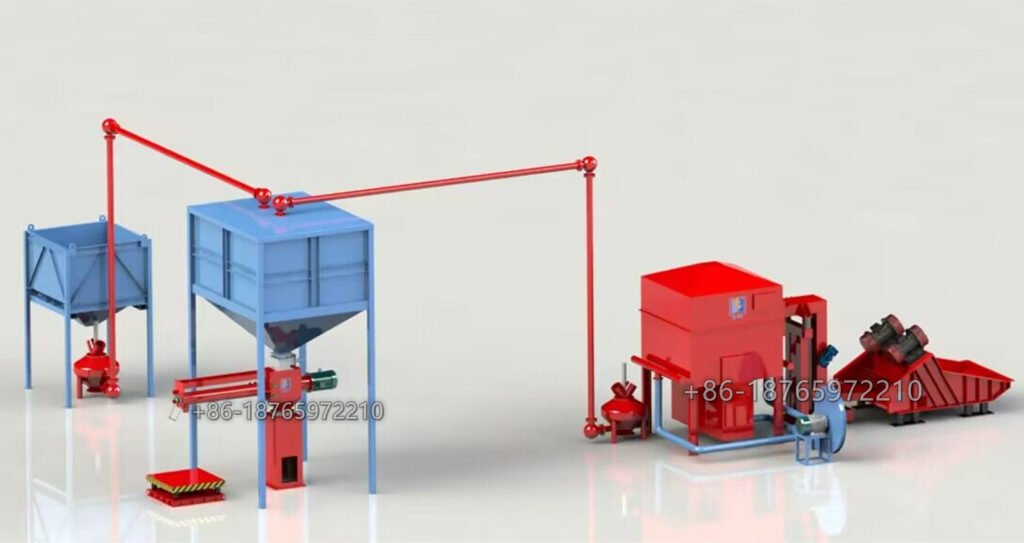
A resin sand molding line is an advanced foundry system designed for producing high-precision castings using resin-bonded sand as the primary molding material.
Resin sand molding technology is widely adopted in metal casting industries due to its efficiency, dimensional accuracy, and suitability for complex geometries.
Components of a Resin Sand Molding Line
- Sand Mixer: Blends sand with resin binders (e.g., furan or phenolic resin) and catalysts to form a homogeneous mixture.
- Molding Equipment: Includes vibrating tables or automated molding machines to compact resin sand into molds.
- Sand Reclamation System: Recycles used sand by removing residual resin and impurities, reducing material waste.
- Curing Stations: Facilitate the hardening of resin-bonded sand through heat or chemical reactions.
- Dust Removal Units: Maintain environmental compliance by filtering particulates during production.

Resin Sand Molding Process
- Sand Preparation:
Raw sand is mixed with resin (3–5%) and a hardening agent to create a moldable compound.
The mixture achieves high flowability and strength, enabling precise mold formation. - Mold Formation:
The resin sand is compacted into molds using vibration or pressure. Self-hardening lines allow molds to solidify at room temperature, while others may use heat. - Casting and Cooling:
Molten metal is poured into the mold cavity. The resin binder decomposes under heat, creating gases that must be managed to avoid defects . - Sand Reclamation:
Post-casting, the sand is cleaned, sieved, and reused, achieving up to 90% recycling efficiency.
Post-Casting Treatment Methods for Used Resin Sand in Sand Casting
Resin-bonded sand is widely adopted in sand casting due to its excellent dimensional accuracy and surface finish. However, the treatment of used resin sand after casting is critical for environmental compliance and cost efficiency.
Advanced Used Resin Sand Reclamation Systems: Technology, Applications, and Innovations
The efficient recycling of used resin sand is critical in foundry operations to reduce waste, lower raw material costs, and minimize environmental impact.
Modern reclamation systems integrate mechanical, thermal, and chemical processes to restore used resin sand to near-new quality for reuse.
Core Components of Reclamation Systems
Modern reclamation systems typically include:
Vibratory Breakers/Regenerators: Fragment old sand molds/cores to separate resin from silica grains .
Thermal Treatment Units: Rotary or fluidized-bed reactors remove residual resins via high-temperature pyrolysis (400–600°C) .
Air Filtration Systems: Capture dust and volatile organic compounds (VOCs) during processing .
Reclamation Techniques
A. Mechanical Reclamation
Process: Uses vibratory or hammer mills to break down spent sand into smaller particles, separating resin from silica.
Advantages: Energy-efficient and cost-effective for lightly bonded sands.
Limitations: Ineffective for heavily cured resins like phenolic or furan systems .
B. Thermal Reclamation
Process: Exposes sand to high temperatures to decompose resin polymers into gases/vapors, leaving reusable silica.
Innovations:
Fluidized Bed Technology: Enhances heat transfer efficiency, reducing energy consumption by 20–30% .
Carbon Additives: Adding glucose or glycerol accelerates resin decomposition and reduces emissions .
C. Combined Systems
Hybrid systems (mechanical + thermal) achieve >95% resin removal while maintaining sand grain integrity, suitable for high-volume foundries .
Why Sand Recycling Is Essential in Resin Sand Molding Process?
The resin sand molding process is a critical technique in foundry operations, where resin-bonded sand is used to create molds for metal casting. However, the sustainability and efficiency of this process heavily rely on sand recycling—a practice that reclaims and reprocesses used sand to reduce waste and resource consumption.
1. Environmental Sustainability
Resin sand molding generates significant waste, including spent sand contaminated with binders and additives. Recycling this sand directly addresses environmental concerns:
- Reduces landfill dependency: By reusing sand, foundries minimize the volume of waste sent to landfills, aligning with global waste reduction goals .
- Conserves natural resources: Virgin sand extraction depletes natural reserves and disrupts ecosystems. Recycling reduces reliance on raw materials, promoting a circular economy .
2. Economic Efficiency
Sand recycling lowers operational costs and enhances profitability:
- Cost savings: Purchasing virgin sand and disposing of waste are expensive. Recycling slashes raw material expenses by up to 50% and reduces landfill fees .
- Extended mold life: Clean, recycled sand maintains consistent grain structure, preventing defects and reducing downtime caused by mold failures .
3. Quality Control and Process Stability
Recycled sand must meet strict quality standards to ensure casting integrity:
- Removal of contaminants: Advanced recycling systems use vibration, screening, and washing to eliminate residual binders, dust, and impurities. This ensures uniformity in sand properties, critical for consistent mold performance .
- Energy optimization: Modern recycling machines (e.g., vibrating crushers and classifiers) operate with energy-efficient motors and adjustable frequencies, minimizing power consumption while maximizing output .
4. Regulatory Compliance
Stringent environmental regulations increasingly mandate waste reduction in manufacturing. Sand recycling helps foundries:
- Avoid penalties: Many regions ban the disposal of resin-contaminated sand in landfills. Recycling ensures compliance and avoids legal risks .
- Enhance corporate image: Adopting sustainable practices aligns with ESG (Environmental, Social, Governance) standards, attracting eco-conscious clients .
5. Technical Advancements in Recycling
Innovations in recycling technology further justify its importance:
- High-frequency vibration systems: Break down hardened resin sand blocks efficiently, recovering reusable grains .
- Thermal treatment: Some processes heat sand to decompose organic binders, enabling cleaner reuse without chemical additives .

Efficiency and Cost-effective Resin Sand Molding Line: Strategies for Optimization
Resin sand molding lines are critical in foundry operations, balancing precision, speed, and cost. Achieving efficiency and cost-effectiveness requires integrating advanced technologies, optimizing workflows, and adopting sustainable practices.
Technological Advancements for Efficiency
Automation and Digital Integration:
Modern resin sand molding lines leverage automation (e.g., robotic pattern handling, automated core shooting) to reduce manual intervention, minimize errors, and enhance throughput . Digital tools like real-time monitoring systems and IoT sensors enable predictive maintenance, reducing downtime and extending equipment lifespan .
Material Optimization:
Using high-performance resins (e.g., furan or phenolic resins) with lower binder content can reduce material costs while maintaining mold strength. Advanced mixers ensure uniform resin distribution, improving sand utilization and reducing waste .
Cost-Effective Design and Operations
- Energy Efficiency:
Energy-intensive processes like sand heating and resin curing can be optimized through:
Renewable Energy Integration: Solar or heat recovery systems to lower energy costs
Process Optimization: Adjusting cycle times and temperature settings to minimize energy waste - Lifecycle Cost Analysis:
Prioritize equipment with high durability and low maintenance costs. For example, modular designs allow easy upgrades, extending the line’s operational life and reducing long-term expenses .
Waste Reduction and Recycling
- Sand Reclamation Systems:
Implementing efficient reclamation units (e.g., rotary drum reclaimers) to recycle spent sand reduces raw material costs by up to 30% . - Byproduct Utilization:
Residual resin-rich sand can be repurposed for non-critical applications (e.g., construction fillers) or converted into fuel, turning waste into revenue streams .
Conclusion
Efficiency resin sand molding line revolutionizes metal casting by combining precision, sustainability, and scalability. As industries demand higher-quality components, this technology will continue evolving with smarter, greener solutions.
A cost-effective and efficient resin sand molding line hinges on technology integration, energy-conscious design, and waste minimization. By adopting these strategies, foundries can achieve competitive advantages while contributing to sustainable industrial practices.