
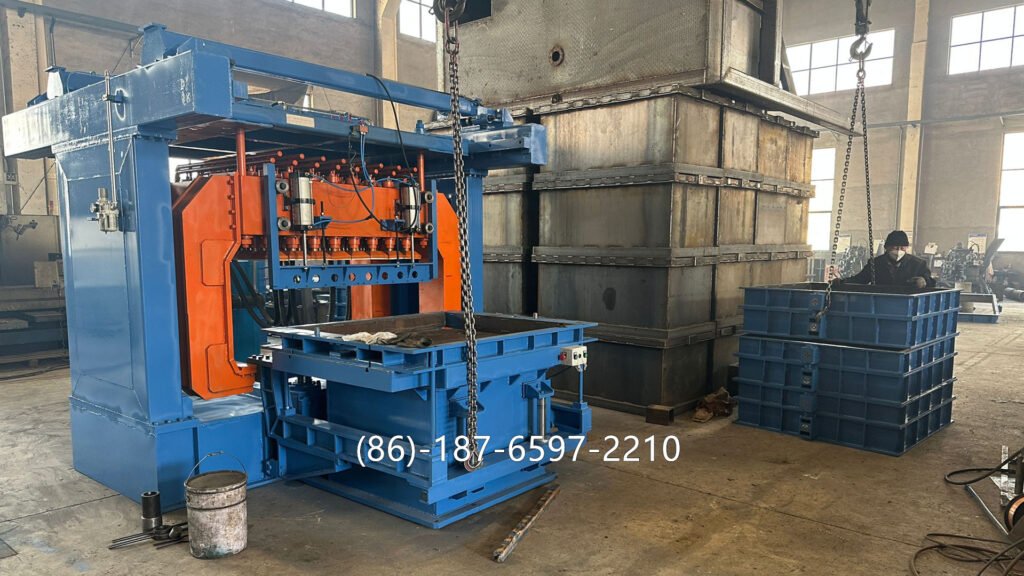
In modern foundry production, green sand molding remains the most economical and flexible casting method. To meet higher requirements on mold strength, dimensional accuracy, and production stability, the Hydraulic Multiple Piston Green Sand Molding Machine has become an important core equipment in automated molding lines.
Compared with traditional jolt-squeeze or mechanical squeeze machines, the hydraulic multiple piston design provides uniform compaction pressure, adjustable molding force, and stable repeatability. From an engineering perspective, understanding its working principle, structural design, applicable standards, and maintenance methods is essential for long-term reliable production.
Working Principle of Hydraulic Multiple Piston Green Sand Molding Machine
The hydraulic multiple piston molding machine uses a hydraulic power system to drive several compaction cylinders simultaneously, forming high-density green sand molds with precise pressure control.
1. Sand Filling Stage
Prepared green sand with controlled moisture and compactability is delivered into the molding flask through a sand hopper and feeding system. Uniform sand distribution is critical to avoid soft spots or mold collapse.
Typical green sand properties follow:
- ISO 17832 – Foundry sand testing methods
- GB/T 2684 – Green sand properties test methods
- JIS Z 2604 – Testing methods for molding sand
2. Multi-Piston Hydraulic Compaction
After sand filling, the hydraulic station supplies high-pressure oil to multiple compaction cylinders. Several pistons press the sand mold surface simultaneously. Because pressure points are distributed evenly, the mold achieves:
- Uniform hardness from top to bottom
- High mold density
- Stable dimensional accuracy
- Reduced casting defects such as sand inclusion and scabbing
Hydraulic pressure, compaction stroke, and holding time can be adjusted based on casting size and sand characteristics.
3. Mold Release and Transfer
After reaching preset pressure, the hydraulic system releases oil pressure. The pattern plate separates from the flask, and the completed mold is transferred to the pouring or assembly line. The full molding cycle is controlled by PLC and electro-hydraulic coordination.
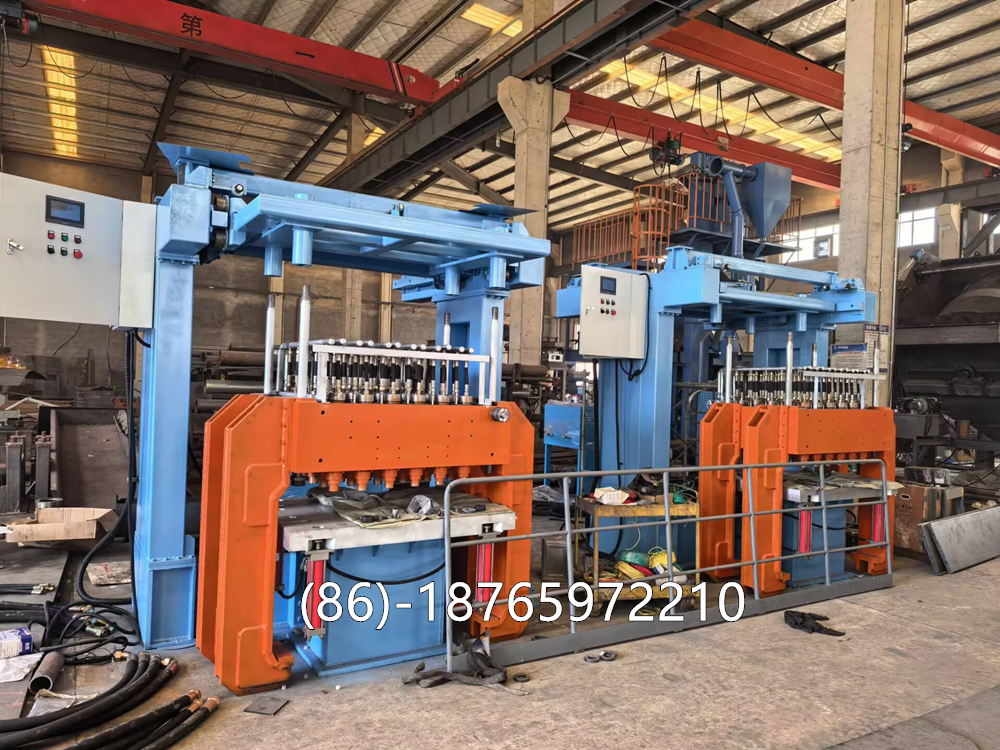
Main Structural Components
A standard hydraulic multiple piston green sand molding machine consists of:
- Hydraulic power station (motor, pump, oil tank, valve block)
- Multiple compaction cylinders and pistons
- Mold box lifting and clamping mechanism
- Sand feeding and leveling device
- Pattern plate and stripping mechanism
- PLC control system and safety interlocks
Each subsystem is designed for continuous automatic production in modern foundry lines.
Technical Parameters (Typical Reference Range)
| Item | Unit | Typical Range |
|---|---|---|
| Flask Size | mm | 1000×900 – 1400×1400 |
| Compaction Pressure | MPa | 8 – 16 |
| Number of Pistons | pcs | 12 – 24 |
| Molding Cycle Time | s | 15 – 30 |
| Hydraulic Motor Power | kW | 7.5 – 22 |
| Mold Hardness | HB | 85 – 95 |
| Production Capacity | molds/hour | 40 – 60 |
Parameters may vary according to model and customer requirements.
Applicable Standards and Design References
To ensure equipment reliability and production safety, hydraulic molding machines are commonly designed and tested according to:
- ISO 12100 – Safety of machinery, risk assessment
- ISO 13849 – Safety-related control systems
- GB/T 16758 – Foundry molding machine general technical conditions
- GB/T 5226.1 – Electrical safety of machinery
- JIS B 9700 – Safety of machinery (Japanese standard)
Following these standards ensures stable operation, safety compliance, and international acceptance.
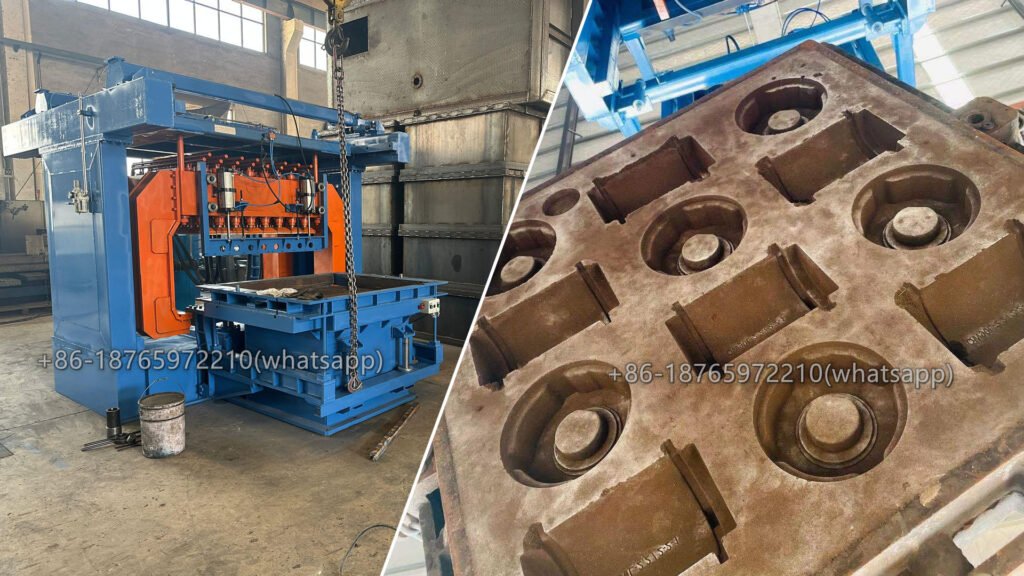
Advantages of Multiple Piston Hydraulic Compaction
Compared with traditional single-cylinder or mechanical squeeze molding machines, multiple piston hydraulic compaction provides:
- Uniform pressure distribution
- Adjustable and precise compaction force
- Low vibration and low noise
- Better mold strength and surface finish
- Reduced casting defect rate
- Long service life of machine structure
Therefore, it is widely used in iron, steel, aluminum, and copper alloy foundries.
Maintenance Methods and Engineering Suggestions
Proper maintenance is key to stable production and long equipment life.
1. Hydraulic System Maintenance
- Check hydraulic oil level and cleanliness regularly
- Replace oil and filters according to operating hours
- Inspect for oil leakage at pipelines and seals
- Keep oil temperature within recommended range
Engineering Note: Clean hydraulic oil is the “blood” of the system.
2. Compaction Cylinder and Piston Care
- Inspect piston rods for wear or surface scratches
- Replace sealing rings periodically
- Ensure smooth piston movement without abnormal noise
Stable piston action guarantees consistent molding pressure.
3. Sand Feeding System Maintenance
- Clean hopper and feeding gate daily
- Prevent sand blockage and moisture accumulation
- Adjust sand quantity to ensure even filling
Uniform sand filling ensures stable mold hardness.
4. Electrical and Control System Check
- Test sensors and limit switches
- Verify PLC signals and interlocks
- Keep control cabinet dust-free and dry
Reliable control means safe continuous production.
5. Daily Operation Practices
- Warm up hydraulic system before full load
- Record pressure and production parameters
- Train operators with standard operating procedures
Good habits prevent unexpected downtime.
Common Troubleshooting Reference
| Problem | Possible Cause | Solution |
|---|---|---|
| Uneven mold hardness | Unbalanced piston pressure | Check hydraulic valves and piston seals |
| Oil temperature too high | Cooling system insufficient | Clean cooler and check oil flow |
| Sand mold collapse | Poor sand filling | Adjust feeding volume and sand moisture |
| Pressure loss | Seal wear or leakage | Replace seals and tighten pipelines |
Conclusion
The Hydraulic Multiple Piston Green Sand Molding Machine combines precise hydraulic control with multi-point compaction technology, providing high-density and stable molds for modern foundry production.
From the manufacturer perspective, understanding the working principle, following international standards, and implementing systematic maintenance are the foundation for long-term stable and cost-effective operation.
Good maintenance is not an expense — it is an investment in continuous production.