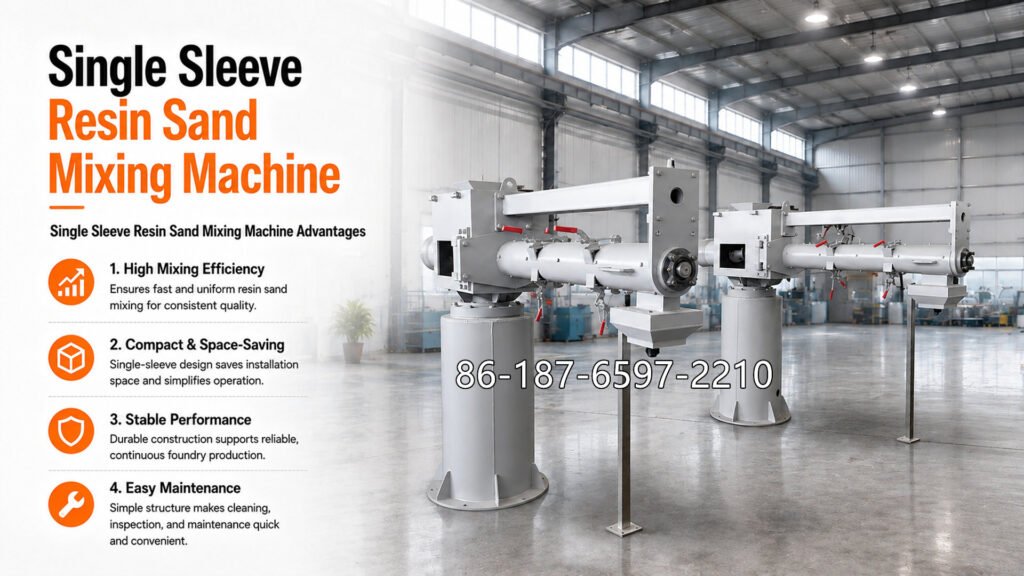
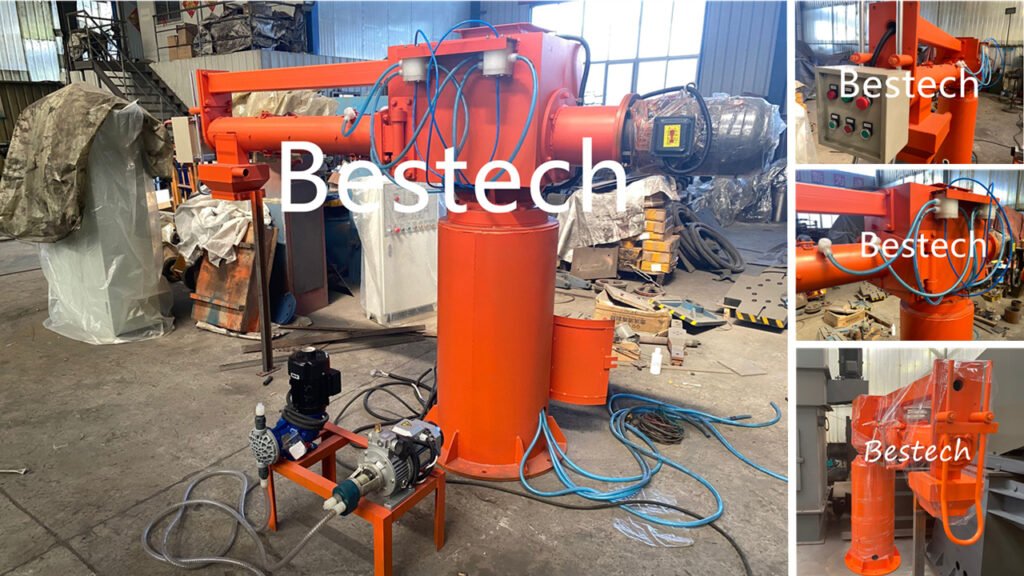
Single Sleeve Resin Sand Mixing Machine | Foundry Mixer
Learn how a single sleeve resin sand mixing machine improves mixing efficiency, binder distribution, sand quality and foundry production costs.Skip to content
A properly configured single-sleeve resin sand mixer can provide controlled mixing of sand and binder components, stable discharge, shorter mixing cycles, and easier maintenance for foundries using resin-bonded sand processes.
For buyers, the key question is:
Can the mixer deliver the required sand quality at the required production rate without creating unnecessary resin, labor, energy, or maintenance costs?
This guide explains how to evaluate a Single Sleeve Resin Sand Mixing Machine from the perspective of mixing efficiency, capacity, binder control, machine design, operating cost, maintenance, standards, and factory purchasing requirements.
1. What Is a Single Sleeve Resin Sand Mixing Machine?
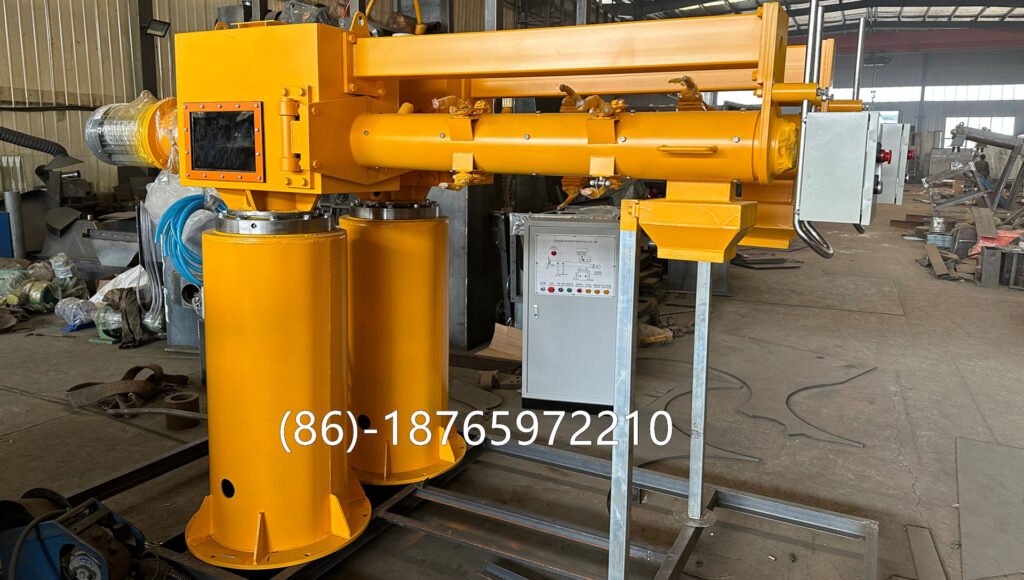
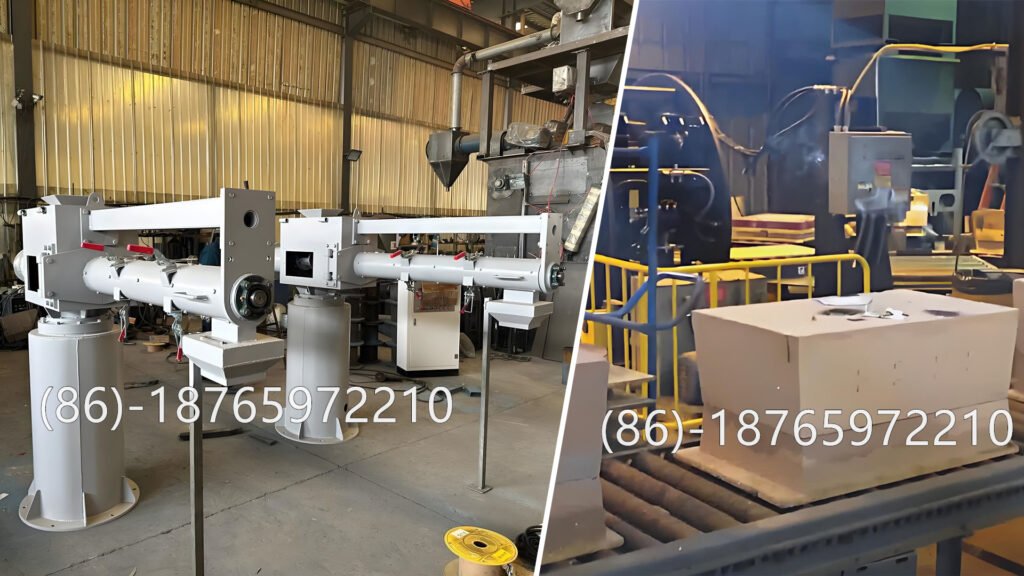
Single Sleeve Resin Sand Mixing Machine is industrial foundry equipment designed to mix molding sand with binder components such as resin and catalyst/hardener to produce uniform resin-bonded sand.
A high-quality mixer is not simply a machine that turns sand.
It is a process-control machine.
3. How Does a Single Sleeve Resin Sand Mixer Work?
A typical process can be divided into five stages.
Step 1 — Sand Feeding
Prepared sand enters the mixing chamber.
The sand may come from:
Sand storage hopper
Reclaimed sand system
Sand cooler
Sand conveyor
Sand weighing system
Step 2 — Binder Addition
Resin and catalyst/hardener are added according to the process recipe.
The dosing system may include:
Resin pump
Catalyst pump
Flow control
Metering system
Automatic control
Step 3 — Intensive Mixing
The mixing mechanism distributes the binder through the sand mass.
The mixer must achieve sufficient:
Contact
Movement
Shearing
Dispersion
without unnecessarily extending the cycle.
Step 4 — Mixing Quality Check
The mixed sand should meet the required process condition.
Depending on the foundry process, quality control may consider:
Binder addition
Mixing time
Sand temperature
Moisture
Flowability
Workability
Mold/core strength
Step 5 — Discharge
The mixed sand is discharged directly to:
Mold-making station
Core-making station
Sand hopper
Conveyor
Automated molding line
4. Why Choose a Single Sleeve Design?
The term single sleeve normally refers to the specific mechanical configuration used by the mixer manufacturer.
The advantage is not simply the name of the structure.
What matters is how the sleeve, mixing chamber, mixing tools, and discharge system work together.
A properly engineered single-sleeve mixer can provide:
Compact Structure
A relatively compact design can help reduce:
Installation footprint
Foundation requirements
Maintenance space
Efficient Mixing
The mixing mechanism is designed to move sand and binder through the working zone efficiently.
Stable Operation
A rigid structure helps maintain stable operation under repeated production cycles.
Easier Maintenance
A simpler mechanical configuration can make inspection and replacement of wear parts easier.
Flexible Integration
The mixer can be integrated with:
Sand storage
Sand reclamation
Sand cooling
Binder dosing
Conveyors
Mold/core production systems
5. Typical Technical Parameters
The exact specifications should be customized according to required production capacity and resin sand process.
The following table provides typical engineering reference ranges, not a universal specification for every single-sleeve mixer.
Parameter
Typical Engineering Reference
Machine Type
Single Sleeve Resin Sand Mixing Machine
Application
Resin-bonded foundry sand
Mixing Method
Intensive mechanical mixing
Batch Capacity
Approx. 50–500 kg/batch
Production Capacity
Approx. 1–10 tons/hour
Main Motor Power
Approx. 7.5–30 kW
Binder System
Resin + catalyst/hardener
Resin Dosing
Manual / automatic
Catalyst Dosing
Manual / automatic
Mixing Time
Process dependent
Discharge
Pneumatic / hydraulic / mechanical
Control
Electrical / PLC + HMI optional
Sand Type
Reclaimed / new / blended sand
Installation
Stand-alone / production line
Customization
Available according to application
Important: Final machine parameters should be selected based on actual sand type, binder system, batch size, required production capacity, mixing time, sand temperature, and installation layout.
6. Batch Capacity vs Actual Production Capacity
This is one of the most common mistakes when comparing sand mixers.
A mixer advertised as:
500 kg/batch
does not automatically mean:
5 tons/hour
You need to calculate the complete production cycle.
Basic Formula
Hourly Capacity = Batch Weight × 60 ÷ Total Cycle Time
For example:
Batch weight = 300 kg
Sand loading = 2 minutes
Binder dosing = 1 minute
Mixing = 3 minutes
Discharge = 1 minute
Total cycle:
7 minutes
Theoretical production:
300 × 60 ÷ 7 ≈ 2.57 tons/hour
Actual production will depend on:
Sand feeding
Binder dosing
Mixing time
Discharge
Operator handling
Conveyor speed
Maintenance downtime
Therefore, always ask the supplier for:
Net production capacity under your actual process conditions.
7. Mixing Time Is Not the Same as Mixing Efficiency
A longer mixing time does not necessarily mean better mixing.
Suppose:
Mixer A
Mixing time = 8 minutes
Mixer B
Mixing time = 4 minutes
If Mixer B achieves the required sand quality in 4 minutes, it may provide significantly higher production capacity.
The real objective is:
Shortest stable mixing cycle that achieves the required sand quality.
This is why a factory should perform actual sand testing before selecting a production mixer.
8. Binder Dosing Accuracy Is Critical
For resin sand systems, the mixer is only one part of the process.
The binder dosing system is equally important.
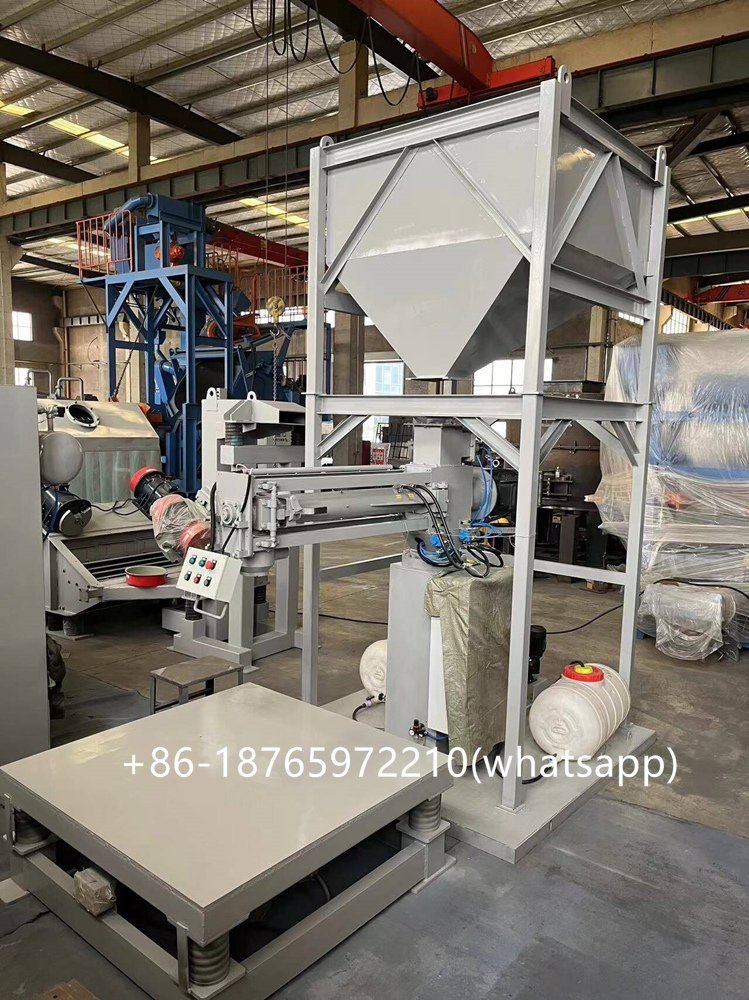
A complete system may include:
Resin Tank → Resin Pump → Metering → Injection
and:
Catalyst Tank → Catalyst Pump → Metering → Injection
The system should provide stable dosing according to the process recipe.
Important factors include:
Pump accuracy
Flow stability
Pipe diameter
Nozzle position
Resin viscosity
Catalyst characteristics
Temperature
Control method
For automatic systems, PLC control can help synchronize:
The mixer needs to provide sufficient mixing while avoiding unnecessary delays.
For no-bake applications, the available working time can be critical.
If the mixed sand begins to cure too quickly:
Flowability can decrease
Mold filling becomes difficult
Sand may remain in the mixer
Cleaning frequency increases
Production efficiency decreases
Therefore, the relationship between:
Mixing Time + Binder Addition + Discharge Time + Working Time
should be evaluated as one complete process.
14. Single Sleeve Resin Sand Mixer for Furan Resin
Furan resin systems are commonly used in no-bake foundry applications.
The mixer configuration should be selected according to:
Sand type
Resin type
Catalyst system
Production rate
Mold size
Required working time
The resin supplier’s recommended binder ratio and process parameters should be treated as the starting point for commissioning.
The mixer manufacturer should then optimize the mechanical process around those requirements.
15. Mixer Wear Parts: Where Maintenance Cost Comes From
A resin sand mixer is exposed to continuous abrasive material.
The main wear areas may include:
Mixing tools
Mixing chamber lining
Sleeve or protective components
Discharge components
Seals
Bearings
Binder nozzles
Wear rate depends on:
Sand hardness
Sand flow
Production hours
Abrasive particles
Mixing intensity
Material selection
A buyer should therefore ask:
Which components are wear parts, and how quickly can they be replaced?
This is much more useful than asking only about the machine warranty.
16. How to Reduce Mixer Maintenance Costs
A practical maintenance program should include:
Daily
Clean residual sand
Check binder nozzles
Inspect discharge
Check abnormal noise
Check leakage
Weekly
Inspect mixing tools
Check seals
Check bearings
Check pump system
Check electrical connections
Periodically
Measure wear
Replace worn mixing tools
Inspect chamber lining
Check motor
Inspect reducer
Calibrate dosing system
The exact maintenance interval should follow the manufacturer’s manual and actual operating conditions.
17. Safety Requirements for Resin Sand Mixing Equipment
A resin sand mixer contains:
Rotating components
Moving discharge mechanisms
Electrical systems
Chemical binder systems
Potential dust exposure
Therefore, safety should be included in the equipment design.
ISO 23062:2022 covers safety requirements for foundry molding and coremaking machinery and associated equipment. The standard specifically recognizes sand mixers as foundry equipment and describes both batch and continuous mixer concepts.
A properly engineered mixer should consider:
Emergency stop
Access protection
Guards
Interlocks
Maintenance access
Safe chemical handling
Electrical protection
Warning labels
Safe cleaning procedures
For an EU-market machine, Regulation (EU) 2023/1230 establishes machinery health and safety requirements and the conformity framework. Where the applicable conformity assessment demonstrates compliance, the manufacturer draws up the EU Declaration of Conformity and affixes the CE marking.
CE marking should not be described simply as a generic “quality certificate.” The actual conformity-assessment route and documentation depend on the machine and applicable legislation.
18. ISO 9001 and Factory Quality Control
When purchasing from an overseas manufacturer, machine quality is not determined only by the final inspection.
A controlled manufacturing process is important.
ISO 9001 provides a framework for establishing, maintaining, and continually improving a quality management system. ISO notes that the standard applies across sectors, including manufacturing, and focuses on consistent processes and customer requirements.
For a resin sand mixer manufacturer, practical quality-control points can include:
Raw Material Inspection
Steel plate
Shafts
Bearings
Motors
Reducers
Electrical components
Manufacturing Inspection
Welding
Machining
Assembly
Alignment
Surface treatment
Final Inspection
Motor operation
Mixing mechanism
Discharge
Binder dosing
Electrical system
Safety devices
Factory Test
Where practical, the machine should undergo:
No-load test → Mechanical inspection → Electrical test → Process test
19. What Makes a Good Single Sleeve Resin Sand Mixer?
Do not evaluate a mixer based only on:
Motor power
Machine size
Price
Instead, evaluate the complete system.
1. Mixing Performance
Can it achieve the required sand quality?
2. Cycle Time
Can it meet the required production rate?
3. Binder Dosing
Can resin and catalyst be added consistently?
4. Discharge
Can the mixed sand leave the chamber quickly and completely?
5. Wear Resistance
Can the main wear parts withstand your sand?
6. Maintenance
Can operators access critical components easily?
7. Automation
Can the mixer integrate with your production line?
8. Safety
Does the machine include appropriate guarding and interlocks?
9. Service
Can the supplier provide spare parts and technical support?
20. Manual vs Automatic Resin Sand Mixing
Manual Mixing
Suitable for:
Small production
Low investment
Simple applications
Disadvantages:
Higher labor dependence
Less consistent dosing
Higher operator variation
Difficult process tracking
Automatic Mixing
Suitable for:
Medium/high production
Stable product requirements
Continuous foundry operations
Advantages:
Consistent dosing
Repeatable mixing cycles
Reduced operator dependence
Easier process monitoring
Better production records
For growing foundries, automatic resin and catalyst dosing can provide a significant improvement in process control.
21. PLC + HMI Control for Resin Sand Mixing
For automated production, a PLC-controlled system can coordinate:
Sand Loading
↓
Resin Dosing
↓
Catalyst Dosing
↓
Mixing
↓
Discharge
The HMI can display:
Batch weight
Resin quantity
Catalyst quantity
Mixing time
Production count
Alarm status
Motor status
This makes the machine easier to operate and troubleshoot.
For more advanced systems, production data can also be integrated into a broader foundry automation system.
22. How to Calculate the Real Cost of Resin Sand Mixing
The machine purchase price is only one part of the total cost.
Consider:
Machine Investment
Labor
Resin
Catalyst
Electricity
Wear Parts
Maintenance
Downtime
=
Total Mixing Cost
A cheaper mixer may not be cheaper to operate.
For example, if poor mixing increases binder consumption by even a small percentage, the annual material cost can become significant in a high-volume foundry.
Therefore:
Compare cost per ton of qualified mixed sand—not only machine purchase price.
23. Example: Cost Reduction Logic
Suppose a foundry produces:
5 tons of resin sand/hour
and operates:
2,000 hours/year
Annual production:
10,000 tons/year
If process optimization reduces unnecessary binder consumption by only 1%, the economic effect can become substantial depending on the binder cost.
The actual economic benefit depends on the binder formulation and purchase price.
This is why even small improvements in dosing and mixing can matter in large foundries.
24. How to Choose the Right Mixer Capacity
Before buying, calculate your real production requirement.
Example
Current production:
1.5 tons/hour
Future target:
3 tons/hour
Do not automatically purchase a 3-ton/hour mixer.
Consider:
Production growth
Peak production
Batch size
Available floor space
Working time
Mold line speed
Sand reclamation capacity
If your mold line requires 3 tons/hour continuously, the mixer and upstream sand system should be designed with sufficient practical capacity rather than operating permanently at its maximum theoretical output.
25. When Should You Choose a Larger Resin Sand Mixer?
A larger mixer may be appropriate when:
Batch size is large
Mold size is large
Production volume is high
Longer continuous production is required
Automatic molding/core production is used
But bigger is not always better.
An oversized mixer can create:
Longer minimum batch requirements
More material left in the chamber
Higher energy consumption
Longer cleaning time
Poor suitability for small batches
The correct machine is the one that matches your actual production range.
26. Single Sleeve Resin Sand Mixer OEM & Customization
For different foundries, standard equipment may not always fit.
OEM customization can include:
Mechanical Customization
Mixer capacity
Chamber dimensions
Discharge height
Inlet height
Frame dimensions
Wear lining
Mixing tools
Binder System
Resin tank
Catalyst tank
Pump
Flowmeter
Dosing nozzle
Automatic dosing
Electrical
PLC
HMI
VFD
Control cabinet
Local voltage/frequency
Production Line Integration
Sand conveyor
Storage hopper
Sand cooler
Reclamation system
Automatic mold line
Weighing system
This is particularly useful when the mixer must fit an existing foundry layout.
27. Factory Acceptance Test for a Resin Sand Mixer
For a serious B2B purchase, request a factory test where possible.
Mechanical Test
Check:
Motor rotation
Mixing mechanism
Bearing operation
Discharge
Abnormal vibration
Abnormal noise
Dosing Test
Check:
Resin pump
Catalyst pump
Flow control
Dosing accuracy
Nozzle operation
Process Test
Use actual or representative sand and verify:
Batch weight
Mixing time
Binder addition
Discharge time
Sand condition
Electrical Test
Check:
PLC
HMI
Sensors
Emergency stop
Interlocks
Alarm system
The best FAT question is:
Can the machine meet my actual process requirement—not simply can the motor run?
28. Common Problems When Buying a Resin Sand Mixer
Problem 1 — Buying Based Only on Capacity
A larger batch does not automatically mean higher productivity.
Problem 2 — Ignoring Binder Dosing
A good mechanical mixer cannot compensate for unstable binder dosing.
Problem 3 — No Sand Test
Different reclaimed sands behave differently.
Problem 4 — No Consideration of Working Time
For no-bake systems, discharge timing can directly affect molding performance.
Problem 5 — Ignoring Wear Parts
A low initial price can become expensive if mixing tools wear quickly.
Problem 6 — No Production-Line Integration
A mixer can be correctly designed but still create bottlenecks if the upstream or downstream equipment is too slow.
Problem 7 — No Spare Parts Plan
Critical components should be available before production starts.
29. How to Choose a Resin Sand Mixer Manufacturer
Before placing an order, ask the supplier:
Technical
What is the actual batch capacity?
What is the tested production rate?
What resin systems are supported?
What is the standard mixing time?
What binder dosing system is included?
What are the main wear parts?
Engineering
Can you customize the machine?
Can you integrate it with our reclamation line?
Can you provide layout drawings?
Can you adapt the discharge height?
Can you design the dosing system?
Quality
What factory tests are performed?
What materials are used for wear parts?
What inspection documents are available?
Is a sample test available?
Service
Spare parts availability?
Installation support?
Commissioning?
Operator training?
Remote technical support?
30. RFQ Template for a Single Sleeve Resin Sand Mixing Machine
To receive an accurate quotation, send the following information.
Sand Information
Sand type: Furan / Phenolic / Alphaset / Other
New sand:
Reclaimed sand:
Sand temperature: __________ °C
Moisture: __________ %
Production Requirements
Required capacity: __________ tons/hour
Batch size: __________ kg
Working hours/day:
Production days/month:
Future capacity target: __________ tons/hour
Binder Information
Resin type:
Catalyst/hardener:
Binder addition rate: __________ %
Automatic dosing required: Yes / No
Resin pump: Required / Existing
Catalyst pump: Required / Existing
Machine Requirements
Mixer type: Single Sleeve Resin Sand Mixing Machine
Control: Manual / Automatic / PLC + HMI
Discharge height: __________ mm
Inlet height: __________ mm
Installation space: L × W × H = __________
Power supply:
Installation country:
31. What Should Be Included in the Supplier Quotation?
A professional quotation should clearly state:
Machine
Model
Batch capacity
Production capacity
Main motor
Machine dimensions
Machine weight
Mixing System
Mixing mechanism
Mixing tools
Chamber lining
Discharge system
Binder System
Resin pump
Catalyst pump
Flow control
Dosing nozzles
Tanks
Control
Electrical cabinet
PLC
HMI
Sensors
VFD
Auxiliary Equipment
Sand hopper
Conveyor
Sand cooler
Dust extraction
Reclamation integration
Commercial
Machine price
Spare parts
Packaging
Delivery
Installation
Commissioning
Training
Warranty
This makes supplier comparison much more transparent.
32. Frequently Asked Questions
What is a Single Sleeve Resin Sand Mixing Machine?
It is a foundry mixer designed to combine sand with resin and catalyst/hardener to produce uniformly bonded resin sand for molding or coremaking applications.
What is the main advantage of a single sleeve resin sand mixer?
Its main advantage is efficient and controlled mixing in a compact mechanical configuration, with options for automated binder dosing and production-line integration.
What resin systems can it handle?
Depending on the configuration, it can be designed for furan, phenolic, Alphaset, and other chemically bonded sand systems. The exact configuration should be matched to the binder supplier’s process requirements.
What is the capacity of a single sleeve resin sand mixer?
Typical engineering configurations may range from small batch mixers to several tons per hour. Final capacity depends on batch size, mixing time, sand characteristics, binder system, and discharge cycle.
Can the mixer use reclaimed sand?
Yes. It can be designed to process reclaimed sand, provided the reclaimed sand has suitable temperature, moisture, grain condition, and residual-binder characteristics for the selected resin system.
Can resin and catalyst be automatically dosed?
Yes. Automatic resin and catalyst dosing can be integrated using pumps, flow control, sensors, PLC and HMI.
How can a resin sand mixer reduce foundry costs?
Better mixing and dosing control can help reduce unnecessary binder consumption, labor requirements, rework, and production variability. Actual savings should be verified through process testing.
Is PLC control necessary?
Not for every application. Small foundries may use simpler controls, while medium- and high-volume production generally benefits from PLC + HMI control for repeatability and monitoring.
Can the mixer be customized?
Yes. Capacity, discharge height, inlet height, binder dosing, control system, machine dimensions, wear protection and production-line integration can be customized according to the application.
How do I choose the correct capacity?
Start with your current and future sand demand in tons/hour, then calculate batch size and complete cycle time. The selected mixer should meet the practical production target without operating permanently at its maximum limit.
We’re here to help! Whether you need more information about our products or services, our team is ready to assist. Don’t hesitate to reach out—we’re just a message away!