
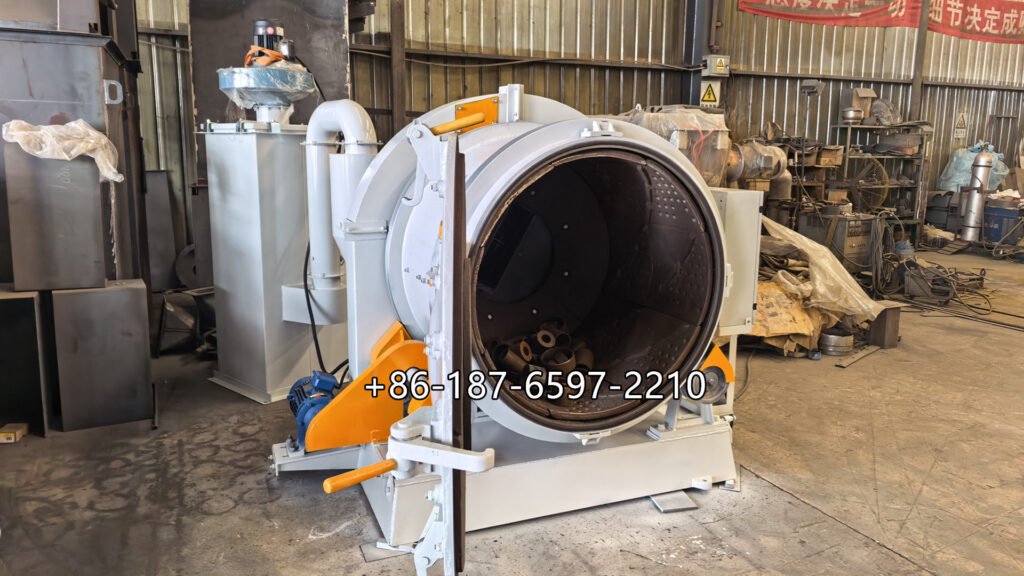
Choosing the best rotary drum shot blasting machine for metal parts requires more than comparing machine prices, drum volume, or blast wheel power. The right equipment must match the workpiece dimensions, batch weight, surface contamination, cleaning requirements, and production target.
For foundries, forging plants, automotive component manufacturers, and metalworking factories, a properly selected rotary drum shot blasting machine can remove rust, oxide scale, molding sand, and other surface contaminants from suitable metal components. It can also help improve production consistency and reduce manual surface cleaning.
However, not every rotary drum shot blasting machine is suitable for every metal part. Small castings, heavy forgings, thin-walled components, and precision-finished parts have different processing requirements.
This guide explains how to evaluate rotary drum shot blasting equipment, compare technical parameters, select suitable abrasives, and avoid common purchasing mistakes.
If you are sourcing a rotary drum shot blasting machine manufacturer for your factory, use the following engineering checklist before requesting a quotation.
1. What Is a Rotary Drum Shot Blasting Machine?
A rotary drum shot blasting machine is an industrial surface treatment system designed to process suitable metal components in batches.
During operation, the workpieces are placed inside a rotating drum or barrel. A centrifugal blast wheel accelerates abrasive particles and projects them onto the workpiece surfaces. The rotation helps expose different surfaces to the abrasive stream.
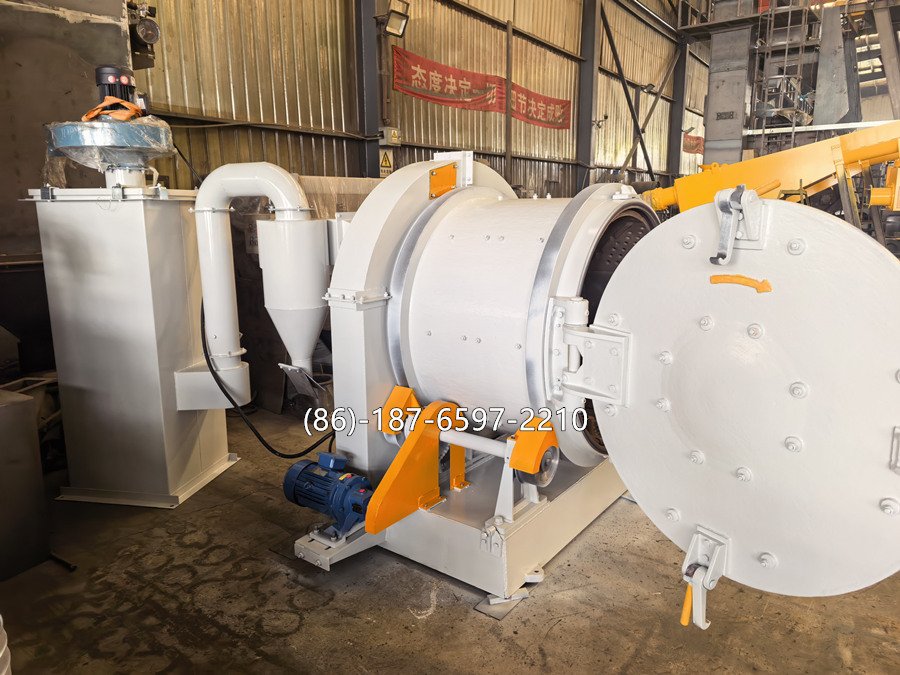
After blasting, reusable abrasive is recovered and returned to the system. A separator removes dust and broken abrasive, while a dust collector controls airborne particles.
A typical rotary drum shot blasting machine consists of:
- Rotary drum or barrel: Holds and moves the metal parts during processing.
- Blast wheel: Projects abrasive particles at high speed.
- Abrasive circulation system: Collects and returns reusable abrasive.
- Elevator and separator: Transport and clean the abrasive before reuse.
- Dust collector: Removes airborne dust and fine particles.
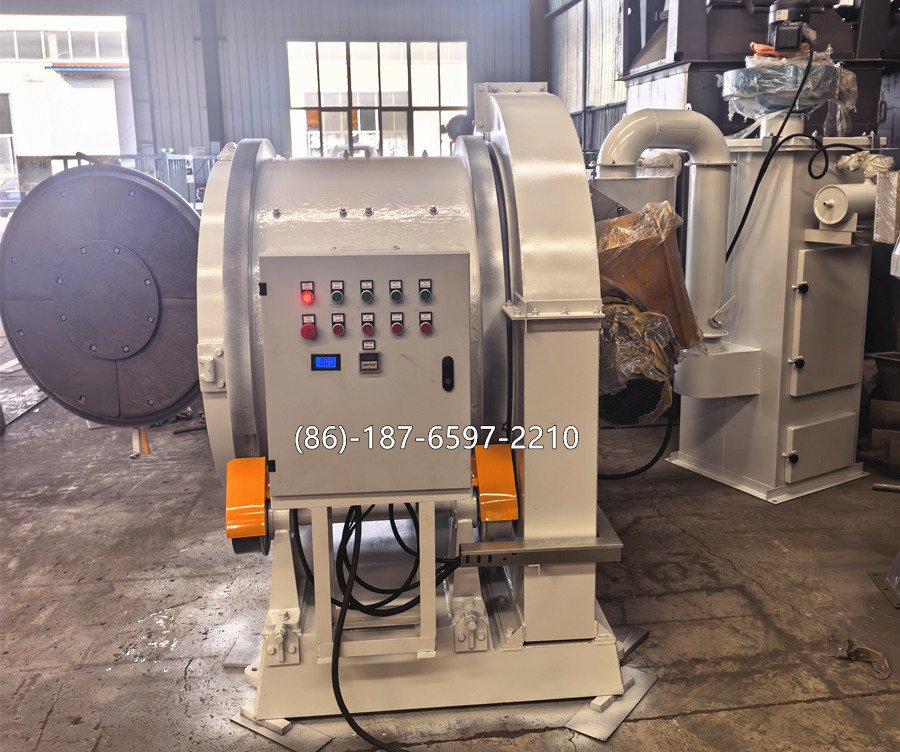
- Electrical control system: Controls the operating sequence and safety interlocks.
- Loading and unloading arrangement: Supports manual, assisted, or automatic handling, depending on the design.
The machine is particularly useful when a factory needs to clean many similar components in repeated batches.
However, the drum design must match the workpiece geometry and mechanical strength. Parts that are fragile, oversized, easily entangled, or sensitive to impact may require a hook-type, rotary table, or another type of shot blasting machine.
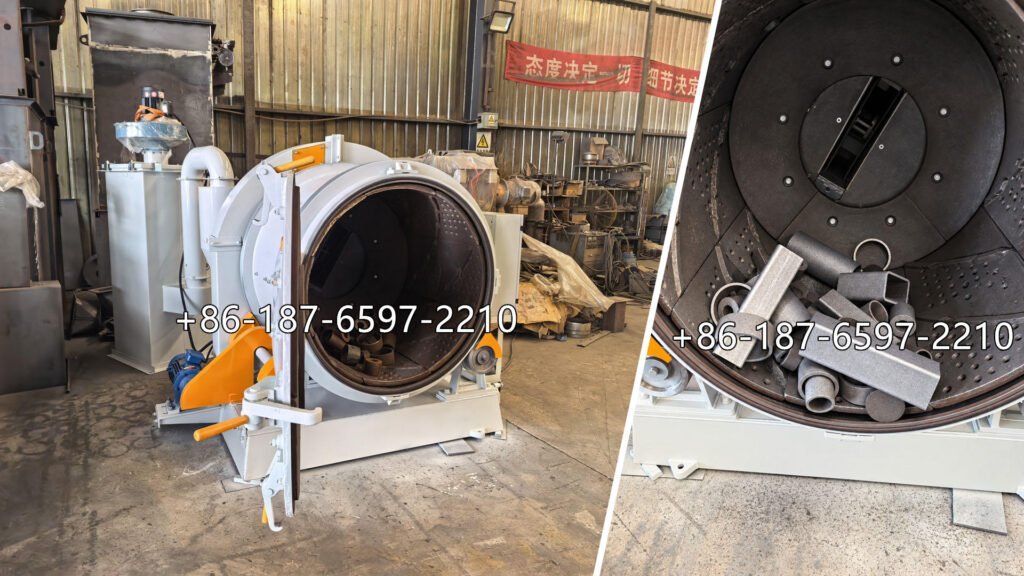
2. Identify Your Metal Parts Before Selecting a Machine
The first step is to evaluate the workpieces, not the equipment catalogue.
Different metal parts require different blasting conditions. A machine that works well for cast iron fittings may cause damage to thin-walled aluminum components or precision-machined parts if the process is not properly controlled.
2.1 Workpiece material
Identify whether the parts are made from:
- Cast iron
- Carbon steel
- Alloy steel
- Forged steel
- Suitable aluminum alloys
- Other metals compatible with the selected abrasive and blasting process
Material hardness, wall thickness, surface condition, and dimensional tolerances affect abrasive selection and operating parameters.
For example, steel shot may be suitable for many robust steel castings, while more delicate components may require a different abrasive, a different machine type, or a separately validated process.
2.2 Workpiece size and shape
Check the maximum length, width, height, and diagonal of each component.
Also consider whether the parts have deep recesses, narrow openings, thin ribs, sharp edges, or internal passages. These features affect abrasive access and the risk of parts becoming trapped during tumbling.
The manufacturer’s maximum workpiece diagonal is an important reference, but it does not guarantee that every part with a smaller diagonal can be processed successfully.
2.3 Individual workpiece weight
The maximum weight of one component is different from the total loading capacity of the machine.
A machine rated for 300 kg per batch may accept hundreds of small components, but it may not be designed to handle one 30 kg casting.
Confirm both limits before selecting a model:
- Maximum total loading weight per batch.
- Maximum permitted weight of an individual component.
2.4 Surface condition and cleaning target
Determine what must be removed from the parts:
- Loose rust and corrosion products
- Mill scale or heat-treatment scale
- Molding sand and surface residues
- Foundry flash or loose contamination, where applicable
- Existing coatings, where the process and machine are suitable
Also define the required final surface condition. Cleaning loose contamination from a casting is different from preparing a steel substrate to a specified cleanliness grade before painting.
A clear cleaning requirement makes machine selection more accurate and reduces disputes during equipment acceptance.
3. Check Drum Capacity and Batch Loading Weight
Drum capacity is one of the most important selection factors, but nominal capacity alone is not enough.
A machine may have sufficient rated loading weight but insufficient usable volume for bulky castings. Conversely, dense components may reach the permitted weight before the drum volume is fully occupied.
Before purchasing, confirm:
- Effective drum volume.
- Maximum loading weight per batch.
- Maximum individual component weight.
- Maximum component dimensions and diagonal.
- Recommended loading ratio for your workpieces.
- Required loading and unloading method.
Practical selection example
Suppose a foundry needs to process 250 kg of castings per batch.
A machine with a nominal capacity of 250 kg may appear sufficient. However, the actual loading capacity must be checked against the casting geometry, component weight distribution, and recommended operating limits.
If the castings are bulky or difficult to tumble, a larger model or a different machine configuration may be required.
Engineering recommendation: Do not fill the drum to its physical limit without the manufacturer’s approval. Excessive loading can reduce workpiece movement, create uneven cleaning, and increase the risk of component damage.
4. Select the Correct Blast Wheel Power
Blast wheel power influences the available blasting energy, but a larger motor does not automatically guarantee better cleaning.
The actual performance depends on several factors:
- Blast wheel motor power and quantity
- Abrasive flow rate
- Wheel design and operating speed
- Abrasive size, shape, and hardness
- Initial surface contamination
- Workpiece movement and exposure
- Required cleaning quality
For example, a higher abrasive flow rate may shorten the cleaning cycle for suitable castings. However, it can also increase abrasive consumption and wear if the machine is not correctly configured.
When comparing rotary drum shot blasting machines, ask the supplier to specify the blast wheel power, abrasive flow rate, recommended abrasive, and expected cleaning cycle.
Request a test using representative workpieces whenever cleaning time or surface quality is a critical purchasing requirement.
5. Choose the Right Abrasive and Recovery System
Abrasive selection directly affects cleaning efficiency, surface appearance, wear, and operating costs.
Common abrasive options
| Abrasive | Typical application considerations |
|---|---|
| Steel shot | Round particles often used for cleaning suitable metal parts and applications where a less angular impact pattern is desired |
| Steel grit | Angular particles that can provide a more aggressive cleaning action and influence the resulting surface profile |
| Other compatible media | Considered when workpiece material, surface finish, or process requirements demand a different approach |
The final choice should account for workpiece hardness, required surface condition, blast wheel design, abrasive recycling equipment, and the risk of part damage.
Why abrasive separation matters
A rotary drum shot blasting machine needs an effective system to separate reusable abrasive from dust, broken particles, and other contaminants.
Poor separation can reduce cleaning consistency, increase abrasive consumption, and accelerate wear in the blast wheel and associated components.
When evaluating a machine, check:
- Abrasive elevator capacity.
- Separator design and performance.
- Abrasive storage and replenishment method.
- Dust collector airflow and filter arrangement.
- Wear-part inspection and replacement access.
The dust collector should be selected according to the required airflow, enclosure design, dust characteristics, and applicable environmental and workplace requirements—not simply by fan motor power.
6. Compare Rotary Drum Shot Blasting Machine Technical Parameters
Published manufacturer specifications provide a useful starting point for comparing equipment sizes and configurations.
The following examples are from AGTOS’s published drum shot blast machine technical brochure. They illustrate how drum volume, blast wheel power, maximum workpiece dimensions, and dust collection requirements vary by machine size.
Representative technical comparison
| Technical parameter | TS 50 | TS 150 | TS 300 | TS 500 |
|---|---|---|---|---|
| Drum volume | 50 L | 150 L | 300 L | 500 L |
| Blast wheel quantity | 1 | 1 | 1 | 1 or 2 |
| Blast wheel power | 7.5 kW | Up to 15 kW | Up to 22 kW | Up to 30 kW |
| Maximum workpiece diagonal | 150 mm | 400 mm | 450 mm | 450 mm |
| Standard dust collector airflow | 1,250 m³/h | 2,000 m³/h | 2,600 m³/h | 2,600 or 4,500 m³/h |
Important: These are reference specifications from a third-party manufacturer, not Bestech machine specifications. The table does not establish a guaranteed batch weight or hourly production rate for your application. The TS 500 configuration also varies with the selected system arrangement.
When requesting a quotation, ask the manufacturer to provide a complete technical data sheet for the proposed model, including the following additional details:
- Maximum loading weight per batch.
- Maximum individual workpiece weight.
- Effective loading volume.
- Blast wheel abrasive flow rate.
- Total installed power.
- Recommended abrasive type and size.
- Dust collection configuration.
- Overall machine dimensions and maintenance clearance.
- Required foundation and electrical supply.
- Expected cycle time based on your workpieces.
A complete specification is more useful than comparing two machines by drum volume or motor power alone.
7. Calculate the Production Capacity You Actually Need
A machine must meet your production target without creating a bottleneck in loading, unloading, or inspection.
Start with this calculation:
Required average production rate = Daily processing quantity ÷ Available production hours
For example, if your factory needs to process 3,200 kg of metal parts in an 8-hour shift:
3,200 kg ÷ 8 hours = 400 kg/h.
The complete process must therefore average at least 400 kg/h during the available production time.
However, this is only a preliminary calculation. The required machine capacity depends on the actual cycle time and operating efficiency.
For batch equipment, estimate the total cycle as:
Total batch cycle = Loading time + Blasting time + Unloading time + Other required handling time
If each batch contains 200 kg and the complete cycle takes 30 minutes, the theoretical output during continuous operation is:
200 kg ÷ 0.5 hour = 400 kg/h.
Actual output may be lower because of interruptions, inspection, maintenance, and variation in workpiece condition.
Use a representative workpiece test to verify whether the proposed configuration can meet your production target.
8. Follow the Relevant Surface Preparation Standards
For metal parts that will be painted or coated, the required cleanliness and surface condition should be defined using the appropriate technical specification and inspection method.
ISO 8501-1: Visual Assessment of Surface Cleanliness
ISO 8501-1 provides visual rust grades and preparation grades for steel substrates, including abrasive blast-cleaning grades such as Sa 1, Sa 2, Sa 2½, and Sa 3.
Sa 2½ is commonly specified for steel surfaces requiring very thorough abrasive blast cleaning before coating.
However, this standard should not be interpreted as a universal acceptance criterion for every metal component. Its scope focuses on steel substrates, and the required cleaning grade must be appropriate to the actual application.
As of October 2026, ISO lists ISO 8501-1:2007 as the published edition while a revised draft, ISO/DIS 8501-1, is under development. Confirm the applicable edition and contractual requirements before finalizing the equipment specification. <Cite refs={[“turn419415search1″,”turn419415search8”]}/>
ISO 8504-2: Abrasive Blast-Cleaning Methods
ISO 8504-2:2019 describes abrasive blast-cleaning methods for preparing steel surfaces before coating, including equipment and procedures.
ISO has also listed a revision project for this standard. Therefore, confirm the applicable edition with the project specification and purchasing contract. <Cite refs={[“turn419415search13″,”turn419415search10”]}/>
ISO 11124-1:2026: Metallic Blast-Cleaning Abrasives
ISO 11124-1:2026 addresses the classification and designation of metallic blast-cleaning abrasives supplied in unused condition.
Abrasive type and particle shape influence the surface appearance and profile. Select the abrasive according to the required cleaning result and ensure that it is compatible with the machine’s blast wheel and recycling system. <Cite refs={[“turn419415search4″,”turn419415search0”]}/>
Practical recommendation: Include the required cleanliness grade, surface profile where applicable, inspection method, and acceptance criteria in the technical agreement. Do not promise a specific grade solely on the basis of the machine model.
9. Rotary Drum vs. Other Shot Blasting Machines
Rotary drum shot blasting is not the best solution for every workpiece.
| Machine type | Recommended application | Main limitation to evaluate |
|---|---|---|
| Rotary drum shot blasting machine | Suitable bulk metal parts processed in a rotating drum | Parts must tolerate repeated tumbling |
| Rubber-belt tumble shot blasting machine | Suitable small and medium-sized castings and components | Sharp, heavy, or fragile parts may require another design |
| Hook-type shot blasting machine | Larger, heavier, or more delicate components that can be suspended | Requires suitable hanging and handling equipment |
| Rotary table shot blasting machine | Parts that need controlled positioning during blasting | Table size and blast coverage must match the workpiece |
| Roller conveyor shot blasting machine | Steel plates, beams, profiles, and other long products | Requires compatible dimensions and continuous-feed handling |
If your factory mainly processes small castings or robust metal components in batches, a rotary drum machine may be a suitable choice.
If the parts are large, fragile, precision-finished, or likely to become entangled, evaluate another machine type before making a purchase.
10. Common Mistakes When Buying a Rotary Drum Shot Blasting Machine
| Purchasing mistake | Possible consequence | Recommended solution |
|---|---|---|
| Selecting by drum volume alone | Insufficient loading capacity for actual parts | Check batch weight, effective volume, and part dimensions |
| Ignoring individual part weight | Overloading or component damage | Confirm maximum weight per component |
| Choosing the highest motor power | Higher cost without a guaranteed cleaning improvement | Match wheel power and abrasive flow to the application |
| Using the wrong abrasive | Poor cleaning consistency or surface damage | Confirm media type, size, and hardness |
| Ignoring dust collection | Excessive dust or poor process control | Verify airflow and filtration requirements |
| Assuming rated output equals actual output | Production target may not be achieved | Calculate the complete cycle and verify with testing |
| Buying without a workpiece test | Unexpected cleaning or handling problems | Request a representative trial where practical |
The lowest initial purchase price does not always provide the lowest operating cost.
A suitable machine should deliver the required cleaning result and production output while keeping abrasive consumption, maintenance, downtime, and workpiece damage within acceptable limits.
11. How to Evaluate a Rotary Drum Shot Blasting Machine Manufacturer
When comparing suppliers, request more than a price list.
A qualified industrial equipment supplier should be able to explain why a specific machine configuration is suitable for your parts and production process.
Evaluate the supplier according to:
- Experience with comparable metal components.
- Availability of detailed technical specifications.
- Blast wheel and abrasive circulation design.
- Dust collection and safety provisions.
- Availability of customized loading and unloading arrangements.
- Wear-part replacement and maintenance requirements.
- Electrical configuration for the destination market.
- Workpiece testing and performance verification.
- Installation guidance, spare parts, and after-sales support.
If the application is unusual, ask the supplier to identify potential limitations before recommending a machine.
A technical recommendation based on workpiece dimensions, weight, material, and production targets is more valuable than a generic claim that one model is suitable for all metal parts.
12. Frequently Asked Questions
Q1: Which rotary drum shot blasting machine is best for metal parts?
The best model depends on the workpiece material, dimensions, individual weight, batch loading weight, required cleaning result, and production target. Confirm the machine’s effective loading volume and maximum part limits before selecting a model.
Q2: What is the typical capacity of a rotary drum shot blasting machine?
Available designs vary substantially. Manufacturers offer different drum volumes, blast wheel powers, and handling configurations. Drum volume alone does not establish batch weight or hourly throughput. Request the manufacturer’s rated loading capacity and confirm it against your actual parts.
Q3: Can a rotary drum shot blasting machine remove rust and oxide scale?
Yes, it can remove rust and oxide scale from suitable workpieces when the abrasive and operating conditions are correctly selected. The result depends on the initial surface condition, abrasive characteristics, wheel performance, and exposure time.
Q4: Can it be used for cast iron and steel castings?
Yes. Rotary drum and tumble-type systems are commonly used for suitable castings. However, brittle, thin-walled, or complex parts need special attention because repeated tumbling and abrasive impact may cause damage.
Q5: How do I reduce abrasive consumption?
Maintain the abrasive separator, use the correct abrasive size and type, inspect wear parts, and prevent excessive dust or broken media from returning to the blast wheel. Proper loading and stable operating conditions also help reduce unnecessary processing time.
Q6: Can the machine be customized?
Depending on the manufacturer, customization may include drum volume, blast wheel configuration, loading and unloading equipment, PLC controls, dust collection, and electrical arrangements. The required changes should be determined by your workpieces and production target.
Q7: What information should I provide for a quotation?
Provide the workpiece material, maximum dimensions, individual part weight, batch weight, daily production target, initial surface condition, required cleaning grade, and preferred automation level. Workpiece photos or drawings can help the engineering team evaluate the application.
13. Get a Rotary Drum Shot Blasting Machine Matched to Your Metal Parts
Choosing the right rotary drum shot blasting machine starts with understanding your production requirements.
A suitable configuration must balance batch capacity, individual workpiece limits, blast wheel performance, abrasive recovery, dust collection, and the required cleaning result. Selecting the machine based on these factors helps reduce the risk of insufficient output, unnecessary investment, and workpiece damage.
Request a Technical Quotation
To evaluate your application, provide the following details:
- Workpiece material: Cast iron, carbon steel, alloy steel, or other material.
- Maximum workpiece size: Length × width × height or maximum diagonal.
- Maximum individual weight: kg per piece.
- Batch loading weight: kg per batch.
- Required production capacity: kg/h, kg/shift, or pieces/day.
- Surface condition: Rust, oxide scale, molding sand, or other contamination.
- Required surface condition: Cleaning target and applicable inspection standard.
- Automation requirement: Manual loading, assisted handling, or automatic loading and discharge.
- Destination country: For electrical supply and configuration requirements.
Send your workpiece photos or drawings together with your expected production output. The machine configuration can then be evaluated against your actual operating conditions.
Looking for a rotary drum shot blasting machine manufacturer for your metal parts? Request a technical evaluation and quotation based on your workpieces, cleaning requirements, and production target.