
Improve metal part cleaning efficiency, stabilize surface quality, and reduce manual handling with the right rotary drum shot blasting machine.
In foundries, forging plants, and metal component manufacturing workshops, surface treatment directly affects production efficiency and downstream processing quality. Rust, oxide scale, molding sand, and other surface contaminants must be removed before painting, coating, machining, inspection, or assembly.
Traditional manual cleaning and inconsistent batch processing can increase labor requirements, extend production cycles, and produce uneven cleaning results. A properly configured rotary drum shot blasting machine offers a more controlled method for processing suitable small and medium-sized metal parts in batches.
However, upgrading your surface treatment process involves more than installing a new blasting machine. Drum capacity, blast wheel performance, abrasive circulation, dust collection, loading arrangements, and maintenance practices must work together.
This article explains how rotary drum shot blasting equipment can improve your production process, which technical parameters deserve attention, and how to select a configuration that matches your actual manufacturing requirements.
If you are planning to upgrade an existing surface treatment line, the following engineering guide will help you identify practical improvements before investing in new equipment.
1. Why Upgrade Your Existing Surface Treatment Process?
Many factories still depend on manual grinding, wire brushing, outsourced blasting, or older equipment with limited production capacity. These methods may be adequate for small production volumes, but they can become inefficient as order quantities increase.
Common problems include:
- Long cleaning cycles for batches of metal parts.
- Inconsistent surface cleanliness between operators or production batches.
- Excessive manual handling and labor requirements.
- High abrasive consumption caused by poor media management.
- Dust leakage or inadequate dust extraction.
- Frequent downtime due to worn blast wheel components.
- Difficult integration with upstream and downstream production processes.
A rotary drum shot blasting machine can address several of these problems by combining controlled workpiece movement with mechanical abrasive projection and abrasive recovery.
The actual improvement depends on the original process, the workpiece characteristics, and the selected equipment configuration. Before upgrading, measure the current cleaning time, labor input, abrasive consumption, rejected parts, and downtime. These figures provide a baseline for evaluating the new system.
2. How Does a Rotary Drum Shot Blasting Machine Work?
A rotary drum shot blasting machine is designed for batch processing of suitable metal components.
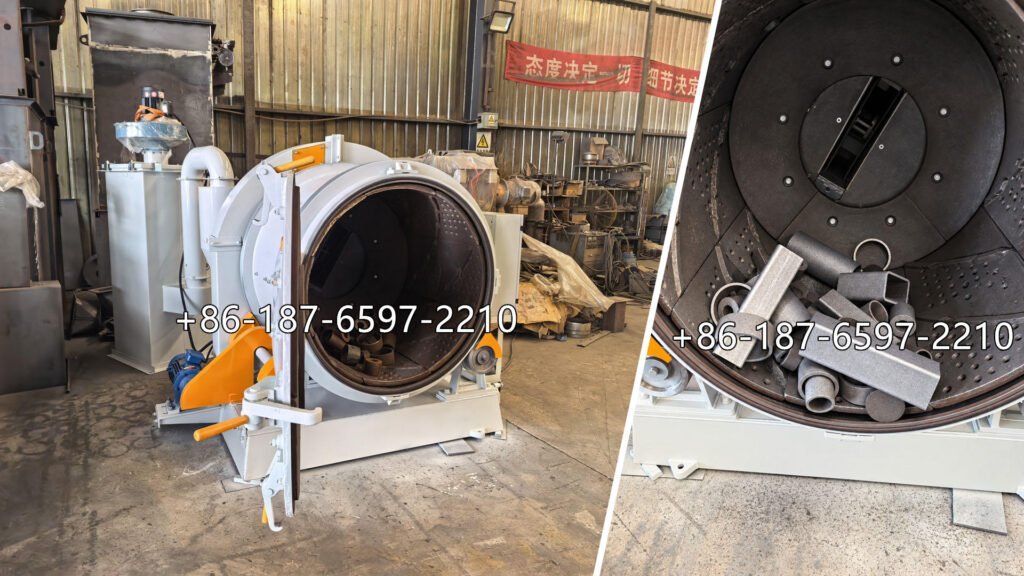
Workpieces are loaded into a rotating drum. A centrifugal blast wheel accelerates abrasive particles and projects them onto the exposed surfaces. As the drum rotates, the parts move and change position, allowing different surfaces to enter the abrasive stream.
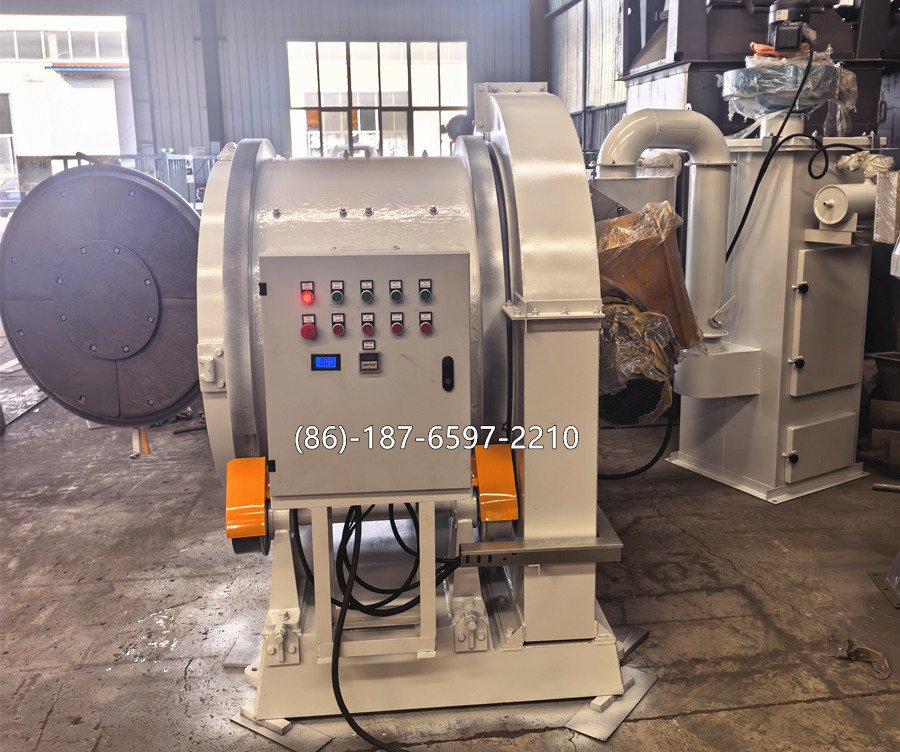
The machine typically incorporates an abrasive circulation system, separator, dust collector, and electrical control system.
Main components and their functions
| Component | Function | Contribution to process improvement |
|---|---|---|
| Rotary drum | Moves workpieces during blasting | Supports batch processing and surface exposure |
| Blast wheel | Projects abrasive onto workpieces | Provides mechanical cleaning action |
| Abrasive recovery system | Collects reusable abrasive | Reduces unnecessary media loss |
| Elevator and separator | Transports and separates abrasive | Supports stable abrasive circulation |
| Dust collector | Extracts airborne dust | Helps control dust within the working environment |
| Control system | Manages the operating sequence | Supports repeatable operation and safety interlocks |
| Loading and unloading equipment | Transfers parts into and out of the machine | Can reduce manual handling and cycle delays |
A key advantage is that multiple suitable components can be processed in one batch rather than cleaned individually by hand.
However, tumbling is not suitable for every workpiece. Fragile castings, thin-walled components, precision-finished parts, and parts that may become entangled require careful evaluation before processing.
3. Five Ways Rotary Drum Shot Blasting Can Improve Production
3.1 Increase Batch Cleaning Efficiency
Batch processing allows multiple workpieces to be cleaned during the same machine cycle.
For foundries and forging plants handling repeated batches of similar parts, this can reduce the need for individual manual cleaning operations.
The production benefit depends on batch weight, component geometry, contamination level, abrasive flow rate, and required cleaning quality.
To improve output, evaluate the complete operating cycle rather than blasting time alone. Loading, unloading, inspection, and maintenance can all affect the actual production rate.
3.2 Improve Cleaning Consistency
Manual cleaning depends heavily on operator technique, access to the workpiece surface, and the time spent on each part.
A rotary drum shot blasting machine uses a controlled mechanical process to expose suitable workpieces to abrasive impact. When the machine is correctly configured, this can help reduce variation between batches.
Consistent results still require suitable abrasive selection, correct loading, stable operating conditions, and regular inspection of the blast wheel and abrasive separator.
For coated steel components, specify the required cleanliness grade and inspection method before commissioning the machine.
3.3 Reduce Manual Handling
Manual grinding and brushing require operators to handle individual parts repeatedly. For factories processing large quantities of suitable metal components, this can consume considerable labor time.
A rotary drum machine consolidates the blasting operation into a batch process. Mechanical loading, hydraulic lifting, or automatic discharge can further reduce handling requirements where the production volume justifies the investment.
When evaluating automation, identify the actual bottleneck first.
If blasting is fast but loading and unloading take too long, an automatic handling arrangement may provide a greater improvement than increasing blast wheel power alone.
3.4 Improve Abrasive Utilization
Abrasive consumption is an important operating cost in shot blasting.
A well-designed recovery system collects reusable abrasive, while the separator removes dust and broken particles. This helps maintain the abrasive condition required for stable blasting performance.
To improve abrasive utilization:
- Select the correct abrasive type and size.
- Inspect the separator and abrasive circulation system regularly.
- Maintain the recommended abrasive working mixture.
- Replace worn blast wheel components when necessary.
- Check for abrasive leakage and excessive carryout.
- Avoid operating with incorrect loading or unstable process settings.
Abrasive recycling does not eliminate media consumption. Abrasive gradually breaks down or becomes unsuitable for reuse, so replenishment remains necessary.
The objective is to reduce avoidable losses while maintaining the required cleaning result.
3.5 Improve Dust Control and Workplace Management
Shot blasting generates dust from surface contaminants, broken abrasive, and other fine particles.
A suitable dust collection system extracts contaminated air from the machine enclosure and filters the collected dust. Its capacity must match the machine configuration, airflow requirements, and dust characteristics.
When upgrading equipment, verify:
- Required airflow in m³/h.
- Filter type and filtration arrangement.
- Ducting and pressure-loss considerations.
- Dust discharge and disposal method.
- Access for filter inspection and replacement.
- Applicable workplace and environmental requirements.
Do not select a dust collector based on fan motor power alone. Correct system airflow and filtration performance are more important than motor rating by itself.
4. How to Select the Right Machine Configuration
A surface treatment upgrade should begin with the workpiece and production requirements.
Step 1: Identify the workpiece material
Determine whether the parts are made from cast iron, carbon steel, alloy steel, or another material compatible with the selected blasting process.
Material hardness, wall thickness, and mechanical strength influence abrasive selection and the risk of damage during tumbling.
Step 2: Confirm maximum dimensions and weight
Provide the manufacturer with the maximum length, width, height, and diagonal of the workpieces.
Also specify the maximum individual part weight and total batch weight.
A machine’s batch capacity does not mean it can accept a single workpiece of the same weight. Both limits must be confirmed.
Step 3: Define the required cleaning result
Specify the contamination to be removed, such as rust, oxide scale, molding sand, or other residues.
If the parts require preparation before painting, identify the applicable cleanliness grade and surface profile requirements. If the purpose is foundry cleaning, define the acceptable level of residual sand and surface contamination for the specific casting.
Step 4: Calculate the production target
Estimate the required output in kilograms per hour, kilograms per shift, or pieces per day.
The machine must meet the target under realistic operating conditions, including loading, unloading, inspection, and interruptions.
Step 5: Select the handling arrangement
Choose between manual loading, assisted loading, hydraulic loading, and automatic discharge according to batch weight, production volume, available labor, and layout.
Step 6: Check abrasive recovery and dust collection
Confirm that the elevator, separator, abrasive storage, and dust collector are designed for the proposed machine configuration.
Step 7: Verify the result using representative parts
When cleaning quality or cycle time is critical, request a trial using representative workpieces before final equipment acceptance.
This helps identify potential problems with coverage, part damage, loading limits, and production time before the machine enters regular operation.
5. Rotary Drum Shot Blasting Machine Technical Parameters
The following published model data provide a reference for understanding how machine capacity and auxiliary systems vary by configuration.
Representative technical specifications
| Parameter | RD150 | RD300 | RD500 |
|---|---|---|---|
| Drum volume | 150 L | 300 L | 500 L |
| Blast wheel quantity | 1 | 1 | 1 |
| Blast wheel power | Up to 15 kW | Up to 22 kW | Up to 22 kW |
| Maximum workpiece diagonal | 400 mm | 450 mm | 450 mm |
| Standard dust collector airflow | 2,000 m³/h | 2,600 m³/h | 4,500 m³/h |
These are published third-party reference values, not Bestech specifications. The table does not establish the maximum batch weight, actual cleaning cycle, or guaranteed hourly output for your parts.
Before purchasing, request the complete specification for the proposed model, including:
- Maximum batch loading weight.
- Maximum individual workpiece weight.
- Effective loading volume and maximum part dimensions.
- Blast wheel power and abrasive flow rate.
- Total installed power, including auxiliary equipment.
- Recommended abrasive type and size.
- Abrasive recovery and separator capacity.
- Dust collector airflow and filter configuration.
- Machine dimensions and required maintenance clearance.
- Loading, unloading, and control system options.
The correct configuration should be selected according to the application rather than choosing the largest available drum or motor.
6. How to Estimate the Production Improvement
Before replacing existing equipment, calculate the current production rate and compare it with the expected output of the proposed system.
Use the following formula:
Average production rate = Total processed weight ÷ Total production time
For example, suppose a factory currently processes 2,400 kg of suitable castings during an 8-hour shift.
The average production rate is:
2,400 kg ÷ 8 h = 300 kg/h.
If the upgraded system is expected to process 3,200 kg during the same shift, the target average production rate would be:
3,200 kg ÷ 8 h = 400 kg/h.
The required improvement is:
(400 − 300) ÷ 300 × 100% = 33.3%.
This is a planning example, not a guaranteed performance result. The proposed equipment must be tested against the actual parts and operating conditions.
For a more reliable evaluation, record the following before and after upgrading:
| Performance indicator | What to measure |
|---|---|
| Production output | kg/shift or pieces/shift |
| Batch cycle time | Loading, blasting, and unloading |
| Labor input | Operator hours per batch or shift |
| Abrasive consumption | kg per tonne of processed workpieces |
| Downtime | Hours lost to breakdowns and maintenance |
| Cleaning quality | Inspection results against the agreed criteria |
| Rework rate | Percentage of parts requiring additional processing |
These measurements help determine whether the investment improves production efficiency rather than simply increasing machine capacity on paper.
7. International Standards for Surface Preparation
When upgrading a shot blasting process, define the required surface condition using the applicable standard and inspection procedure.
ISO 8501-1: Visual Assessment of Steel Surface Cleanliness
ISO 8501-1 specifies visual rust grades and preparation grades for steel substrates, including abrasive blast-cleaning grades Sa 1, Sa 2, Sa 2½, and Sa 3.
Sa 2½ is frequently specified for steel surfaces requiring very thorough abrasive blast cleaning before coating.
However, ISO 8501-1 is not a universal acceptance standard for every metal component. Its scope concerns steel substrates, and the required grade must be appropriate to the intended application.
A rotary drum shot blasting machine cannot automatically guarantee Sa 2½ on every workpiece. The result depends on the initial surface condition, abrasive, process parameters, workpiece geometry, and inspection procedure.
ISO 8504-2: Abrasive Blast-Cleaning Methods
ISO 8504-2 describes abrasive blast-cleaning methods for preparing steel surfaces before coating.
It provides relevant guidance when establishing the preparation procedure, but the actual process must still be selected according to the workpiece and the required finish.
ISO 11124-1:2026: Metallic Blast-Cleaning Abrasives
ISO 11124-1:2026 covers the classification and designation of metallic blast-cleaning abrasives supplied in unused condition.
Abrasive type and particle shape influence the resulting surface appearance and profile. Selecting suitable media is therefore an important part of upgrading the blasting process.
Use the applicable abrasive specification and verify compatibility with the blast wheel, separator, and workpiece material.
For coated steel applications, consider the surface profile requirements as well as visual cleanliness. Where required, ISO 8503 provides methods for assessing the surface roughness of prepared steel substrates.
Purchasing recommendation: State the applicable standard and edition, required cleanliness grade, surface profile requirement where applicable, and acceptance method in the technical agreement. Confirm the latest applicable editions before finalizing the specification.
8. Common Mistakes When Upgrading Shot Blasting Equipment
| Mistake | Potential result | Recommended action |
|---|---|---|
| Increasing motor power without evaluating the process | Higher operating cost without resolving the bottleneck | Review abrasive flow, cycle time, and workpiece movement |
| Selecting a larger drum based only on volume | Incorrect batch loading or poor cleaning coverage | Confirm effective volume, batch weight, and part dimensions |
| Ignoring abrasive recovery | Increased media consumption and unstable blasting | Evaluate separator performance and media management |
| Undersizing the dust collector | Poor dust extraction and operating conditions | Verify required airflow and filtration |
| Overlooking loading and unloading | Actual output remains below target | Evaluate the complete batch cycle |
| Ignoring part fragility | Surface damage or broken components | Test representative workpieces and consider alternative machine types |
| Using unverified cleaning claims | Failed acceptance or coating preparation | Define and inspect the required surface condition |
A successful upgrade addresses the actual production problem. If the bottleneck is manual loading, adding a larger blast wheel may not improve overall output. If cleaning is inconsistent because the abrasive mixture is poorly maintained, replacing the entire machine may not be the most cost-effective first step.
Evaluate the whole process before deciding which components need to change.
9. Rotary Drum Shot Blasting vs. Other Equipment
Rotary drum shot blasting is well suited to batch processing of compatible metal parts, but other machine types may provide better results for different workpieces.
| Machine type | Typical application | Key consideration |
|---|---|---|
| Rotary drum shot blasting machine | Suitable small and medium-sized bulk metal components | Workpieces must tolerate tumbling |
| Rubber-belt tumble shot blasting machine | Suitable small castings and components processed in batches | Sharp edges, heavy parts, and entanglement risks require evaluation |
| Hook-type shot blasting machine | Larger, heavier, or delicate components that can be suspended | Requires suitable hanging and handling equipment |
| Rotary table shot blasting machine | Components requiring controlled positioning | Table dimensions and blast coverage |
| Roller conveyor shot blasting machine | Steel plates, profiles, beams, and long products | Requires compatible dimensions and continuous-feed handling |
If your existing production line processes many small castings or forged parts in batches, a rotary drum machine may provide a practical upgrade path.
If the parts are long, oversized, fragile, or precision-finished, consider another machine type before investing.
10. Maintenance Practices That Support Long-Term Performance
A machine upgrade only delivers lasting value when the equipment is maintained correctly.
Daily inspection
- Check for abnormal noise or vibration.
- Inspect the drum and loading area for accumulated debris.
- Check abrasive levels and circulation.
- Confirm that dust extraction is operating normally.
- Inspect doors, interlocks, and emergency stop functions.
Periodic inspection
- Inspect blast wheel blades and other wear parts.
- Check the separator and abrasive condition.
- Inspect conveyor, elevator, and screw conveyor components.
- Check dust collector filters and the dust discharge system.
- Inspect electrical connections and safety controls according to the maintenance plan.
Preventive maintenance
Follow the manufacturer’s maintenance schedule and replace worn parts before their condition affects cleaning performance or equipment safety.
Always isolate electrical and mechanical energy before maintenance, follow lockout procedures, and wait for all rotating components to stop. Do not open the blasting chamber while the blast wheel is operating.
The inspection interval should be based on operating hours, abrasive characteristics, production conditions, and the manufacturer’s instructions.

11. Frequently Asked Questions
Q1: What is the main advantage of a rotary drum shot blasting machine?
Its main advantage is batch processing of suitable metal components. The rotating drum exposes different workpiece surfaces to abrasive impact, while the abrasive recovery system supports repeated use of suitable media.
Q2: Can a rotary drum shot blasting machine replace manual cleaning?
It can reduce or replace some manual cleaning operations when the parts are suitable for tumbling and the required cleaning result can be achieved. Fragile, oversized, or precision-finished parts may require another process.
Q3: How can I increase shot blasting production capacity?
First identify the bottleneck. Review batch loading, blasting time, unloading, abrasive flow, separator performance, and maintenance downtime. Automation may be useful when handling time limits production, while wheel or drum changes may be needed for other applications.
Q4: How much abrasive does a rotary drum shot blasting machine consume?
Consumption depends on the abrasive type, surface contamination, operating conditions, separator performance, and the quantity of material processed. The best approach is to measure abrasive replenishment per tonne of workpieces and compare it over a representative production period.
Q5: Can the machine be integrated into an automatic production line?
Depending on the design, a rotary drum shot blasting machine can be configured with mechanical loading, hydraulic loading, automatic discharge, conveyors, and PLC-based controls. Integration requirements should be confirmed during the equipment design stage.
Q6: What standards should be considered when upgrading surface treatment equipment?
For steel substrates before coating, ISO 8501-1 addresses visual cleanliness grades, ISO 8504-2 covers abrasive blast-cleaning methods, and ISO 11124-1:2026 addresses the classification of metallic blast-cleaning abrasives. The applicable standards depend on the material and intended process.
Q7: How do I know whether I need a new machine or just a process improvement?
Measure output, cleaning time, abrasive consumption, labor input, downtime, and rework. If the existing machine is mechanically sound, correcting loading practices, abrasive management, or maintenance may help. If capacity, workpiece limits, or machine condition prevent the target from being met, equipment replacement or customization may be justified.
12. Upgrade Your Surface Treatment Process with the Right Equipment
Improving surface treatment requires a balance between cleaning performance, production capacity, abrasive utilization, dust control, and maintenance.
A properly configured rotary drum shot blasting machine can help manufacturers process suitable metal components in batches, reduce dependence on manual cleaning, and establish more repeatable operating conditions.
However, the right solution depends on your actual workpieces and production bottlenecks. Drum volume, blast wheel power, loading capacity, abrasive circulation, and automation must be evaluated together.
Request a Customized Rotary Drum Shot Blasting Machine Quotation
To help our engineering team evaluate your application, provide the following details:
- Workpiece material: Cast iron, carbon steel, alloy steel, or other metal.
- Maximum workpiece dimensions: Length × width × height or maximum diagonal.
- Maximum individual weight: kg per piece.
- Batch loading weight: kg per batch.
- Current production output: kg/h, kg/shift, or pieces/day.
- Required output after upgrading: Target kg/h or pieces/shift.
- Surface condition: Rust, oxide scale, molding sand, or other contamination.
- Required cleaning result: Applicable grade and inspection method, where specified.
- Automation requirements: Manual loading, assisted handling, or automatic loading and discharge.
- Destination country: For electrical and configuration requirements.
Send your workpiece photos, drawings, or representative samples together with your production target. The equipment configuration can then be evaluated according to your cleaning requirements, batch capacity, abrasive circulation, dust collection, and handling needs.
Looking for a rotary drum shot blasting machine manufacturer? Request a technical evaluation and quotation based on your workpieces and production goals.