
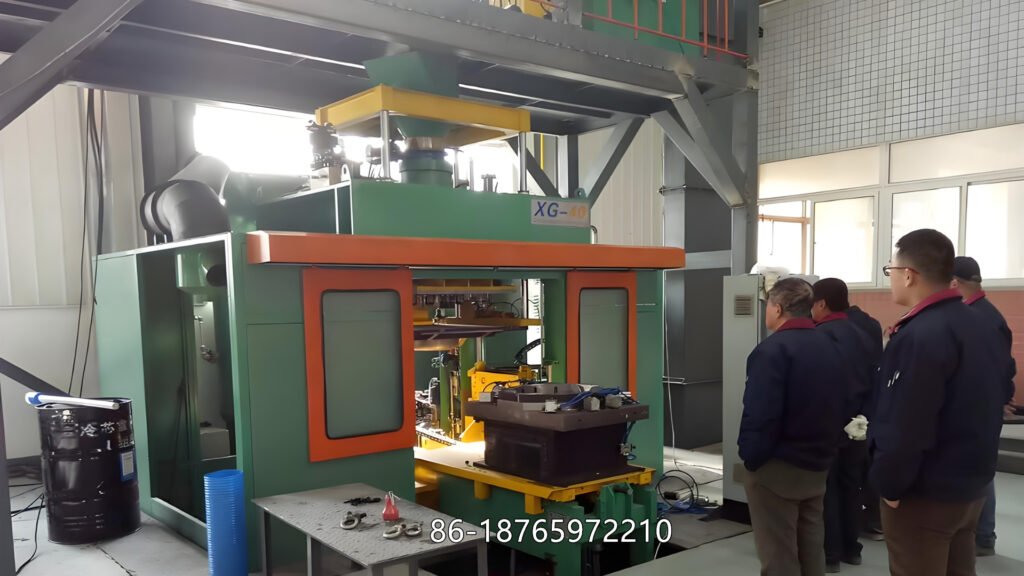
Struggling with how to produce sand cores?
In the metal casting industry, core shooting machines play a pivotal role in creating intricate internal geometries for cast components. These specialized machines produce high-precision sand cores, which define cavities, channels, or complex internal features in cast metal parts.
From automotive engines to aerospace components, core shooting technology ensures the production of dimensionally accurate and repeatable castings.
Traditional vs. Modern Sand Core Manufacturing: Evolution in Metal Casting Introduction
Sand cores are critical for creating internal cavities and complex geometries in metal castings. Over decades, core manufacturing has evolved from labor-intensive manual methods to high-precision automated processes.
1. Traditional Sand Core Manufacturing Methods
A. Hand Rammed Cores
Process: Cores are manually packed into wooden or metal core boxes using basic tools.
Materials: Natural sand mixed with clay or organic binders (e.g., linseed oil).
Limitations:
Low dimensional accuracy (±2–3 mm).
Labor-intensive and time-consuming.
Inconsistent density due to manual compaction.
B. Shell Molding (Croning Process)
Process: A resin-coated sand mixture is heated in a core box to form a thin, hollow shell.
Advantages:
Better surface finish than hand ramming.
Lightweight cores for simple geometries.
Drawbacks:
Limited to small-to-medium cores.
High energy consumption for heating.
C. CO₂ Silicate Process
Process: Sodium silicate (water glass) is mixed with sand and hardened by CO₂ gas injection.
Advantages:
Fast curing (seconds to minutes).
Moderate strength for non-complex cores.
Challenges:
Brittle cores prone to cracking.
Difficult to remove after casting.
2. Modern Sand Core Manufacturing Techniques
A. Core Shooting Machines
Process:
Automated injection of resin-bonded sand into precision core boxes using compressed air or hydraulics.
Controlled curing via heat, catalysts, or UV light.
Advantages:
High precision (±0.1–0.3 mm).
Rapid cycle times (10–60 seconds per core).
Complex geometries (undercuts, thin walls).
B. Cold Box Process
Process:
Sand mixed with urethane or phenolic resins is blown into core boxes.
Curing triggered by amine gas or other catalysts.
Advantages:
Superior strength and dimensional stability.
Minimal VOC emissions compared to hot box methods.
3. Key Differences Between Traditional and Modern Methods
| Aspect | Traditional Methods | Modern Methods |
|---|---|---|
| Precision | ±2–3 mm tolerance | ±0.1–0.3 mm tolerance |
| Production Speed | Hours per core (hand ramming) | Seconds to minutes per core (shooting/3D) |
| Complexity | Limited to simple shapes | Intricate geometries, internal channels |
| Labor Dependency | High manual intervention | Fully automated or semi-automated |
| Material Efficiency | High sand waste (manual processes) | Closed-loop systems minimize waste |
| Sustainability | High emissions (CO₂, VOCs) | Low-VOC binders, recyclable sand |
4. Impact on Industry
- Quality: Modern methods reduce casting defects (e.g., veining, core shift) by 40–60%.
- Cost: Automation lowers labor costs but requires higher initial capital investment.
- Flexibility: 3D printing enables mass customization without retooling core boxes.
- Environmental Compliance: Modern binders (e.g., bio-based resins) align with stricter emission regulations.
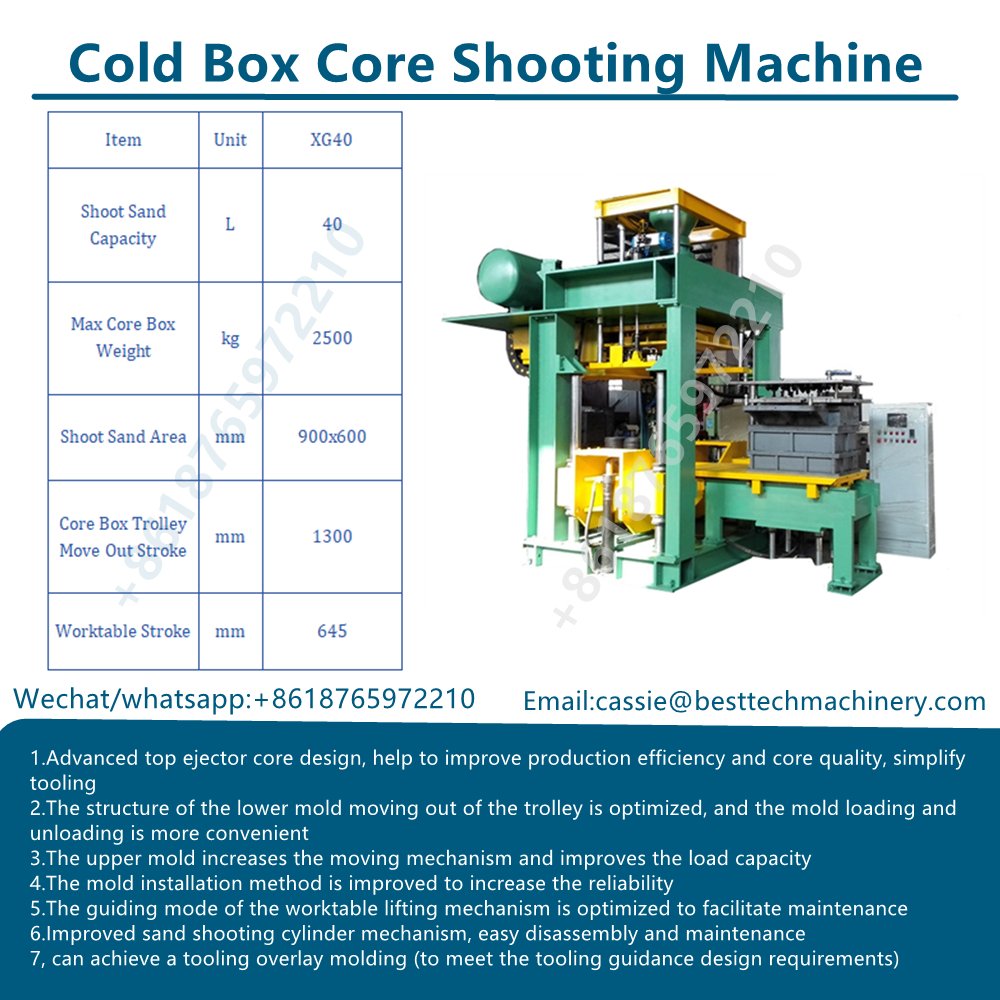
Core Shooting Machine: A Comprehensive Introduction
Core shooting machines are indispensable in foundry industries for producing high-precision sand cores and shell molds, enabling efficient and consistent metal casting processes. Their integration of automation, energy efficiency, and advanced control systems has revolutionized modern manufacturing.
1. Definition and Purpose
A core shooting machine is specialized industrial equipment used in foundry processes to fabricate sand cores, which are essential for creating internal cavities in metal castings (e.g., engine blocks, hydraulic components). By injecting resin-bonded sand into molds under high pressure, it ensures precise core formation with minimal defects.
2. Working Principle
The machine operates through a sequence of automated steps:
- Sand Injection: Compressed air propels a mixture of sand and binder into a mold cavity, ensuring uniform compaction.
- Curing: Post-injection, the core undergoes thermal or chemical hardening (e.g., using catalysts or heat) to achieve structural stability.
- Ejection: The solidified core is ejected for subsequent casting applications.
3. Key Components
- Shooting Head: Delivers high-pressure sand into molds, ensuring consistency and density.
- Mold Clamping System: Secures the mold during injection to prevent leakage.
- Control Unit: Modern machines integrate PLCs or AI-driven systems for real-time parameter adjustments (e.g., pressure, temperature).
Core Shooting Machine Functionality
Core shooting machines inject resin-coated sand (dry) or furan resin sand (wet) into mold cavities under high pressure. The process involves heating the mold to solidify the sand, forming durable cores for casting complex geometries. For example:
Shell Core Shooter: Designed for sand and shell core production in foundries, supporting both manual and automated cycles.
Double Station Core Shooter: A double-head automated machine with a net weight of 550 kg and heating power of 6.7 kW, optimized for rapid production.
Key Features of a Core Shooting Machine
- Function: It compacts sand mixed with a binder (usually resin) into a core box using compressed air or mechanical force.
- Core Material: Typically uses cold-box or hot-box resin-coated sand.
- Core Box: A mold made of metal or other materials that defines the shape of the core.
- Curing Process:
Cold-box process: Uses a gas (like amine) to cure the resin.
Hot-box process: Uses heat from the core box to cure the resin. - Cycle Time: Very fast, enabling high-volume production of consistent cores.
Application
- Automotive: Engine blocks, cylinder heads, and transmission housings.
- Aerospace: Turbine blades and lightweight structural components.
- Heavy Machinery: Hydraulic valves and pump housings.
- Energy: Components for wind turbines and pipeline systems.
Advantages of Core Shooting Technology
- High Precision: Capable of producing cores with tight tolerances (±0.2 mm).
- Rapid Production: Cycle times as short as 10–60 seconds per core.
- Material Efficiency: Minimizes sand waste through closed-loop systems.
- Complex Geometries: Encores thin walls, undercuts, and fine details unachievable with manual methods.
- Consistency: Automated processes reduce human error.
Conclusion
Core shooting machines remain indispensable in modern metal casting, bridging the gap between design complexity and mass production. By continually adopting advanced materials and smart manufacturing principles, this technology will drive innovation in precision casting for decades to come.