
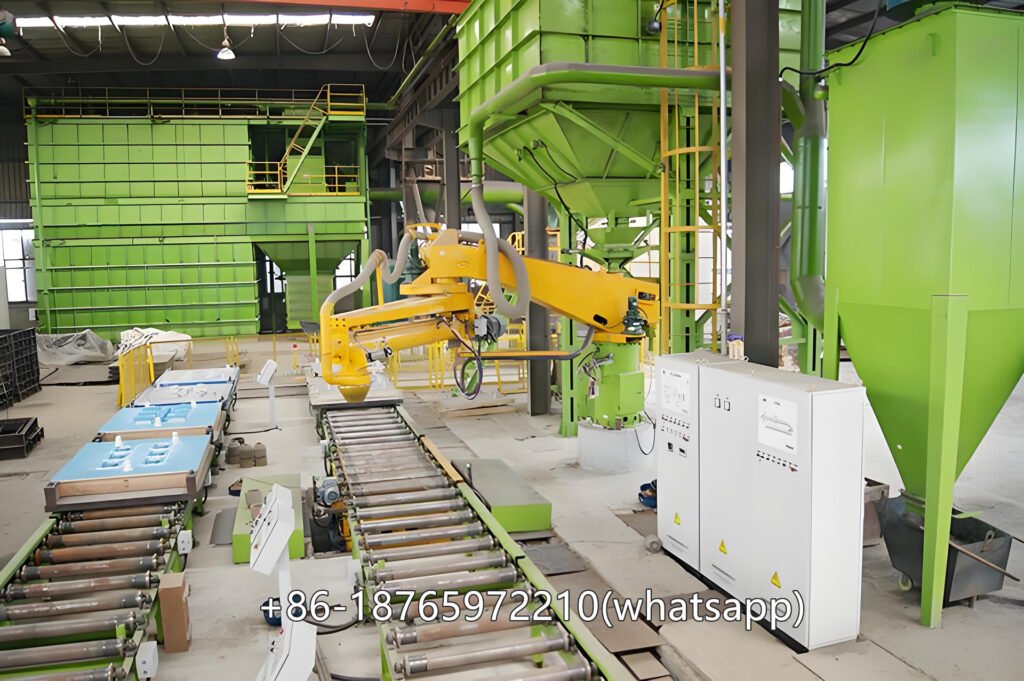
Still Struggling with the smoothness of the casting surface?
Enhancing Casting Surface Smoothness with Furan Resin Sand Molding Line
Achieving a smooth casting surface remains a critical challenge in foundry processes.
Resin sand molding technology offers a robust solution to improve surface quality while maintaining structural integrity.
Furan Resin Sand Molding Process: A Comprehensive Overview
What Is Furan Resin Sand Molding Process?
Furan resin sand molding is a widely adopted casting method in foundries, particularly for producing high-precision ferrous and non-ferrous metal components.
This no-bake, self-curing process utilizes furan resin as a binder mixed with silica sand, offering advantages in dimensional accuracy and surface finish compared to traditional green sand methods.
Furan Resin Sand Molding Steps
Sand Preparation:
Silica sand is blended with furan resin (2–3% by weight) and a catalyst (e.g., sulfonic acid) to initiate polymerization. The resin acts as a thermosetting binder, forming a 3D network upon curing.
Adjustments in resin-to-catalyst ratios control curing speed and final strength.
Mold/Core Formation:
The resin-sand mixture is compacted into molds or cores using manual ramming, vibration, or blow molding techniques. Unlike green sand, no external heat is required for hardening.
Curing time typically ranges from 30 minutes to 2 hours, depending on ambient temperature and catalyst activity.
Curing Mechanism:
The acid catalyst triggers a polycondensation reaction between furfuryl alcohol (primary resin component) and formaldehyde, creating a rigid, heat-resistant structure.
Post-Processing:
After casting, the sand mold exhibits excellent collapsibility, reducing shakeout efforts. However, residual sulfur from catalysts may require additional surface treatments for critical applications.
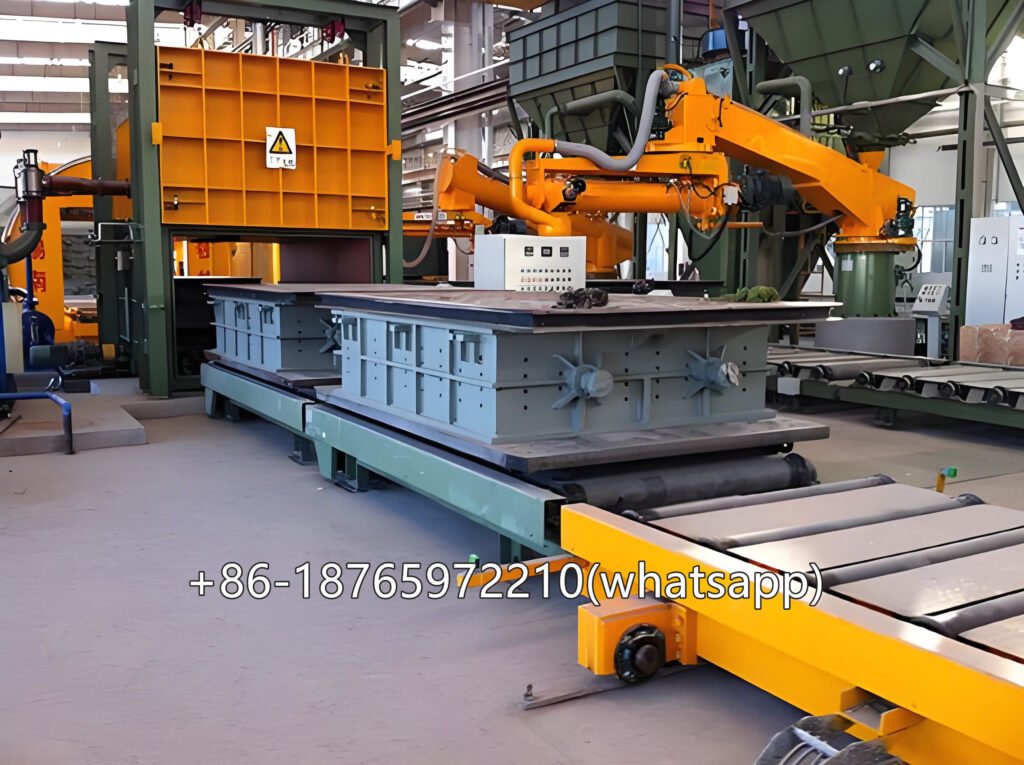
Advantages
- High Precision: Minimal mold deformation ensures tight tolerances (±0.5–1.0 mm).
- Surface Quality: Produces castings with Ra 6.3–12.5 μm, ideal for automotive and marine components.
- Versatility: Suitable for complex geometries, including thin-walled (3–5 mm) and large-scale parts (e.g., ship engine blocks).
- Cost Efficiency: Reduced energy consumption due to ambient curing.
Modifications for Enhanced Performance
To address limitations like poor collapsibility (leading to casting defects) and odor, researchers have developed modified furan resins:
Acetone-Modified Furan Resin: Adding acetone improves high-temperature plasticity, reducing hot tearing in steel castings.
Silane Coupling Agents: Enhance resin-sand adhesion, boosting mold strength and reducing cracking risks.
Thermoplastic Furan Resin: Combines high room-temperature strength with improved collapsibility for thin-walled castings.
Application
- Heavy Machinery: Used in manufacturing large-scale cast iron components, such as marine diesel engine cylinder blocks.
- Aluminum Alloys: Modified furan resin sand enables production of thin-walled, complex aluminum castings with minimal defects.
- Corrosion-Resistant Linings: Furan resin concrete is applied in acid-resistant industrial equipment, like saturators and reaction vessels.
Why Choose Resin Sand Molding Lines in Foundries?
Resin sand molding has become a cornerstone of modern foundry processes, particularly for high-precision and complex castings.
What Is Furan Sand?
Furan resin sand casting is a molding process. This method uses furan resin as a bonding agent and mixes with Catalyst in a suitable proportion to produce sand mold. The mixing ratio of furan resin binders for casting groups is different depending on the mas of the castings mass.
Key Reasons Driving Its Adoption
1. Superior Casting Quality and Dimensional Accuracy
- Resin-bonded sand molds (e.g., phenolic or furan resin systems) provide excellent dimensional stability and surface finish. The microseism squeeze molding technology, as noted in , enhances mold hardness (HB90+) and surface toughness, reducing defects like porosity and sand inclusion. This ensures castings meet tight tolerances, critical for industries like automotive and aerospace.
2. Flexibility in Production
- Resin sand systems (self-hardening, no-bake, or cold-box) adapt to diverse casting needs:
- Complex geometries: Suitable for intricate parts like engine blocks or medical equipment molds .
- Material versatility: Works with cast iron, steel, aluminum, and alloys.
- Rapid prototyping: Laser sintering or 3D-printed resin sand molds enable fast iteration .
3. Enhanced Process Efficiency
- Reduced labor: Automated resin sand mixing and molding lines (e.g., clay sand molding machines .
4. Environmental and Economic Benefits
- Lower emissions: Compared to traditional green sand molds, resin systems reduce volatile organic compounds (VOCs) when optimized .
- Energy savings: No high-temperature baking required for no-bake resins.
- Waste reduction: High reclaim rates decrease landfill dependency.
5. Technical Advantages in Mold Performance
- High rigidity: Resin sand molds withstand molten metal pressure without deformation, critical for large or thin-walled castings .
- Thermal stability: Resins like polyamide or epoxy maintain integrity at elevated temperatures, minimizing burn-on defects .
- Customizable additives: Anti-veining agents or coatings (e.g., zircon-based) further enhance surface quality .
6. Industry-Specific Applications
- High-end manufacturing: Used in 3C electronics (e.g., Apple, Samsung) for polished, defect-free components.
- Medical devices: Resin molds enable biocompatible, high-precision implants.
- Heavy machinery: Durable molds for mining or construction equipment parts.
Application of Resin Sand Systems in Modern Foundry Technology
The casting industry has witnessed significant advancements through the development of resin-bonded sand systems, which offer superior dimensional accuracy, thermal stability, and reduced porosity compared to traditional green sand.
Alkaline Phenolic Resin Sand
Chemical Composition: Produced via alkaline-catalyzed condensation of phenol and formaldehyde.
Key Features:
- High thermal resistance (200-300°C) and excellent refractoriness
- Superior wear resistance and dimensional stability
- Suitable for complex geometries requiring high sand strength
Applications:
- Cast steel components (e.g., engine blocks, turbine parts)
- High-temperature molds requiring minimal post-processing
Furan Resin Sand
Furan Resin Mechanism: Acid-catalyzed polycondensation with furfuryl alcohol.
Advantages:
- Cost-effective compared to phenolic systems
- Good collapsibility for large castings
- Compatible with automated production lines
Industrial Use:
- Gray iron and ductile iron castings
- Ideal for mass production of automotive components
Ester-Cured Alkaline Phenolic Resin Sand
Innovation: Hybrid system combining phenolic resin with organic esters.
Performance:
- Reduced emission levels through ester hardening
- Improved reusability via multi-stage mechanical reclamation
Applications:
- Aerospace components requiring low gas evolution
- High-precision cores for turbine blades
Conclusion
The furan resin sand molding process remains a cornerstone of modern foundry technology, driven by its adaptability, cost-effectiveness, and environmental compatibility. Continuous advancements in resin chemistry and process optimization ensure its relevance in producing castings for automotive, aerospace, and heavy industry sectors.