
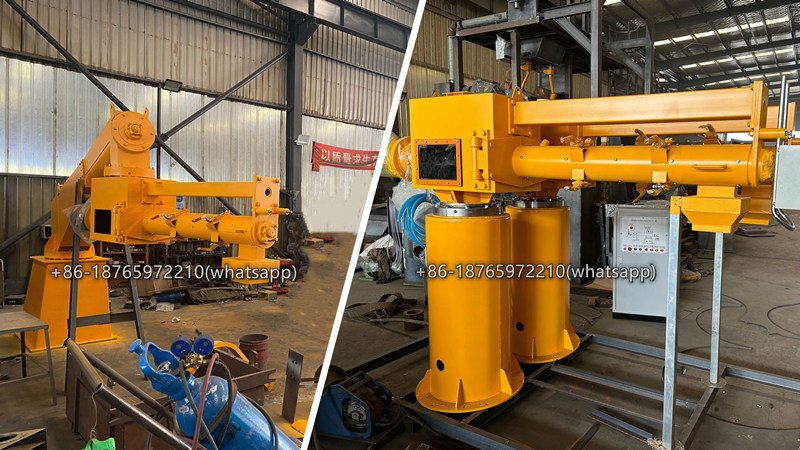
Resin sand mixer is a machine used in foundry operations to mix resin with sand to create a moldable material suitable for casting. The mixed resin sand is widely used for precision casting, as it provides high strength, good moldability, and improved surface finish.Choosing between a single-arm resin sand mixer and a double-arm resin sand mixer depends on various factors related to your production requirements, the materials you work with, and the space available.
Types of Resin Sand Mixers
Single-Arm Resin Sand Mixer
- Features one mixing arm.
- Suitable for small or medium-scale operations.
- Lower capacity and less complex design, making it more affordable and easier to maintain.
Double-Arm Resin Sand Mixer
- Features two mixing arms for enhanced mixing efficiency.
- Suitable for medium to large-scale operations.
- Provides more uniform mixing and higher production capacity.
Resin Sand Mixer Working Principle
Sand and Resin Feeding:
The sand (silica, zircon, or other types) and liquid resin (phenolic, furan, or other resins) are fed into the mixer, usually from hoppers.
Mixing:
The mixer uses rotating blades or arms to mix the sand, resin, and hardener uniformly.
The resin coats the sand particles to form a moldable compound.
Discharge:
The mixed resin sand is discharged into molds or other containers for further processing.
How To Choose Between Single Arm Resin Sand Mixer And Double Arm Resin Sand Mixer?
- Production Capacity
Single-Arm Mixer: Typically has a lower mixing capacity. It is more suitable for small-scale operations or facilities with limited demand.
Double-Arm Mixer: Offers higher mixing capacity and is better suited for larger-scale production where higher throughput is required. - Mixing Efficiency
Single-Arm Mixer: Sufficient for basic mixing needs. Ideal for operations where precision in mixing homogeneity is less critical.
Double-Arm Mixer: Provides superior mixing efficiency and uniformity due to the interaction of the two arms, making it suitable for complex or precise applications. - Material Type
If your process requires mixing of complex sand-resin formulations or hard-to-mix materials, a double-arm mixer is preferable due to its more vigorous and thorough mixing action.
For simpler sand-resin formulations, a single-arm mixer may suffice. - Space Availability
Single-Arm Mixer: Takes up less space, making it more practical for compact workshops or facilities with limited floor area.
Double-Arm Mixer: Requires more space but delivers better performance for large-scale operations. - Cost Consideration
Single-Arm Mixer: Generally more affordable due to its simpler design and lower capacity.
Double-Arm Mixer: Higher initial investment but may be more cost-effective in the long run for high-volume production. - Ease of Maintenance
Single-Arm Mixer: Easier and cheaper to maintain because it has fewer moving parts.
Double-Arm Mixer: May require more maintenance due to its complexity, but it often offers better durability in heavy-duty operations. - Speed of Operation
Double-Arm Mixer: Can achieve mixing in a shorter time due to the dual-arm system, which may be critical for fast-paced production.
Single-Arm Mixer: May take longer to achieve the same level of mixing. - Future Growth
If you anticipate expanding your production in the future, a double-arm mixer provides more scalability and flexibility.
Resin Sand Mixer Advantages
Single Arm Resin Sand Mixer
Compact Design
The single-arm mixer has a smaller footprint, making it ideal for workshops with limited space.
Easy to install and relocate if necessary.
Lower Cost
It is more affordable compared to double-arm or continuous mixers due to its simpler design.
Suitable for businesses with budget constraints or low-volume production needs.
Ease of Operation
Simple mechanical structure and controls make it easy to operate.
Less training required for operators.
Ease of Maintenance
Fewer moving parts result in lower maintenance requirements.
Repairs are simpler and typically less costly compared to double-arm mixers.
Suitable for Small-Scale Production
Ideal for workshops or foundries with lower production volumes.
Provides adequate performance for producing smaller batches of resin sand.
Energy Efficiency
Consumes less energy compared to larger, double-arm, or continuous mixers.
Cost-effective for businesses focused on reducing operational expenses.
Flexibility
Suitable for basic mixing tasks and simpler resin-sand formulations.
Can handle a variety of sand and resin types for small-scale applications.
Quick Installation
Easy to set up due to its compact size and simple design.
Minimizes downtime during installation or relocation.
Customizable Output
Can be adjusted to meet specific small-to-medium production needs.
Allows control over the mixing time and material composition.
Durability for Light Use
Designed for lighter workloads, meaning less wear and tear in such environments.
Longer lifespan when used within its operational limits.
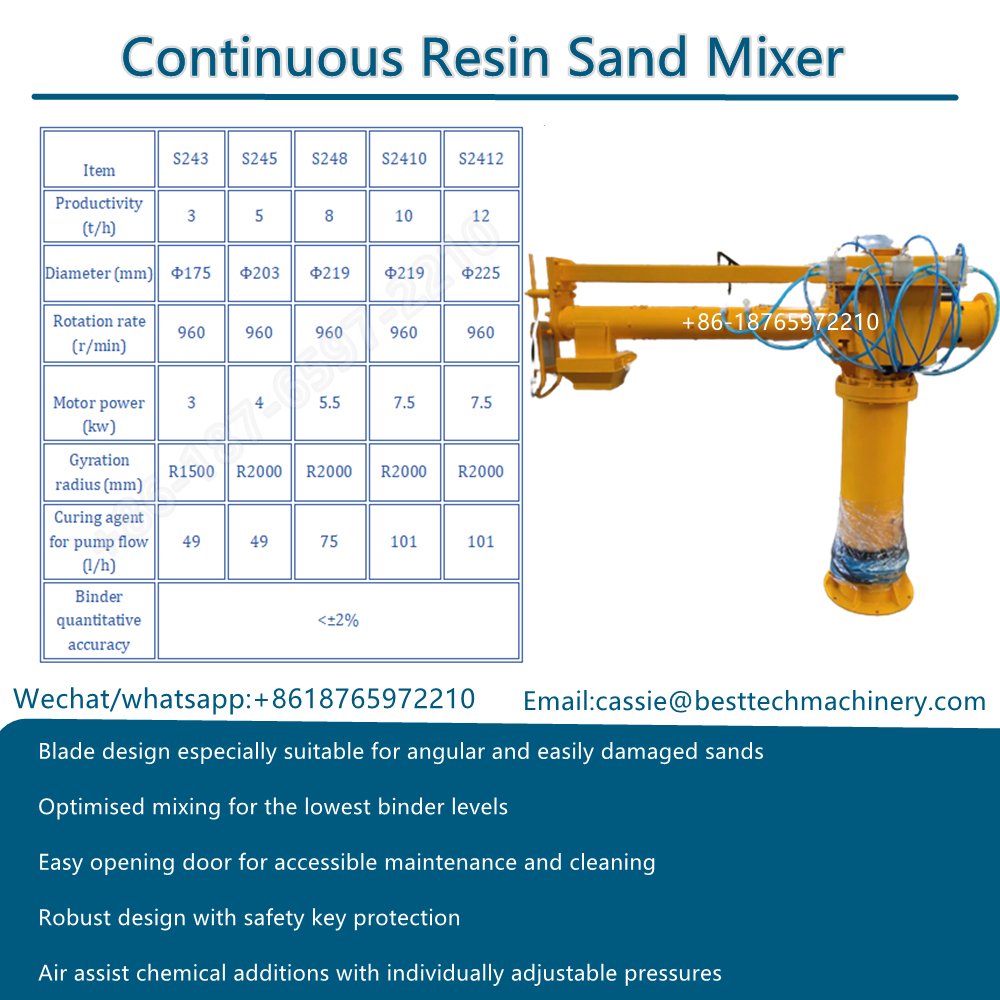
Double Arm Resin Sand Mixer
High Mixing Efficiency
The two mixing arms work simultaneously, ensuring thorough and uniform mixing of sand, resin, and hardeners.
Ideal for producing high-quality resin sand with consistent properties.
Increased Production Capacity
Can handle larger volumes of sand and resin, making it suitable for medium to high-volume production.
Reduces cycle times and increases productivity in demanding operations.
Superior Mixing Uniformity
The dual-arm system provides more vigorous and comprehensive mixing.
Ensures that all particles are evenly coated with resin, resulting in better mold strength and surface finish.
Adaptability to Complex Formulations
Excels at mixing complex sand-resin formulations or materials with varying densities.
Suitable for foundries requiring high precision in sand molding processes.
Reduced Mixing Time
The two arms enable faster mixing compared to single-arm mixers, saving time and enhancing efficiency.
Ideal for high-speed production lines.
Enhanced Durability
Built to withstand heavy-duty operations, making it more durable for continuous or large-scale use.
Designed to handle abrasive materials like silica sand effectively.
Scalability
Supports higher scalability, allowing foundries to expand their production capacity without needing to replace the mixer.
Automation Options
Many double-arm mixers come with advanced automation features, such as programmable controls for precise resin and sand ratios.
Enables consistent operation with minimal human intervention.
Versatility
Suitable for various types of sand and resin systems, including furan, phenolic, or alkaline resins.
Can be used for both continuous and batch operations, depending on the model.
Improved Mold Quality
The uniform and precise mixing improves the quality of molds, leading to better casting accuracy, surface finish, and strength.
Reduced Material Waste
Ensures optimal utilization of resin and hardener by preventing overuse or uneven mixing.
Contributes to cost savings in material usage.
Supports Larger Molds
Capable of producing larger volumes of mixed resin sand, which is essential for creating large or complex molds.
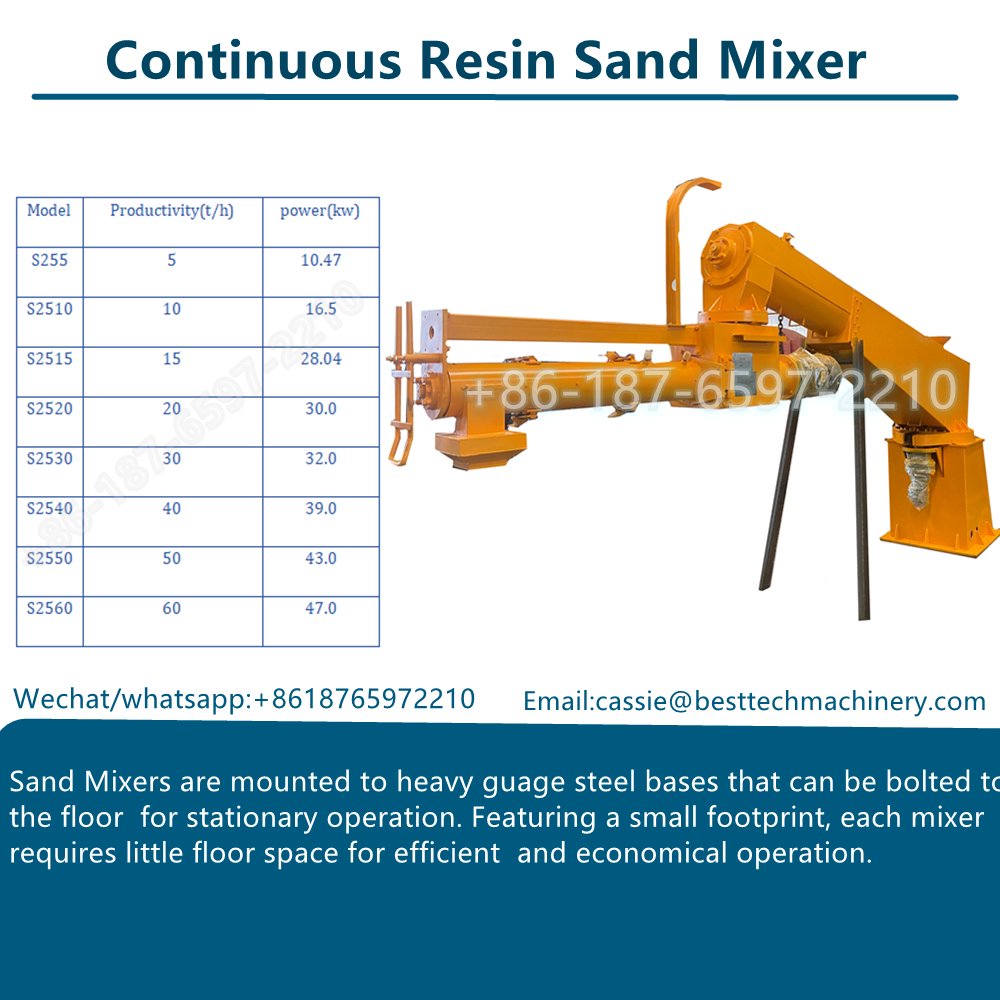
Recommendation:
Single-Arm Mixer: If you have a small-scale operation, limited budget, or space constraints, and your mixing requirements are not too demanding.
Double-Arm Mixer: If you operate at a larger scale, require superior mixing uniformity, or deal with challenging formulations and need to ensure high efficiency and precision