
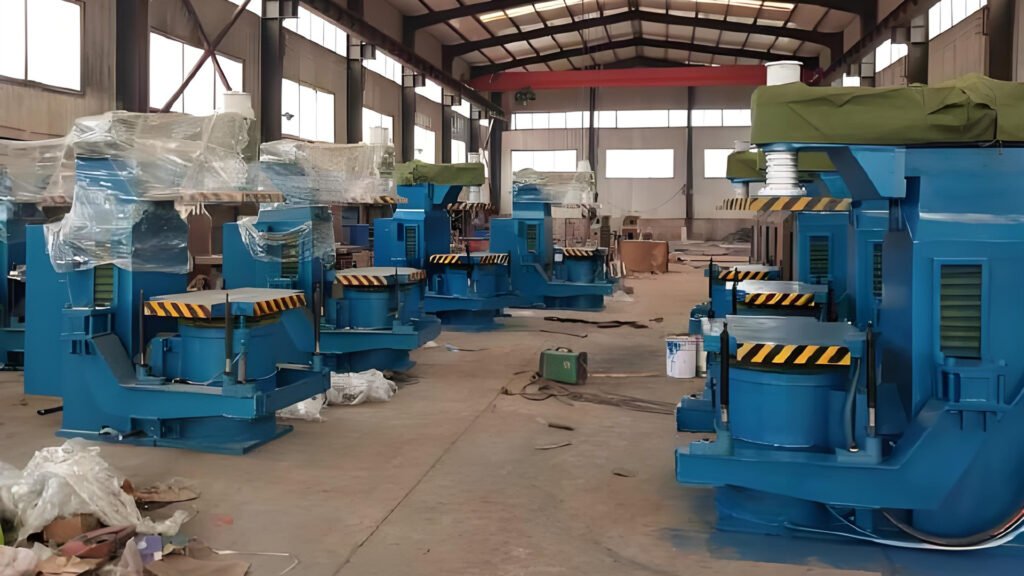
Struggling with low production efficiency of castings?
The Jolt Squeeze Molding Machine is a specialized foundry equipment designed to streamline sand mold preparation in metal casting processes.
By combining jolting and squeezing mechanisms, it ensures high-quality molds with minimal waste and labor input, making it a cornerstone of modern foundries.
What Is a Jolt Squeeze Molding Machine?
A jolt squeeze molding machine is a type of foundry equipment used in the sand casting process to create molds for metal casting. It combines two key actions—jolting and squeezing—to pack sand tightly around a pattern inside a mold flask (a box that holds the sand).
Working Principle
The machine operates through a micro-seismic jolt-squeeze mechanism that applies high-frequency, low-amplitude vibrations to the sand mold while simultaneously applying compressive force. This dual action:
- Compacts the green sand uniformly to enhance mold integrity.
- Reduces air pockets and defects, ensuring precise casting outcomes.
- Supports both simple and complex mold designs without pre-squeezing.
How It Works
Jolting Phase:
The pattern and flask are placed on a table that repeatedly lifts and drops (jolts). This vibration causes the loose sand to settle and compact, especially around the pattern details.
Squeeze Phase:
After jolting, a squeeze head comes down and applies uniform pressure on the top of the sand, further compacting it to ensure a firm and well-defined mold.
Industrial Applications
- Automotive Components: Engine blocks, rims, and alloy wheels
- Pump Manufacturing: Precision molds for hydraulic and water systems
- General Engineering Castings: Decorative lighting, water heaters, and small mechanical parts
- Water Heating Industry: Mass production of small castings with smooth surfaces

Why Jolt Squeeze Molding Machines Are Widely Used in Foundry Plants
Jolt Squeeze Molding Machines have become indispensable in modern foundry operations due to their unique design, efficiency, and adaptability.
1. Efficient Compaction Mechanism
Jolt squeeze molding machine combine jolting (vibration) and squeezing (mechanical pressure) to achieve uniform sand compaction in mold boxes. This dual-action process ensures:
- High-density molds: The jolting action settles sand particles tightly, while the squeeze mechanism further compacts the sand, minimizing voids and defects in castings.
- Consistent hardness: The synchronized vibration and pressure create molds with balanced upper and lower hardness, critical for producing dimensionally accurate and defect-free castings.
2. Cost-Effectiveness and Low Investment
- Affordable for small foundries: Jolt Squeeze molding machine require lower initial capital compared to automated molding lines, making them ideal for small-to-medium enterprises.
- Energy efficiency: Powered by compressed air or hydraulic systems, they consume less energy while maintaining high output.
3. Operational Flexibility
- Portability: Many jolt squeeze molding machine models feature wheeled bases, allowing easy repositioning within workshops to optimize workflow and reduce material-handling distances.
- Adaptability: Suitable for diverse applications, including small castings for lighting fixtures, machinery parts, and plumbing hardware.
4. Simplified Maintenance and Durability
- Robust construction: Designed for heavy-duty use, JSMMs withstand the harsh conditions of foundry environments with minimal wear.
- Easy mold stripping: Integrated pulsators gently shake the mold plate during demolding, reducing manual labor and cycle times.
5. Environmental and Safety Compliance
- Dust reduction: Advanced models incorporate dust collectors to minimize airborne particulates, aligning with workplace safety and environmental regulations.
6. Versatility in Production
Jolt squeeze molding machine excel in batch production of small-to-medium castings. Examples include:
- Lighting accessories: Smooth surface finishes and precise geometries .
- Automotive components: High-strength iron or aluminum parts .
Jolt Squeeze Molding Machines dominate foundry plants due to their balance of efficiency, affordability, and adaptability. Their ability to produce high-quality molds with minimal operational complexity makes them a cornerstone of sand casting processes.
Features of Jolt Squeeze Molding Machine
The Jolt Squeeze Molding Machine is a specialized equipment widely used in foundry processes for creating high-quality sand molds. Its unique combination of mechanical jolting and hydraulic squeezing ensures efficient compaction of molding sand, making it indispensable in metal casting industries.
1. Core Mechanism: Dual-Phase Compaction
The machine integrates jolting (vibration) and squeezing (pressure) actions to achieve uniform sand density.
- Jolting Phase: High-frequency vibrations (typically 500–1,000 cycles/minute) loosen and distribute sand particles evenly within the mold cavity.
- Squeezing Phase: Hydraulic pressure (0.25–0.4 MPa for standard models; up to 0.7 MPa in high-pressure variants) compacts the sand vertically, eliminating air gaps and enhancing mold strength .
This dual-action design minimizes porosity and ensures dimensional accuracy in castings.
2. Structural Design and Components
- Robust Frame: Built with heavy-duty steel to withstand repetitive mechanical stress.
- Adjustable Parameters: Operators can fine-tune jolt intensity, squeeze pressure, and cycle duration to accommodate different sand types (e.g., green sand, resin-bonded sand) .
- Automated Pattern Release: Advanced models include stripping mechanisms to detach molds smoothly without damaging intricate patterns .
3. Operational Efficiency
- High Productivity: Capable of producing 80–120 molds per hour, depending on size and complexity.
- Energy-Saving: Optimized hydraulic systems reduce power consumption compared to older pneumatic models .
- Low Maintenance: Simplified mechanical components and wear-resistant materials extend service intervals .
4. Technical Advantages
- Superior Surface Finish: Reduces defects like sand burn-on or veining in castings.
- Versatility: Suitable for both small-batch and mass production of ferrous/non-ferrous metal parts .
- Adaptability: Compatible with automated foundry lines for integrated pouring and cooling processes .
Comparison with Other Molding Machines
| Feature | Jolt Squeeze | High-Pressure Molding | Manual Molding |
| Compaction Mechanism | Vibration + Squeeze | Hydraulic Pressure | Human Labor |
| Mold Hardness | Moderate-High | Very High | Low |
| Production Speed | Medium-Fast | Fast | Slow |
| Cost | Moderate | High | Low |
| Source: Adapted from |
Conclusion
The Jolt Squeeze Molding Machine represents a leap in foundry automation, balancing precision, cost-effectiveness, and scalability. Its adoption is critical for manufacturers aiming to reduce defects, lower operational costs, and meet global quality standards.