
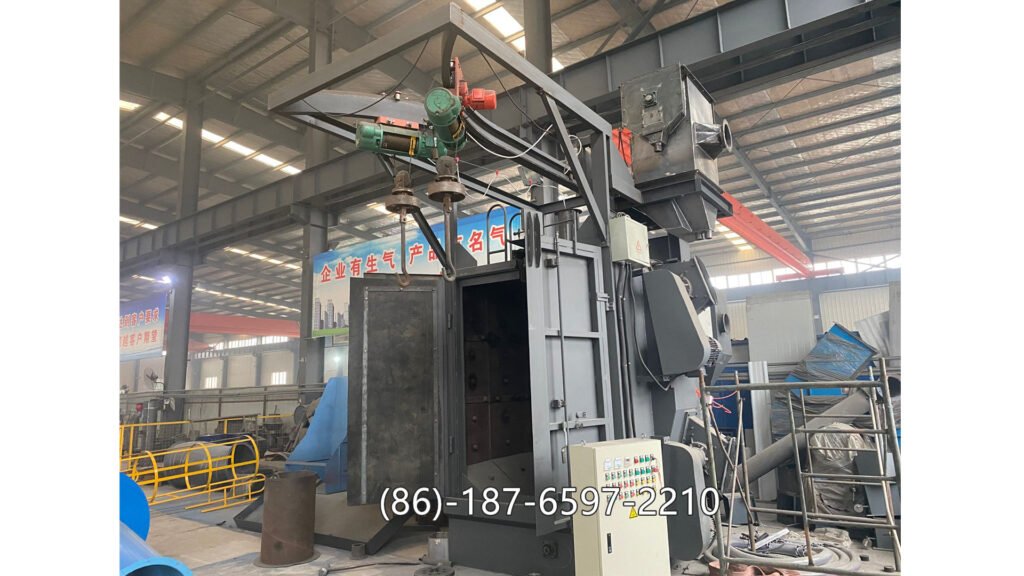
Don’t wait for a breakdown: The Golden Rules of Hanger Shot Blaster Maintenance.
Hanger Type Shot Blasting Machine is a high-energy environment. Every second, thousands of metallic abrasives impact not just your workpieces, but the machine itself. Without a rigorous service schedule, efficiency drops and safety risks rise.
Introduction
Hanger shot blasting machines are widely used for cleaning, descaling, and surface preparation of medium and large metal workpieces. Due to the high-impact and high-abrasion working environment, regular maintenance and proper servicing are essential to ensure stable blasting performance and long equipment service life.
Poor maintenance may result in uneven cleaning, excessive wear, increased power consumption, and unexpected downtime. From an engineering point of view, systematic maintenance is the key to maintaining optimal performance.
This article introduces practical maintenance and servicing tips based on real production experience.
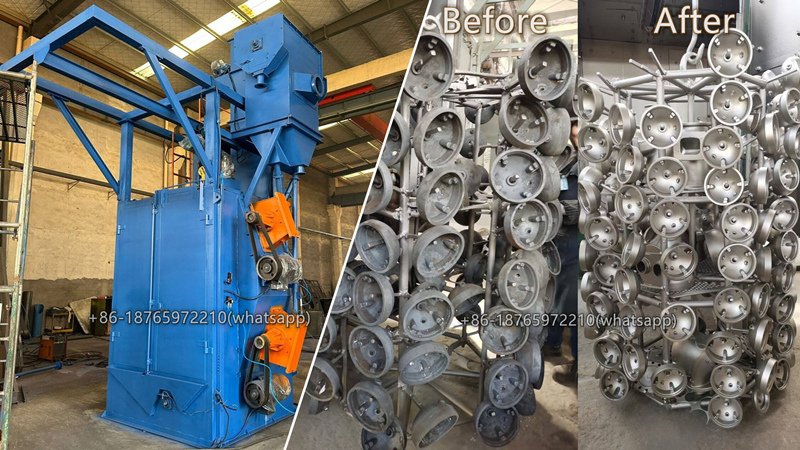
1. Daily Inspection and Cleaning
Daily maintenance is the foundation of stable operation.
Recommended daily checks:
- Clean shot residue and dust inside the blasting chamber
- Check blast wheel noise and vibration
- Inspect hanger hook rotation and movement
- Check door seals and chamber sealing
- Observe blasting effect on workpieces
Engineering note:
Abnormal noise from blast wheels usually indicates blade wear or shot blockage.
2. Blast Wheel Maintenance
Blast wheels are the core components and require close attention.
2.1 Blade and Control Cage Inspection
- Check blade thickness and wear level
- Replace blades when wear exceeds 20–25%
- Inspect control cage opening position
- Ensure shot flow direction is correct
Uneven blade wear directly affects blasting efficiency and surface quality.
2.2 Shot Flow Control
- Check shot feed valve operation
- Remove shot blockage in pipes
- Ensure stable shot flow rate
Typical shot throwing speed:
- 70 – 80 m/s
Stable shot flow ensures uniform surface cleaning.
3. Abrasive Media Management
Correct shot media management reduces wear and improves blasting quality.
Maintenance tips:
- Separate broken shot and dust regularly
- Maintain correct shot size distribution
- Avoid excessive fine particles
- Replace shot when efficiency drops
Typical shot media:
- Steel shot S330 / S390
- Steel grit G25 / G40
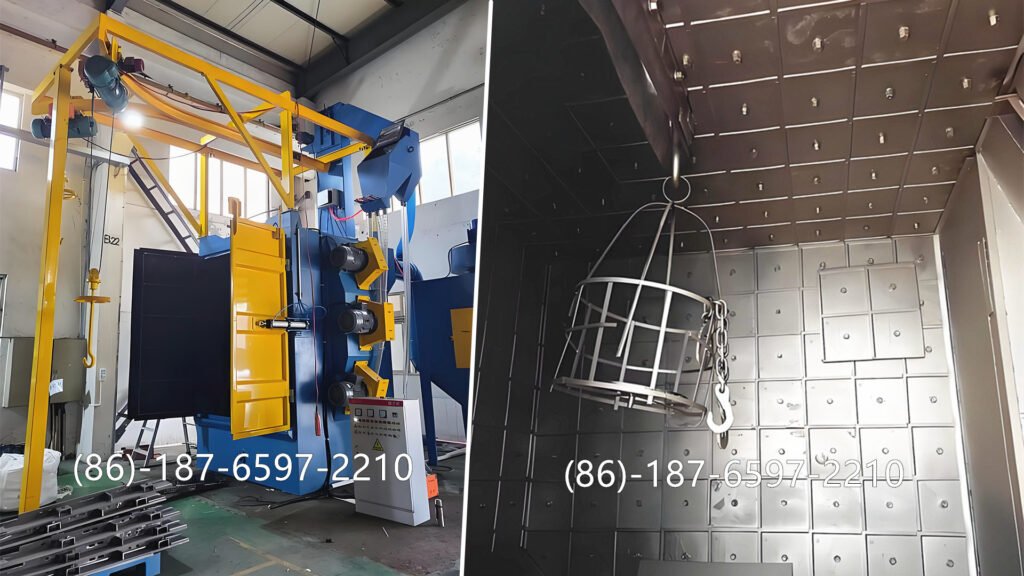
4. Wear Protection System Inspection
The blasting chamber operates under severe abrasion.
Key wear protection areas:
- Chamber liners (Mn steel or alloy)
- Shot distribution pipes
- Wheel housing liners
Maintenance recommendation:
- Inspect liners weekly
- Replace liners before full penetration
- Tighten liner fixing bolts regularly
Good liner condition protects the machine structure.
5. Hanger Hook and Rotation System Maintenance
The hanger system directly affects blasting uniformity.
Check items:
- Hook rotation motor and gearbox
- Bearing lubrication condition
- Rotation speed stability
- Load balance on hook
Typical rotation speed:
- 2 – 6 rpm
Unstable rotation causes shadow areas and uneven blasting.
6. Dust Collector and Environmental System
Efficient dust collection is necessary for safe operation.
Maintenance points:
- Clean or replace filter cartridges regularly
- Check fan vibration and bearing condition
- Inspect duct sealing
- Monitor dust emission level
Dust emission should meet local environmental standards and workshop requirements.
7. Electrical and Control System Servicing
Modern machines use PLC-based control systems.
Recommended checks:
- Inspect sensors and limit switches
- Check cable connections
- Test emergency stop and safety interlocks
- Backup PLC parameters periodically
Stable control systems ensure safe and repeatable operation.
8. Lubrication and Mechanical Parts
Lubrication reduces mechanical wear.
Lubrication points:
- Bearings
- Gearboxes
- Chain and drive systems
Engineering tip:
Follow manufacturer lubrication intervals and use recommended grease types.
9. Periodic Maintenance Schedule (Recommended)
| Maintenance Item | Frequency |
|---|---|
| Chamber cleaning | Daily |
| Blast wheel inspection | Weekly |
| Shot media separation | Weekly |
| Liner inspection | Weekly |
| Dust filter cleaning | Weekly |
| Electrical system check | Monthly |
| Full machine inspection | Quarterly |
10. Safety and Standards Compliance
Maintenance work should follow international safety standards:
- ISO 9001 – Quality Management
- EN 1247 – Foundry Machinery Safety
- CE Machinery Directive 2006/42/EC
- ISO 13849 – Safety Control Systems
Always lock out power and follow safety procedures during maintenance.
11. Hanger Shot Blasting Machine Troubleshooting Table
| No. | Problem / Symptom | Possible Cause | Recommended Solution |
|---|---|---|---|
| 1 | Poor cleaning effect | Blast wheel blades worn | Replace blades (wear > 20–25%) |
| Shot flow rate too low | Adjust shot feed valve | ||
| Incorrect blast wheel angle | Adjust control cage position | ||
| Workpiece rotation too slow | Set rotation speed to 2–6 rpm | ||
| Shot media contaminated | Screen or replace abrasive | ||
| 2 | Uneven surface cleaning | Workpiece shadow area | Improve hook rotation or add wheel |
| Improper wheel layout | Optimize blast wheel arrangement | ||
| 3 | Excessive shot consumption | Low-quality abrasive | Use standard steel shot (S330 / S390) |
| Over-blasting | Reduce blasting time | ||
| Worn liners | Replace liners | ||
| 4 | Abnormal noise from blast wheel | Uneven blade wear | Replace full blade set |
| Shot blockage | Clean blast wheel | ||
| Bearing damage | Replace bearings | ||
| Loose bolts | Tighten fixing bolts | ||
| 5 | Strong vibration during operation | Imbalanced blast wheel | Reinstall blades correctly |
| Bearing failure | Inspect and replace | ||
| 6 | Dust leakage from chamber | Door seals worn | Replace rubber seals |
| Insufficient dust collector air volume | Check fan capacity | ||
| Blocked filters | Clean or replace filters | ||
| 7 | Steel shot leakage | Door not sealing properly | Adjust door locking mechanism |
| Liner gaps | Reinstall or tighten liners | ||
| 8 | Hanger hook not rotating | Motor or gearbox failure | Inspect motor / gearbox |
| Bearing lack of lubrication | Lubricate or replace bearing | ||
| Overload | Reduce hanging weight | ||
| 9 | Unstable hook rotation | Chain or coupling wear | Replace worn parts |
| Speed reducer problem | Check reducer oil and gears | ||
| 10 | Rapid liner wear | Incorrect blast wheel angle | Adjust blasting direction |
| Wrong abrasive type | Select proper shot size | ||
| 11 | Poor dust collector performance | Filter clogged | Clean or replace cartridge |
| Fan malfunction | Inspect fan motor | ||
| Air duct leakage | Seal air ducts | ||
| 12 | Machine cannot start | Safety interlock active | Check door and safety switches |
| Electrical wiring loose | Tighten wiring | ||
| PLC alarm | Check alarm code | ||
| 13 | Sudden machine stop | Sensor failure | Replace faulty sensor |
| Overload protection triggered | Check motor current | ||
| 14 | Excessive power consumption | Worn blast wheel parts | Replace wear parts |
| Over-blasting | Optimize blasting cycle |
Conclusion
Regular maintenance and proper servicing are essential for ensuring optimal performance of a hanger shot blasting machine. From an engineering perspective, attention to blast wheels, shot media, wear protection, and dust collection systems directly determines cleaning quality and operating cost.
A well-maintained machine not only improves surface treatment results but also reduces downtime, extends service life, and ensures safe operation. Preventive maintenance is always more cost-effective than emergency repair.