
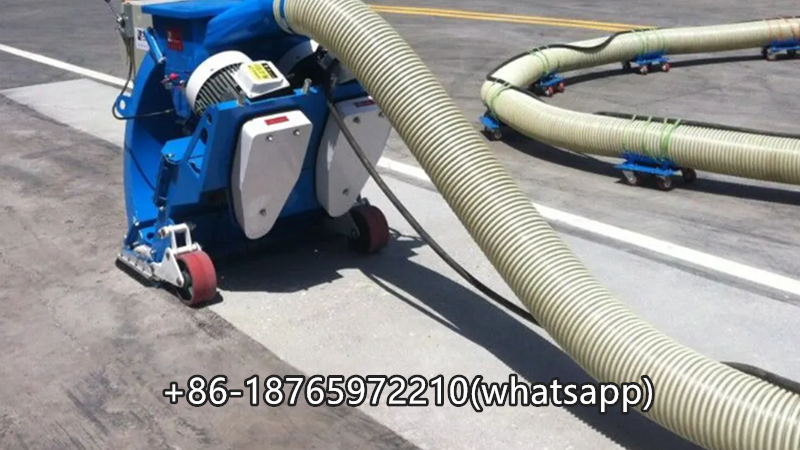
Shot blasting concrete works by using an airless, centrifugal wheel that propels blast media at a high velocity in a controlled pattern and direction. A blast wheel is accelerated at the concrete surface and contaminants that are removed land in a recovery chamber.
What Is Shot Blasting For Concrete Surface?
Shot blasting for concrete surface is an advanced and modern solution that allows preparing and cleaning a concrete floor before applying its coating.
It consists on grinding the bearing layer of concrete, giving it a perfect roughness to apply a coating, such as epoxy resins or micro-cement, or for a smoothing treatment of polished concrete, facilitating its adherence.
It is a method that recycles the abrasive material by collecting it in an airtight container, thus avoiding contamination.
Concrete Shot Blasting Machine Introduction
Concrete shot blasting is a high-efficiency surface treatment method widely used in concrete preparation and maintenance. The process utilizes centrifugal wheel technology to propel abrasive media (e.g., steel shot or grit) at high velocities toward the concrete surface, removing contaminants such as coatings, laitance, or weak aggregates .
Studies prior to shot blasting concrete
When shot blasting concrete, in order to have satisfactory results, it should be noted that each case has its own peculiarities.
For example, it’s not the same to do it on a highway than on a roundabout. The characteristics of the pavement, the humidity of the environment, the type of shot, the granulometry, the capacity of the vacuum cleaner, the machine, the working width, the speed, etc. All must be analyzed.
Basically, they are all factors that directly influence the choice of type of shot blasting and the strategy.
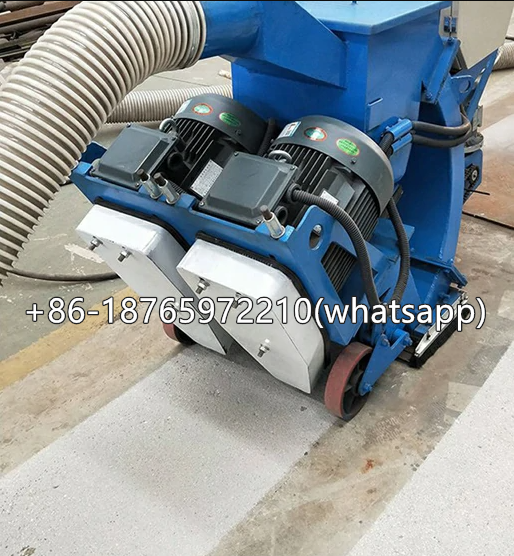
Key Components and Workflow
Centrifugal Wheel System:
- A motor-driven wheel accelerates abrasive media through centrifugal force, directing them in a controlled pattern toward the concrete .
- The wheel’s rotational speed and abrasive feed rate determine the impact force and surface profile (e.g., CSP 3-7 for coatings) .
Abrasive Media and Recovery:
- Media (e.g., steel shot, chilled iron) rebound after impacting the surface, removing debris that collects in a recovery chamber.
- A dust collection system ensures environmental compliance by capturing airborne particles .
Concrete Surface Preparation:
- Light to heavy blasting profiles (CSP 1-7) are tailored for applications like epoxy coatings, floor toppings, or aggregate exposure.
- Aggressive blasting can expose aggregate for aesthetic or functional purposes .
Advantages Over Traditional Methods
- Precision: Controlled media velocity and direction minimize over-treatment or substrate damage.
- Efficiency: Faster than manual grinding or hydro-blasting, with immediate reuse of cleaned surfaces.
- Versatility: Suitable for large-scale industrial floors, pipes, and cylindrical parts .
Environmental and Safety Considerations
- Closed-loop systems recycle abrasive media and dust, reducing waste.
- Safety protocols include operator training and protective gear to mitigate risks from rebounding media.
Conclusion
Concrete shot blasting equipment, by using steel balls or other materials of approximately 2 mm in diameter, hit the concrete flooring at a high pressure and speed in order to eliminate the its surface layer (old coatings, stains, dirt, etc.) and leave it in an optimal condition to then apply a new coating.
However, it’s important to know that they can also be used on different types of floors, such as asphalt, concrete and even steel.
Many concrete shot blasting machines eject the pellets onto the surface at a high speed, fracturing it along with dirt, paint or other contaminating residue.
The dirt removal capacity depends on several factors such as the machine’s movement speed, the impact force of the shot, the size and concentration of the shot, among other factors.
A great benefit from using these machines is that they generate little dust or waste because they have a collector that gathers them. This means they are an excellent option when treating floors in agri-food industries or logistics centers.