
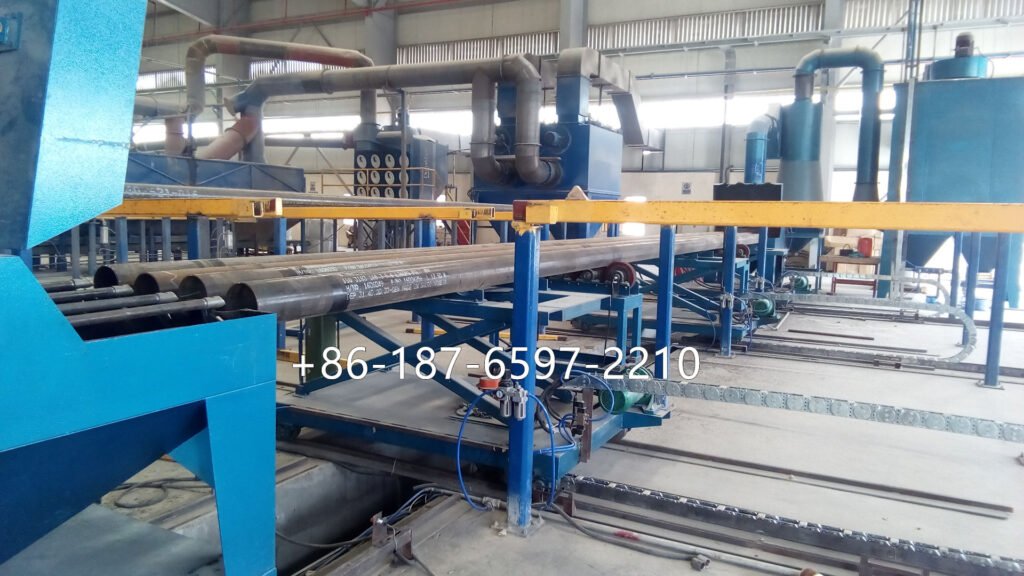
Cleaning the inside of a steel pipe is not the same as cleaning the outside.
The internal wall is narrow, enclosed and difficult to access. Manual grinding is slow. Wire brushing is inconsistent. Conventional external shot blasting equipment cannot reach the internal surface effectively.
For pipe manufacturers, coating contractors and pipeline fabrication plants, the real question is not simply:
“How can we remove rust?”
It is:
“How can we clean the entire internal pipe surface uniformly, quickly and repeatedly before coating?”
This is where a Steel Pipe Inner Wall Shot Blasting Machine becomes a practical production solution.
The machine uses a controlled abrasive blasting system to clean the internal wall of steel pipes, removing rust, mill scale, oxide, welding residues and other contaminants while creating a suitable surface profile for subsequent coating.
What Is a Steel Pipe Inner Wall Shot Blasting Machine?
Steel Pipe Inner Wall Shot Blasting Machine is specialized equipment designed to blast the inside surface of cylindrical steel pipes.
Instead of sending abrasive toward the outside diameter, the blasting assembly enters the pipe and directs steel shot or steel grit against the internal wall.
Depending on the machine configuration, the blasting head can:
- Move axially through the pipe
- Rotate during blasting
- Combine axial movement with rotary blasting
- Adjust blasting coverage according to pipe diameter
- Process different pipe lengths with customized travel systems
The result is a much more controlled internal surface preparation process than manual cleaning.
Why Internal Pipe Cleaning Is a Difficult Problem
A typical steel pipe may have:
- Rust
- Mill scale
- Oxide
- Welding residue
- Dust
- Old coating
- Manufacturing contamination
The outside surface is relatively easy to access.
The inside is different.
If the pipe diameter is small or the pipe is several meters long, operators cannot easily maintain consistent blasting pressure, angle and coverage.
This creates several production problems:
Manual Cleaning
Slow + labor intensive + inconsistent
Internal Grinding
Limited reach + high labor requirement + difficult quality control
Manual Abrasive Blasting
Operator dependent + difficult to maintain uniform coverage
Internal Shot Blasting
Controlled + repeatable + high efficiency
That is why internal pipe blasting is increasingly treated as a dedicated surface preparation process rather than a manual cleaning job.
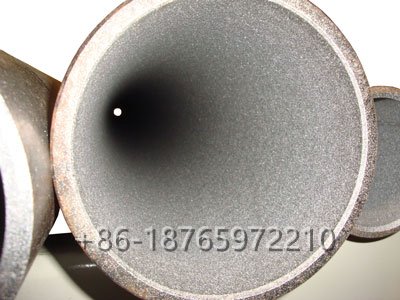
How Does an Internal Pipe Shot Blasting Machine Work?
The basic process is straightforward.
Step 1 — Pipe Loading
The steel pipe is positioned on the supporting rollers or pipe handling system.
Step 2 — Blasting Head Entry
The blasting lance or blasting head enters the pipe.
Step 3 — Abrasive Blasting
Steel shot or steel grit is accelerated and projected onto the internal wall.
Step 4 — Axial Movement
The blasting head moves through the pipe at a controlled speed.
Step 5 — Internal Surface Rotation
Depending on the machine design, the blasting head or pipe rotates to improve circumferential coverage.
Step 6 — Abrasive Recovery
Used abrasive is collected and returned to the recycling system.
Step 7 — Dust Separation
Dust and broken abrasive particles are separated through the dust collection system.
Step 8 — Finished Pipe
The cleaned internal surface is ready for inspection, coating or the next manufacturing process.
Internal Pipe Shot Blasting vs. Manual Cleaning
| Item | Manual Cleaning | Internal Shot Blasting |
|---|---|---|
| Labor | High | Low |
| Cleaning consistency | Operator dependent | Highly repeatable |
| Long pipe cleaning | Difficult | Suitable |
| Production speed | Low | High |
| Surface profile control | Limited | Adjustable |
| Abrasive recovery | Usually poor | Automatic |
| Dust control | Difficult | Integrated |
| Automation | Low | High |
| Batch production | Inefficient | Suitable |
| Coating preparation | Inconsistent | More controllable |
For factories processing large quantities of steel pipe, the difference becomes significant.
Main Benefits of Steel Pipe Inner Wall Shot Blasting
1. Uniform Internal Surface Preparation
The blasting head is engineered to maintain a controlled blasting position inside the pipe.
This helps produce more uniform cleaning than manual methods.
2. Effective Rust and Mill Scale Removal
High-velocity abrasive impact can remove:
- Surface rust
- Mill scale
- Oxide
- Welding residues
- Loose coatings
- Surface contaminants
The actual result depends on pipe condition, abrasive type, blasting parameters and required cleanliness grade.
3. Better Preparation for Coating
A properly blasted steel surface provides a controlled profile that can improve mechanical adhesion of protective coating systems.
The required profile should always be specified together with the coating manufacturer’s requirements rather than using one fixed value for every application.
ISO 8503 provides methods for assessing the surface profile of blast-cleaned steel substrates, including comparator and replica-tape methods.
4. Lower Labor Dependency
Instead of assigning operators to manually clean every pipe, the machine performs the repetitive blasting operation.
Operators can focus on:
- Loading
- Inspection
- Process monitoring
- Maintenance
- Quality control
5. Abrasive Recycling
A properly designed system recovers reusable abrasive and separates dust and broken particles.
For metallic abrasives, ISO 11124 specifies classification and characteristics of metallic blast-cleaning abrasives. ISO 11124-3, for example, covers high-carbon cast-steel shot and grit, including hardness, density and chemical requirements.
Recommended Technical Configuration
The exact configuration should be calculated from your pipe dimensions and production target.
A typical internal pipe shot blasting system may include:
| Component | Typical Configuration |
| Blasting Head | Rotary / centrifugal / pneumatic type |
| Pipe Diameter | Approx. 100–2000 mm |
| Pipe Length | Approx. 3–15 m |
| Blasting Motor | Approx. 7.5–22 kW |
| Abrasive | Steel Shot / Steel Grit |
| Pipe Rotation | Optional |
| Lance Movement | Automatic |
| Control | PLC + Touch Screen |
| Dust Collector | Pulse Jet Bag Filter / Cartridge Filter |
| Abrasive Recovery | Screw Conveyor + Elevator |
| Separator | Air-Wash Abrasive Separator |
| Surface Grade | Up to Sa 2½ / Sa 3, depending on process |
| Automation | Manual, Semi-Automatic or Automatic |
Important: These are engineering reference ranges, not universal machine specifications. Final parameters should be confirmed after reviewing pipe diameter, length, wall thickness, initial surface condition, abrasive, required cleanliness and production capacity.
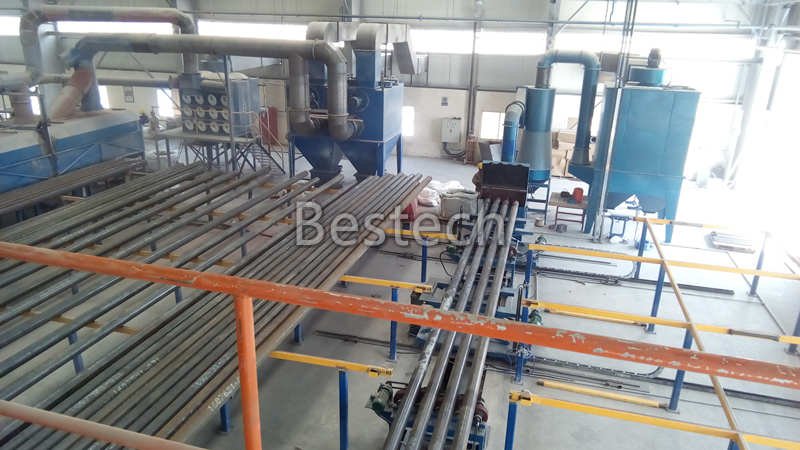
What Surface Cleanliness Can Be Achieved?
For steel surfaces prepared for coating, common requirements include:
- Sa 2 — Thorough blast cleaning
- Sa 2½ — Very thorough / near-white blast cleaning
- Sa 3 — Blast cleaning to visually clean steel
ISO 8501-1 establishes preparation grades and visual assessment criteria for steel substrates after cleaning.
For Sa 2½ and Sa 3 surfaces, ISO 8503-2 provides a method for grading the surface profile using ISO surface profile comparators.
Important Engineering Note
Do not select the machine based only on the phrase “Sa 2.5.”
The correct machine configuration also depends on:
Pipe diameter + pipe length + surface condition + abrasive + blasting speed + required profile + production capacity.
This is the information an experienced supplier should request before making a quotation.
Surface Profile Matters More Than Many Buyers Expect
Removing rust is only half of the job.
If the pipe will subsequently receive:
- Epoxy coating
- FBE coating
- Polyurethane coating
- Anti-corrosion coating
- Internal lining
the surface profile becomes an important parameter.
Too little profile can reduce coating adhesion.
Too aggressive a profile may increase abrasive consumption or create a surface profile that does not match the coating specification.
ISO 8503-5 describes the replica-tape method for measuring blast-cleaned surface profile, with commercially available replica tapes covering profile ranges from approximately 20 μm to 115 μm.
The correct target should therefore come from the coating specification and project requirement—not from a generic machine brochure.
Steel Pipe Inner Wall Shot Blasting Machine Applications
This equipment is suitable for many pipe-processing industries.
Oil & Gas Pipes
Internal surface preparation before protective coating or lining.
Water Pipeline
Cleaning internal pipe surfaces before corrosion-protection treatment.
Structural Steel Pipes
Removing mill scale and rust before painting.
Boiler and Pressure Equipment
Surface preparation of tubular components where internal cleaning is required.
Petrochemical Industry
Internal preparation before specialized protective coating.
Steel Tube Manufacturing
Cleaning pipes before downstream finishing processes.
Large-Diameter Pipe Fabrication
Efficient preparation of long and heavy pipes.
Internal Pipe Blasting for Coating Lines
A typical production sequence can be:
Steel Pipe Loading
        ↓
Pipe Positioning
        ↓
Internal Shot Blasting
        ↓
Abrasive Recovery
        ↓
Dust Separation
        ↓
Internal Air Cleaning
        ↓
Surface Inspection
        ↓
Internal Coating
        ↓
Curing / Drying
        ↓
Final Inspection
For high-volume production, the blasting machine can be integrated with automatic pipe handling and downstream coating equipment.
This changes the machine from a standalone cleaner into a complete internal pipe surface preparation station.

How to Select the Right Internal Pipe Shot Blasting Machine
Before asking for a quotation, prepare these 8 parameters.
1. Minimum Pipe Diameter
Example:
Ø100 mm
or
Ø300 mm
This determines whether the blasting head can physically enter the pipe.
2. Maximum Pipe Diameter
Example:
Ø1200 mm
This affects blasting-head selection and coverage.
3. Pipe Length
For example:
6 m / 9 m / 12 m / 15 m
Longer pipes require appropriate lance travel and abrasive recovery design.
4. Pipe Wall Thickness
Wall thickness affects handling and allowable blasting conditions.
5. Initial Surface Condition
Is the pipe:
- New?
- Rusted?
- Mill scale covered?
- Previously coated?
- Welded?
This directly affects required blasting time.
6. Required Cleanliness
Specify:
Sa 2 / Sa 2½ / Sa 3
if applicable.
7. Required Surface Profile
For example:
40–75 μm
But the final target should be confirmed with the coating system and project specification.
8. Production Capacity
Tell the manufacturer:
pipes/hour
or
tons/day
This is much more useful than simply saying:
“I need a pipe blasting machine.”
What Makes a Good Internal Pipe Blasting Machine?
A low-cost machine is not necessarily a low-cost solution.
When comparing suppliers, check these points:
Blasting System
Is the abrasive delivery stable?
Blasting Coverage
Does the design provide complete internal coverage?
Wear Protection
Are critical blasting chamber components protected against abrasive wear?
Abrasive Recovery
Can the system efficiently separate reusable abrasive from dust and broken particles?
Dust Collection
Is the dust collector sized for the actual blasting airflow?
Pipe Handling
Can the loading and positioning system handle your actual pipe weight?
Automation
Can blasting speed and movement be controlled accurately?
Maintenance
Can wear parts be replaced quickly?
After-Sales Support
Can the supplier provide installation, commissioning and spare parts?
These details often matter more than the headline motor power.
Common Problems Caused by Poor Machine Selection
Problem 1: Incomplete Internal Cleaning
Cause: Incorrect blasting coverage or insufficient exposure time.
Solution: Optimize blasting head design, travel speed and abrasive flow.
Problem 2: Uneven Surface Profile
Cause: Unstable blasting distance or rotation.
Solution: Improve blasting-head movement and process control.
Problem 3: Excessive Abrasive Consumption
Cause: Poor separation or unsuitable abrasive size.
Solution: Optimize separator performance and abrasive selection.
Problem 4: Excessive Dust
Cause: Inadequate dust collector capacity or poor sealing.
Solution: Match dust extraction capacity to the blasting system.
Problem 5: Low Production Capacity
Cause: Manual pipe loading/unloading becomes the bottleneck.
Solution: Integrate automatic pipe handling and synchronized blasting.
Steel Pipe Internal Shot Blasting: Cost vs. Productivity
When evaluating an internal pipe blasting machine, do not compare suppliers only by purchase price.
Calculate the total operating cost:
Total Cost = Labor + Abrasive + Electricity + Maintenance + Downtime + Rework
A machine with a slightly higher initial investment can be more economical if it provides:
- Higher output
- Lower labor requirement
- Better abrasive recovery
- More stable cleaning quality
- Lower rework rate
- Easier maintenance
For B2B buyers, the correct question is therefore:
“What is the cost per cleaned meter of pipe?”
not simply:
“What is the machine price?”
Why Choose a Customized Internal Pipe Shot Blasting Solution?
There is no single internal blasting configuration that is optimal for every pipe.
A pipe manufacturer processing:
Ø168 × 6 m
has completely different requirements from a manufacturer processing:
Ø1200 × 12 m.
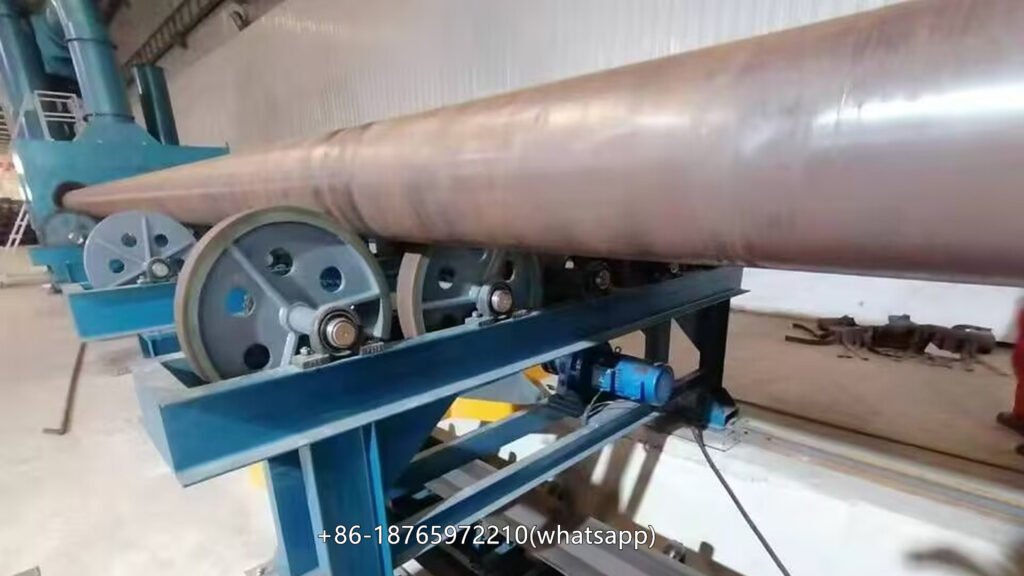
The blasting head, travel system, abrasive flow, dust collection and pipe handling system should be selected according to the actual production conditions.
A customized engineering proposal can include:
- Machine configuration
- Blasting head selection
- Pipe handling layout
- Abrasive recycling system
- Dust collector
- Electrical control system
- Production capacity calculation
- Foundation requirements
- Installation drawings
Buyer Checklist: Send These Details for a Fast Quotation
To receive a technically accurate quotation, simply send:
① Pipe diameter: ___ mm
② Pipe length: ___ mm
③ Pipe wall thickness: ___ mm
④ Pipe material: ___
⑤ Initial surface condition: ___
⑥ Required cleanliness: Sa 2 / Sa 2½ / Sa 3
⑦ Required surface profile: ___ μm
⑧ Production capacity: ___ pipes/hour
⑨ Pipe weight: ___ kg/pc
⑩ Destination country: ___
⑪ Power supply: ___ V / ___ Hz
If you have pipe drawings or workshop layout drawings, send them together.
This allows the manufacturer to recommend the correct blasting configuration instead of offering a generic machine.
Frequently Asked Questions
Can this machine remove rust from the inside of steel pipes?
Yes. The machine is specifically designed for internal surface preparation and can remove rust, mill scale, oxide and other contaminants when properly configured.
Can it achieve Sa 2½?
Yes, an appropriately designed blasting process can be configured for Sa 2½ requirements. Actual results depend on pipe condition, abrasive, blasting parameters and process time.
Can the machine process different pipe diameters?
Yes. A suitable blasting-head and pipe-handling configuration can be designed for a specified diameter range.
Can it process long steel pipes?
Yes. Long-pipe applications can use a controlled lance travel system and customized pipe handling.
What abrasive should be used?
Steel shot and steel grit are common choices. Abrasive selection should consider the required surface profile, cleaning efficiency, substrate and coating specification.
Is the machine fully automatic?
It can be configured as manual, semi-automatic or fully automatic depending on production requirements.
Can it be integrated with an internal pipe coating line?
Yes. The blasting machine can be integrated with pipe loading, internal air cleaning, coating, curing and inspection systems.
Final Buying Advice
If your factory processes steel pipes in volume, internal surface preparation should not be treated as a manual finishing operation.
The right Steel Pipe Inner Wall Shot Blasting Machine can turn a slow and labor-intensive cleaning process into a controlled production process.
The key is not simply choosing the machine with the largest motor.
Choose the machine according to:
Pipe Size → Blasting Coverage → Surface Cleanliness → Surface Profile → Production Capacity → Abrasive Recovery → Automation
Get these seven factors right, and the machine becomes a production asset rather than just another piece of equipment on the workshop floor.
Get a Customized Steel Pipe Inner Wall Shot Blasting Solution
Looking for an internal pipe shot blasting machine for your production line?
Send us your:
Pipe Diameter + Pipe Length + Wall Thickness + Production Capacity + Surface Requirement
Our engineers can evaluate your working conditions and recommend a suitable:
- Internal blasting system
- Blasting head
- Abrasive recycling system
- Dust collector
- Pipe handling system
- PLC control configuration
- Complete production-line layout
Request a customized technical proposal and quotation today.