
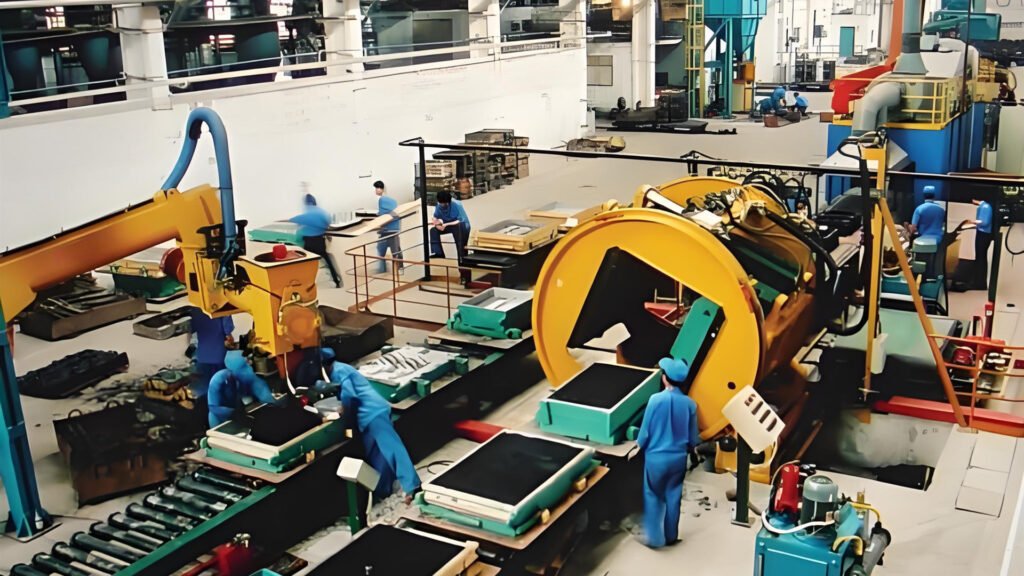
Struggling with the quality of the castings?
Casting quality issues—such as porosity, dimensional inaccuracies, or surface defects—are common pain points in foundries.
Resin sand molding lines offer a systematic solution to porosity, dimensional inaccuracies, or surface defects by enhancing precision, consistency, and process control.
Introduction to Resin Sand Molding Technology
Resin sand molding is an advanced casting process widely used in the foundry industry to produce high-quality metal castings with complex geometries and superior surface finishes.
This technology involves the use of resin-coated sand as the mold material, providing enhanced dimensional accuracy and strength compared to traditional green sand molding methods.
What is Resin Sand Molding?
Resin sand molding, also known as no-bake or self-hardening molding, is a process in which sand is mixed with a liquid resin binder and a hardener. The mixture quickly hardens at room temperature without the need for baking, forming a solid mold cavity into which molten metal is poured.
Key Components:
- Silica Sand – The primary material that provides the bulk of the mold.
- Resin Binder – A synthetic resin, commonly phenolic urethane, furan, or epoxy, that binds the sand particles together.
- Hardener/Catalyst – Initiates the chemical reaction that solidifies the resin binder.
Process Overview:
- Mixing – Sand is mixed with a predetermined ratio of resin and hardener.
- Mold Making – The mixture is packed around a pattern in a mold box.
- Curing – The mold hardens at ambient temperature within minutes.
- Pattern Removal – The pattern is withdrawn, leaving behind a hardened mold cavity.
- Casting – Molten metal is poured into the mold cavity.
- Cooling and Shakeout – After solidification, the mold is broken, and the casting is removed.
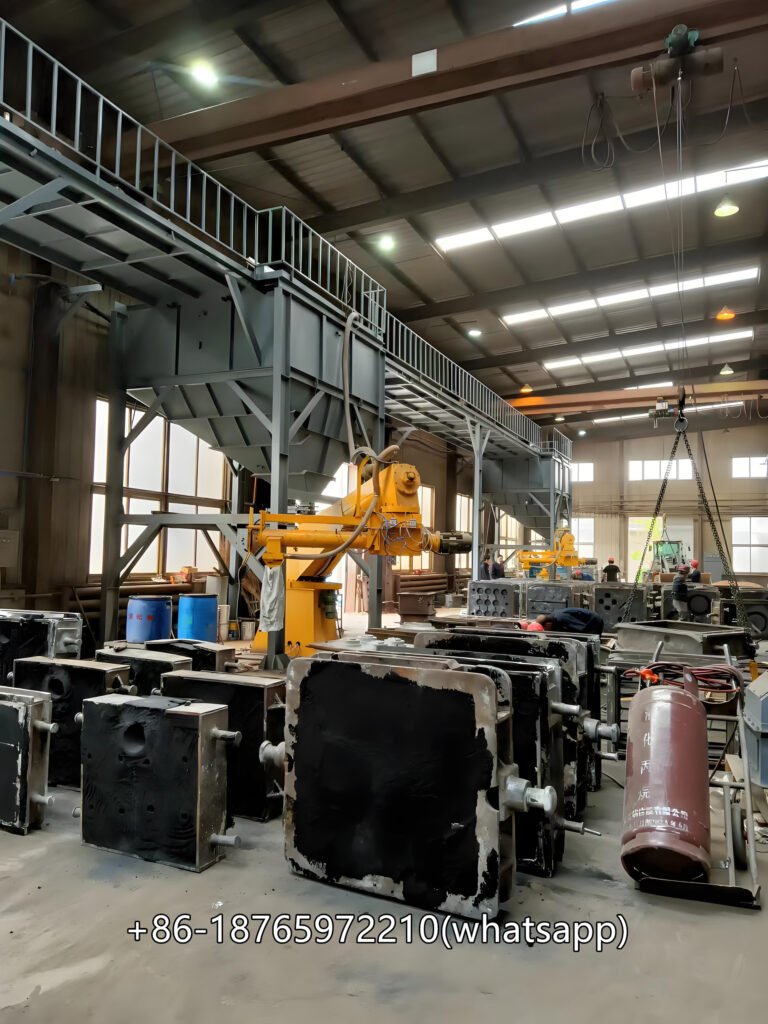
Key Advantages of Resin Sand Molding Lines
- High dimensional accuracy and excellent surface finish
- Strong mold structure suitable for large and complex castings
- No need for baking ovens (in no-bake systems)
- Better mold collapsibility for easy removal of castings
Resin sand molding technology represents a significant advancement in casting processes. Its ability to create precise, durable molds without high-temperature curing makes it ideal for a wide range of industrial applications, especially where intricate detail and high strength are critical.
The advantages are specifically reflected in the following aspects
- High Precision & Consistency: Automated resin sand molding lines integrate air-impact or low-pressure injection systems to ensure uniform sand compaction. This minimizes defects such as gas holes or shrinkage, critical for mass production of components like engine blocks or hydraulic valves.
- Efficiency in Mass Production: Modern lines, such as the Automatic Resin Sand Moulding Machine (6–15 kW power range), enable rapid mold preparation with pulsation strength up to 200 kN, achieving cycle times as low as 2–3 minutes per mold.
- Material Reusability: Advanced resin sand reclamation systems can recycle up to 90% of used sand, reducing material costs and environmental waste. Techniques like mechanical crushing and thermal regeneration restore sand grains for repeated use.
Industrial Applications and Case Studies
Resin sand molding lines are mainly applied in Production of steel, iron, and non-ferrous alloy castings; Large components such as engine blocks, pump housings, and turbine casings; Suitable for prototype and low to medium volume production.
1. Production of Steel, Iron, and Non-Ferrous Alloy Castings
Resin sand systems excel in producing high-integrity castings for metals such as cast iron, steel, and non-ferrous alloys (e.g., aluminum, magnesium). The technology ensures:
Dimensional accuracy: Resin-coated sands (e.g., phenolic resin-based formulations) provide tight tolerances with minimal machining allowances, critical for complex geometries.
Surface quality: Smooth casting surfaces due to fine sand grain distribution and low gas evolution during pouring, eliminating defects like sand fusion.
Material adaptability: Suitable for both ferrous (engine blocks) and non-ferrous (pump housings) alloys, with resin formulations optimized for different metal melting points.
2. Large Components: Engine Blocks, Pump Housings, and Turbine Casings
Resin sand molding is ideal for heavy-duty industrial components:
Complex shapes: Resin-bonded molds maintain structural integrity during pouring, enabling intricate designs like water jackets in engine blocks.
High productivity: Automated resin-coated sand systems (e.g., core shooters) achieve consistent cavity formation for repetitive large-scale parts.
Durability: Resin sands withstand high thermal stresses during pouring, ensuring dimensional stability for turbine casings and pressure vessels.
3. Prototype and Low-Medium Volume Production
Resin sand technology bridges the gap between prototyping and mass production:
Rapid mold creation: Shell molding processes enable quick pattern replication, reducing lead times for prototypes.
Cost-effective small batches: Minimal material waste and reusable molds lower costs for low-volume runs.
Design flexibility: Supports iterative changes without significant tooling adjustments, crucial for R&D phases.
Resin sand molding lines are indispensable for industries requiring precision, scalability, and material versatility. Their adaptability across steel/iron casting, large components, and prototype production makes them a cornerstone of modern foundries.
Conclusion
Resin sand molding lines have revolutionized foundry operations by balancing efficiency, precision, and sustainability. As automation and material science advance, their role in producing high-integrity castings will expand, solidifying their position as a backbone of modern manufacturing.