
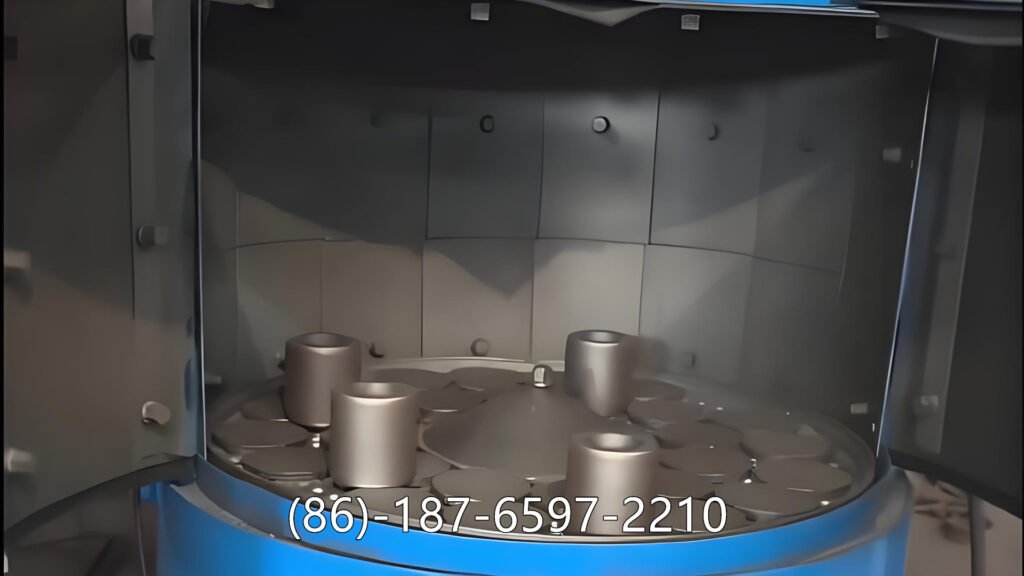
Versatility Meets Durability: Why the Turntable Blaster is Your Shop’s Most Flexible Asset.
Need to clean heavy gears, fragile castings, or complex weldments without the risk of tumbling?
The Turntable Shot Blasting Machine is the ultimate “loading-and-blasting” solution for diverse production lines.
What Is a Turntable Shot Blasting Machine?
Turntable Shot Blasting Machine (also called rotary table shot blasting machine) is a type of industrial shot blasting system designed for heavy, flat, or stable-position workpieces.
Unlike hanger shot blasting machines, the workpiece is placed on a rotating table. The table rotates slowly while high-speed turbines project steel shot to remove:
- Rust
- Mill scale
- Oxide layer
- Welding slag
- Surface contamination
This type of turntable blasting equipment is widely used in:
- Steel fabrication plants
- Foundry workshops
- Mold manufacturing factories
- Heavy machinery production lines
If your parts are heavy and cannot hang safely, a turntable shot blasting machine is usually the correct engineering solution.
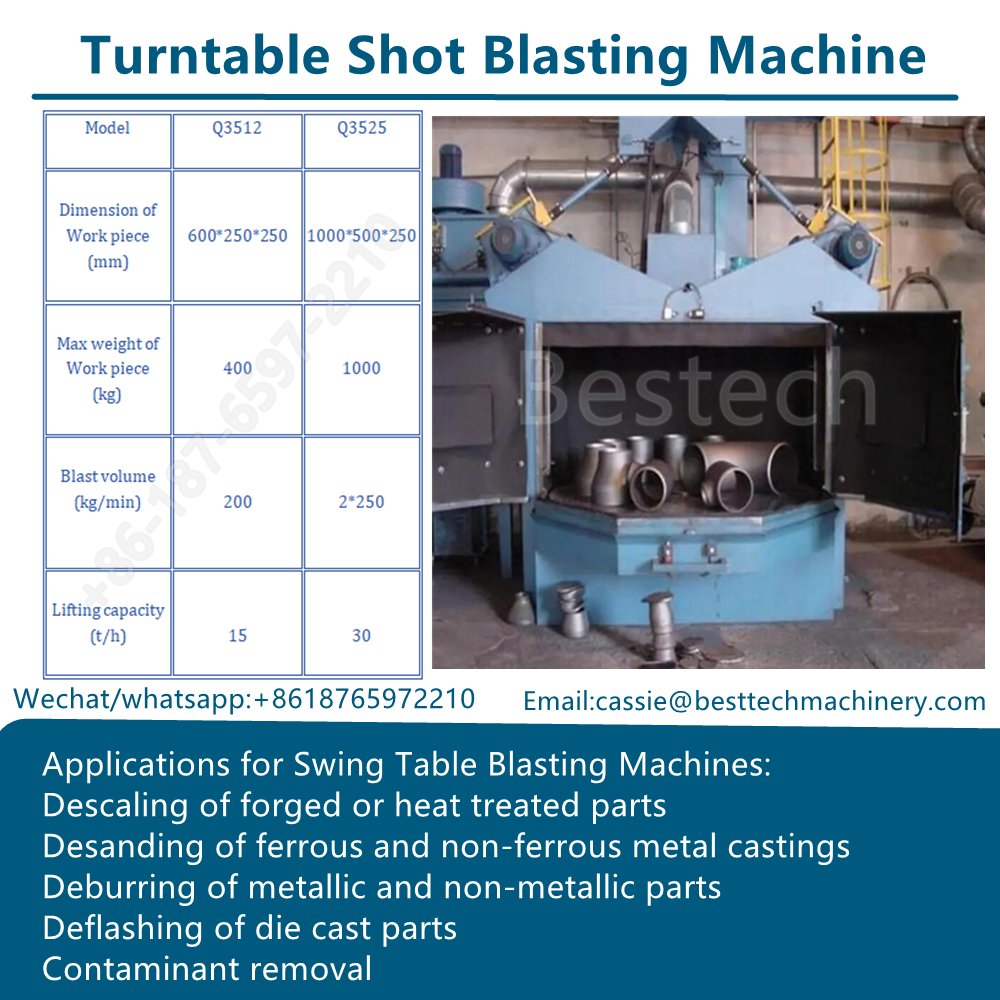
Core Structure of Turntable Shot Blasting Machine
Professional buyers do not only look at price.
They check structure.
1. Blasting Chamber
The chamber must resist continuous impact from steel shot at 60–80 m/s.
Typical configuration:
- Outer shell: Q235 structural steel
- Inner liner: Mn13 wear-resistant steel
- Liner thickness: 8–12 mm
Design references:
- ISO 12100
- ISO 5817
Poor welding means deformation after long-term vibration.
A heavy duty shot blasting machine must start from solid chamber structure.
2. Rotary Turntable System
This is the core difference.
Typical parameters:
- Table diameter: 1000–2500 mm
- Load capacity: 500–5000 kg
- Rotation speed: 1–5 rpm (VFD adjustable)
- Drive system: Gear reducer or slewing bearing system
Balanced rotation ensures:
- Uniform surface preparation
- No shadow areas
- Stable vibration level
If table alignment is poor, cleaning result will never reach Sa 2.5.
3. Blast Turbine Assembly
The turbine defines efficiency.
Typical configuration of industrial shot blasting system:
- 1–4 blast wheels
- 7.5–22 kW each
- 2900 rpm
- 150–250 kg/min abrasive flow
Surface cleaning standard reference:
- ISO 8501-1
- Target grade: Sa 2.5 / Sa 3
A professional turntable shot blasting machine manufacturer calculates:
- Impact angle
- Coverage rate
- Abrasive distribution
Random layout reduces efficiency by 20–30%.
4. Abrasive Circulation System
A complete rotary table shot blasting machine includes:
- Screw conveyor
- Bucket elevator
- Air separator
- Storage hopper
Separator efficiency must be ≥95%.
If broken abrasive returns to turbine:
- Blade wear increases
- Cleaning quality drops
- Energy cost rises
A stable abrasive system determines machine lifetime.
5. Dust Collection & Environmental Compliance
Dust is not small problem.
Professional turntable blasting equipment follows industrial safety requirements such as:
- OSHA dust exposure limits
- CE Marking compliance
Typical dust system parameters:
- Air volume: 4000–10000 m³/h
- Filtration efficiency: ≥99%
- Pulse jet cleaning system
Good dust control means:
- Safer workshop
- Longer bearing life
- Lower maintenance cost
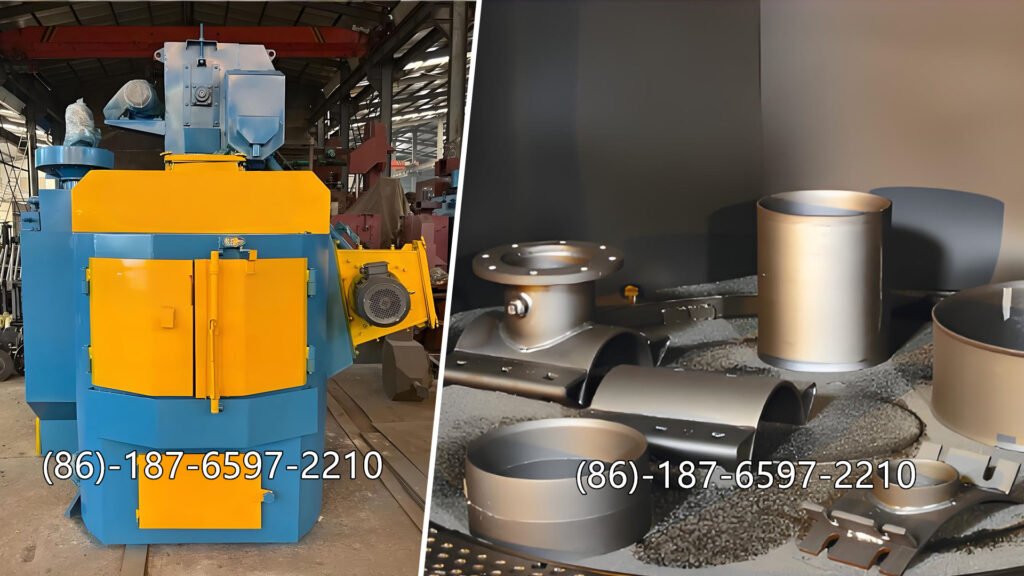
Manufacturing Process of Turntable Shot Blasting Machine
If you search “Turntable Shot Blasting Machine supplier,” many factories look similar.
Real difference is in manufacturing discipline.
Step 1 – Steel Cutting & Welding
- CNC plasma cutting
- Controlled welding sequence
- Structural deformation control
Large models require stress relief treatment.
Without stress control, table alignment will shift.
Step 2 – Precision Machining
Critical parts:
- Turbine mounting surface
- Turntable bearing seat
- Reducer base
Flatness tolerance usually within 0.2–0.5 mm.
Precision affects vibration level.
Step 3 – Turbine Dynamic Balancing
Every heavy duty shot blasting machine must perform:
- Impeller dynamic balancing
- Full blade set replacement rule
- Vibration test before shipment
Unbalanced turbine at 2900 rpm destroys bearings quickly.
Step 4 – Assembly & Load Testing
Before delivery, professional manufacturer performs:
- No-load operation test
- Load simulation test
- Abrasive circulation inspection
- Noise measurement (85–100 dB typical)
Without full test, performance is uncertain.
Technical Parameters – Typical Industrial Model
| Item | Specification |
|---|---|
| Table Diameter | 1500 mm |
| Max Load | 2000 kg |
| Turbine Power | 15 kW × 2 |
| Abrasive Flow | 200 kg/min |
| Cleaning Grade | Sa 2.5 |
| Surface Roughness | 40–70 μm |
| Total Installed Power | 45–60 kW |
Energy consumption reference:
0.8–1.2 kWh per ton of steel.
Cheap machine often consumes more power.
Why Choose Turntable Shot Blasting Machine?
Compared to hanger type:
- More stable loading
- Better for flat components
- Lower structural complexity
- Reduced risk of workpiece drop
Ideal for:
- Steel plates
- Gear housings
- Mold bases
- Heavy castings
Correct machine selection increases production efficiency by 20–30%.
Common Mistakes When Buying Turntable Shot Blasting Machine
Let’s speak honestly.
- Choosing thin liner plate to reduce price
- Undersized dust collector
- No turbine balancing certificate
- Overstated load capacity
- No surface cleaning standard reference
If supplier cannot explain Sa 2.5 or Sa 3 clearly, be careful.
Professional manufacturer talks standards.
Service Life & Maintenance Expectation
With proper maintenance:
- Blade life: 400–800 hours
- Liner life: 2000–4000 hours
- Machine life: 8–12 years
Stable operation depends on:
- Abrasive quality
- Daily inspection
- No overload operation
Equipment longevity equals discipline.
Why Our Turntable Shot Blasting Machine Stands Out
We focus on:
- Real Mn13 liner thickness
- Verified turbine balancing
- Calculated blast layout
- Full load factory testing
- Engineering-level technical support
Not just selling equipment.
We deliver stable industrial shot blasting systems.
Request Technical Proposal
If you are selecting a Turntable Shot Blasting Machine, we need:
- Workpiece size & weight
- Required cleaning grade (Sa 2.5 or Sa 3)
- Daily production capacity
- Workshop layout
Our engineers will calculate:
- Turbine quantity
- Table diameter
- Power configuration
- Dust collector capacity
Stable production starts from correct calculation.