
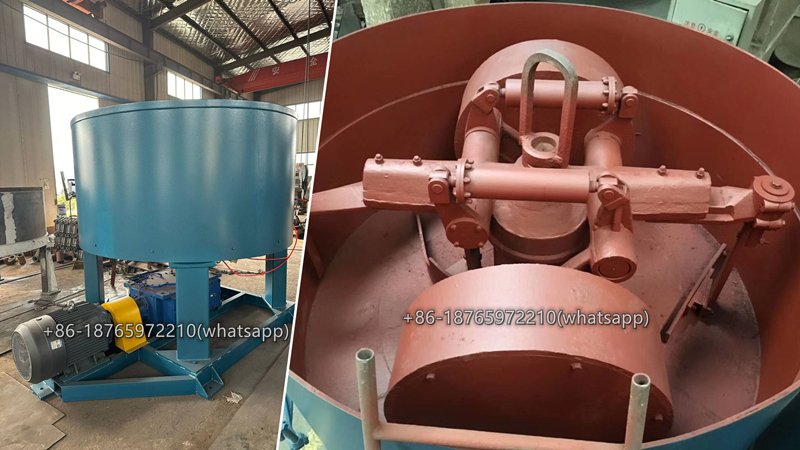
Roller sand mixer is a machine used in foundries and other industries to mix sand with binders (like clay, water, or chemical additives) to prepare molding sand for casting processes. It ensures that the sand mixture has a uniform consistency, which is critical for creating high-quality molds for casting metal components.
Roller Sand Mixer Key Components:
Rollers: These are heavy, cylindrical wheels that rotate and crush the sand mixture to break up clumps and ensure even mixing.
Mixing Pan: A large, circular pan or trough that holds the sand and binders during the mixing process
Scrapers or Blades: These ensure the sand mixture stays in the path of the rollers and prevent it from sticking to the pan.
Drive System: A motor or other power source that drives the rollers and mixing mechanism.
When the roller sand mixer works, the electromotor drives the planet cage on the vertical shaft, and the under the both ends of the planet cage, there are a pair of mixing shovel which is rotating clockwise around the vertical shaft at a certain speed, and at the same time, the two pairs of mixing shovels revolve on its axis anticlockwise at a certain speed, and the two roller will grind the materials that are constantly stirring along the clockwise direction. This working method has the functions of grinding, kneading and mixing so that it is a new wheel rolling type mixing machine integrated with several features that other types of sand mixers do not have.
How Roller Sand Mixer Works
Roller sand mixer works by combining heavy rollers and scrapers within a rotating or stationary mixing pan to uniformly mix sand with binders (like clay, water, or chemical additives).
1: Loading the Materials
Raw materials such as sand, clay, and water (or other additives) are loaded into the mixing pan.
The amount of each component is measured based on the required sand mixture specification.
2: Rolling and Crushing
Rollers (heavy cylindrical wheels) are mounted on an axle and move over the sand mixture.
As the rollers rotate, they exert pressure on the materials, crushing clumps of sand and mixing the binders into the sand.
The crushing action ensures that the sand particles are evenly coated with the binders.
3: Scraping and Mixing
Scrapers or mixing blades are positioned near the rollers or along the edge of the mixing pan.
These scrapers prevent the sand from sticking to the pan or rollers and redirect the mixture back into the rollers’ path for further processing.
This process ensures the sand mixture is uniform in consistency and evenly blended.
4: Rotational Mixing (in some designs)
In some roller sand mixers, the entire pan rotates while the rollers remain stationary. This improves the mixing efficiency by moving the sand mixture under the rollers more dynamically.
In other designs, the rollers themselves may rotate around the pan, ensuring even coverage of the entire mixture.
5: Discharge
Once the sand mixture reaches the desired consistency and uniformity, it is discharged from the mixing pan.
The prepared molding sand is now ready for use in creating molds or other industrial processes.

Conclusion
Roller sand mixer is used for evenly mixing the components of the sand and making the adhesive effectively coating the sand particles. Sand mixer crushes materials using the relative movement of the wheel roll and grinding base. This machine can crush the materials and mix them at the same time, so that it is the ideal equipment for producing baking-free brick, lime-sand brick, cement brick and refractory brick and for crushing and mixing coal ash, boiler slag and tailing slag.
Roller sand mixer is suitable for mixing and making sand and core sand in the casting foundry and is widely used in medium and small-sized casting foundry and township enterprise casting foundry. It is the ideal sand mixing and making equipment and it can also be used for mixing and making powder materials in chemistry, light industry and building material industry.