
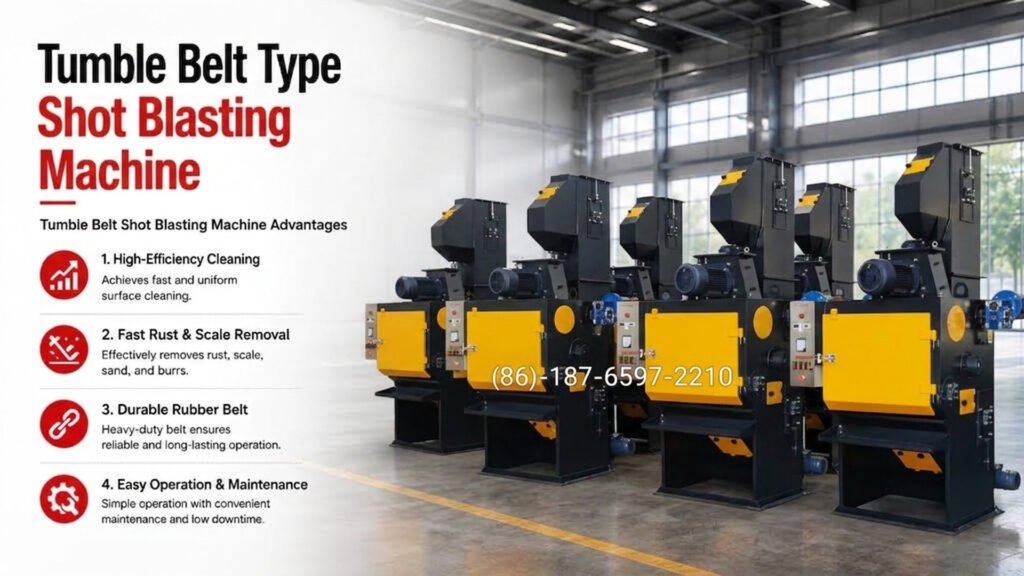
Why Are Manufacturers Choosing the Q324 Crawler Shot Blasting Machine?
For foundries, forging plants and metal component manufacturers, surface cleaning is not simply a finishing operation.
It directly affects:
- Production cycle time
- Labor requirements
- Surface quality
- Coating preparation
- Abrasive consumption
- Equipment maintenance
- Overall manufacturing cost
Traditional manual grinding, wire brushing and hand cleaning become expensive when production volume increases.
Q324 Crawler Shot Blasting Machine provides a compact batch-cleaning solution for small and medium-sized metal components. Its rubber crawler continuously tumbles the workpieces while a high-speed blast wheel throws abrasive onto their surfaces.
The result is simple:
More effective cleaning + less manual work + better surface consistency + lower operating cost.
For buyers processing small castings, forgings, stampings, gears, springs and heat-treated components, Q324 can be a practical alternative to labor-intensive cleaning.
What Is a Q324 Crawler Shot Blasting Machine?
Q324 is a batch-type tumble/crawler shot blasting machine designed primarily for small metal components that can tolerate controlled tumbling and impact.
Typical applications include:
- Iron castings
- Steel castings
- Small forgings
- Heat-treated components
- Stamping parts
- Gears
- Springs
- Valve components
- Pump components
- Automotive parts
- Hardware components
- General engineering parts
The workpieces are loaded into the rubber crawler. During blasting, the crawler continuously rotates and tumbles the parts.
At the same time, the blast wheel accelerates steel shot or steel grit to high velocity.
The abrasive impacts the exposed surfaces and removes:
- Foundry sand
- Rust
- Oxide scale
- Heat-treatment scale
- Surface contamination
- Light burrs and flash
- Residual coatings or deposits where applicable
The abrasive is then recovered, separated and returned to the blasting system.
This closed-loop process is one of the key reasons Q324 can reduce consumable costs compared with uncontrolled abrasive cleaning.
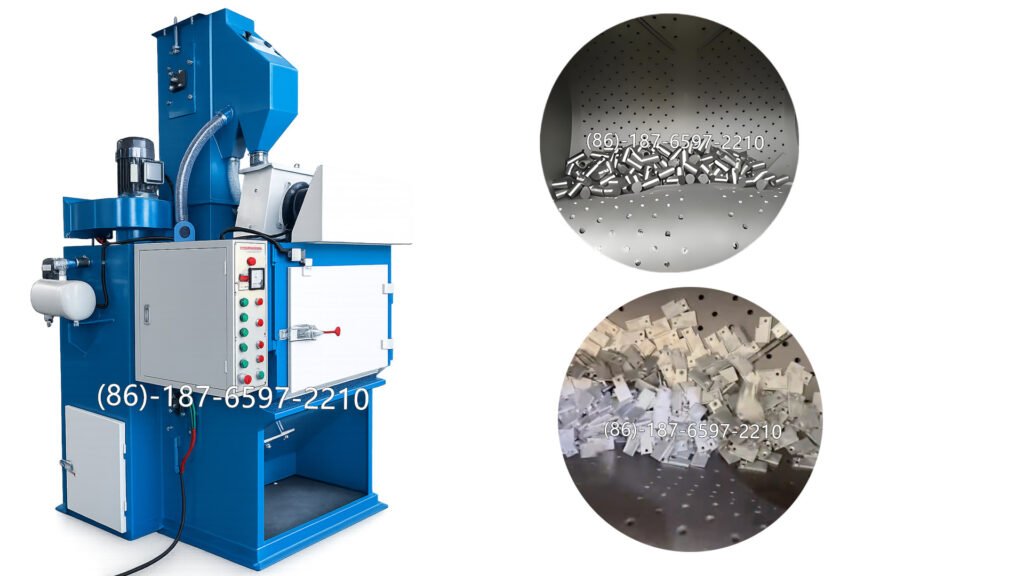
7 Key Benefits of the Q324 Crawler Shot Blasting Machine
1. Faster Batch Cleaning
The biggest advantage is productivity.
Instead of manually cleaning individual components one by one, Q324 processes a batch of parts inside the blasting chamber.
The crawler keeps rotating the workpieces so that different surfaces are repeatedly exposed to the abrasive stream.
This makes the process much faster for repetitive production.
Why it matters for factories
If operators spend several minutes manually cleaning every casting, labor costs quickly become significant.
With batch shot blasting:
Loading → Blasting → Unloading
can be standardized into a repeatable production cycle.
This makes production planning easier and reduces dependence on manual cleaning speed.
2. More Uniform Surface Cleaning
Manual cleaning quality often depends on operator skill.
One part may be thoroughly cleaned while another still contains:
- Sand residue
- Rust
- Oxide scale
- Contamination
- Difficult-to-reach deposits
The Q324 crawler creates continuous movement of the workpieces during blasting.
This helps expose different surfaces to the abrasive stream and provides more consistent batch-to-batch cleaning.
For manufacturers supplying parts for painting, coating, machining or assembly, consistent surface preparation can be especially important.
3. Lower Labor Costs
Labor is often one of the hidden costs of surface cleaning.
A manual process may require workers for:
- Grinding
- Wire brushing
- Chipping
- Part turning
- Visual inspection
- Re-cleaning
Q324 automates the main blasting operation.
Depending on the loading and unloading configuration, one operator can manage the loading, cycle monitoring and unloading process instead of manually cleaning each component.
The real cost advantage
The machine does not simply replace one worker.
It can reduce:
Cleaning labor + rework + inconsistent quality + production bottlenecks.
That is why equipment ROI should be calculated based on total operating cost rather than machine purchase price alone.
4. Rubber Crawler Reduces Part-to-Part Impact
A major advantage of crawler/tumble blasting is controlled movement of the workpieces.
The rubber belt continuously lifts and drops the components inside the chamber.
Compared with rigid steel handling surfaces, a rubber crawler can help reduce impact damage and operating noise for suitable workpieces.
This makes Q324 particularly suitable for components that require bulk cleaning but can tolerate controlled tumbling.
However, the machine should not be selected solely by workpiece size.
Before purchasing, the manufacturer should evaluate:
- Material
- Shape
- Weight
- Fragility
- Surface requirements
- Required blasting intensity
Very fragile or easily scratched components may require a different blasting configuration.
5. Automatic Abrasive Recovery Reduces Shot Consumption
A professional shot blasting machine does not simply throw abrasive at the workpiece and discard it.
Q324 uses an abrasive circulation system to recover and reuse suitable blasting media.
The basic process is:
Blast Wheel → Workpiece → Recovery → Elevator/Conveyor → Separator → Reusable Abrasive → Blast Wheel
The separator removes dust, broken abrasive and other contaminants from the reusable abrasive stream.
This improves abrasive utilization and helps protect the blast wheel and other wear components.
For high-volume production, abrasive recovery can have a significant impact on operating cost.
6. Compact Equipment for Limited Workshop Space
Not every factory has the floor space for a large continuous shot blasting line.
Q324 is designed as a relatively compact batch machine.
This makes it attractive for:
- Small foundries
- Job shops
- Forging workshops
- Heat-treatment plants
- Automotive component suppliers
- Small and medium-sized manufacturing facilities
A compact machine can also be easier to integrate into an existing production area.
Before final equipment selection, however, buyers should consider not only machine dimensions but also:
- Loading space
- Unloading space
- Dust collector location
- Maintenance clearance
- Electrical cabinet position
- Material flow
- Operator access
7. Lower Total Cost of Ownership
The cheapest shot blasting machine is not always the cheapest machine to operate.
A better purchasing calculation considers:
Purchase Cost
Initial machine investment.
Labor Cost
Operators required for loading, cleaning, unloading and inspection.
Abrasive Cost
Steel shot or grit consumption and replacement frequency.
Electricity Cost
Blast wheel, crawler, elevator, dust collector and auxiliary equipment.
Maintenance Cost
Wear liners, belts, blades, bearings, seals and other consumables.
Downtime Cost
Lost production caused by equipment failure or difficult maintenance.
The Q324 concept addresses several of these cost factors through:
- Batch automation
- Abrasive recycling
- Compact design
- Rubber crawler operation
- Replaceable wear protection
- Integrated dust collection
- Simple material handling
The final operating cost will depend on the workpiece, cycle time, abrasive, production volume and machine configuration.
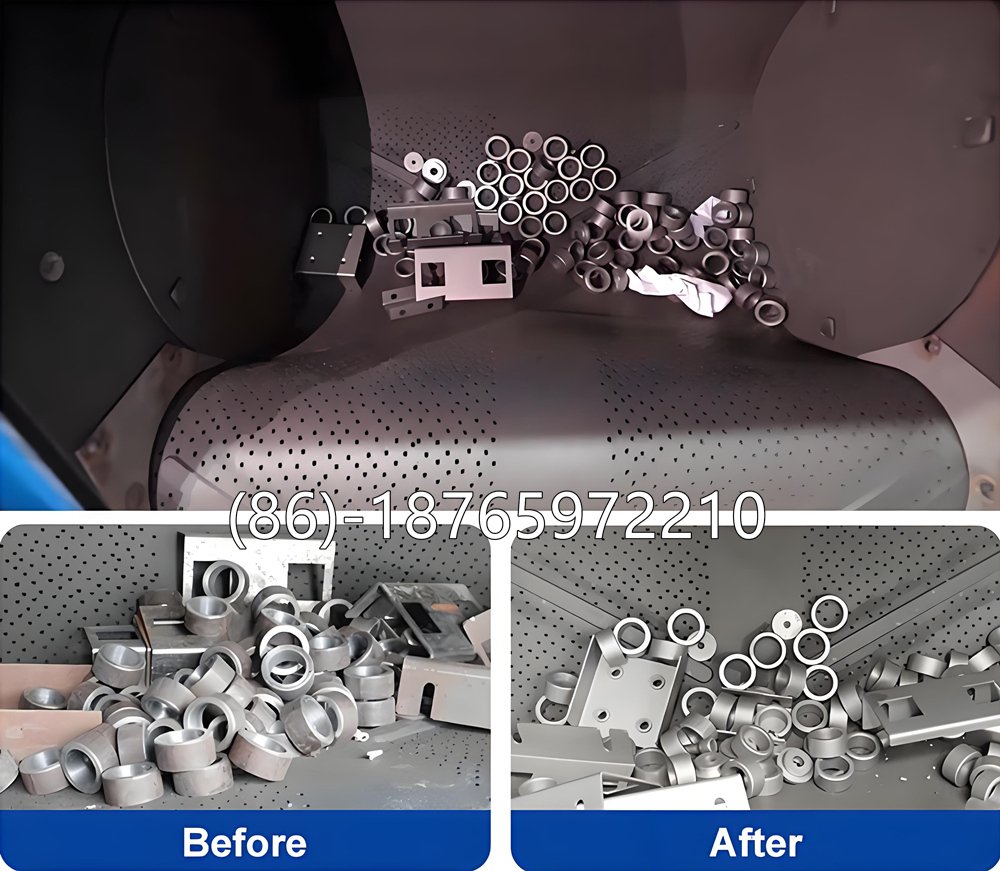
Q324 Crawler Shot Blasting Machine Working Principle
The Q324 blasting process can be divided into five main stages.
Step 1: Batch Loading
A controlled quantity of workpieces is loaded into the crawler.
The loading weight should remain within the machine’s rated capacity.
Overloading can reduce cleaning quality and increase mechanical wear.
Step 2: Crawler Tumble
The rubber crawler rotates and continuously turns the workpieces.
This movement exposes different surfaces to the blast stream.
Step 3: High-Speed Abrasive Blasting
The blast wheel accelerates abrasive particles toward the workpieces.
Depending on the selected abrasive and process parameters, the system can remove:
- Sand
- Rust
- Scale
- Oxide
- Surface contamination
Step 4: Abrasive Recovery and Separation
Used abrasive falls through the recovery system.
The separator removes unwanted contaminants and damaged abrasive particles.
Reusable abrasive returns to the blasting circuit.
Step 5: Automatic or Assisted Unloading
After the blasting cycle is complete, the crawler can reverse or use the configured unloading system to discharge the cleaned components.
This reduces manual handling and helps create a repeatable production cycle.
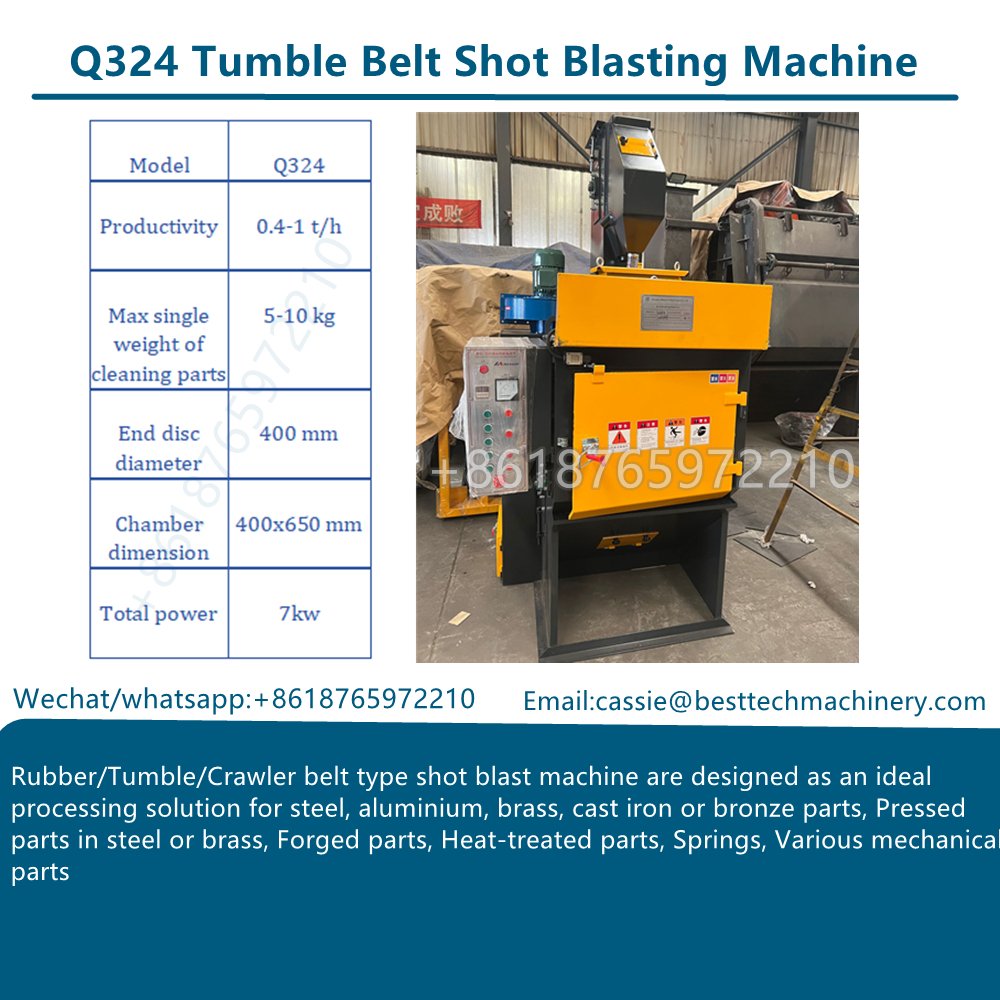
Q324 Technical Parameters
Different Q324 manufacturers may use different mechanical configurations, blast wheels and dust collection systems.
Therefore, specifications should always be confirmed against the final equipment quotation.
A representative Q324 configuration can include:
| Parameter | Typical Q324 Reference |
|---|---|
| Machine Type | Crawler / Tumble Belt Shot Blasting Machine |
| Model | Q324 |
| Crawler Type | Rubber Belt |
| End Disc Diameter | Ø400 mm |
| Max. Single Workpiece Weight | Up to approx. 5 kg |
| Batch Load | Approx. 50–100 kg |
| Productivity | Approx. 0.3–0.6 t/h |
| Abrasive Flow Rate | Approx. 40–100 kg/min |
| Blast Wheel | 1 set |
| Blast Wheel Power | Approx. 4–7 kW |
| Dust Collection Air Volume | Approx. 2,000–2,200 m³/h |
| Control | Electrical / PLC configuration optional |
| Abrasive | Steel Shot / Steel Grit |
| Application | Castings, Forgings, Stampings, Gears, Springs |
| Loading | Manual or Customized Automatic Loading |
| Unloading | Reverse Crawler / Automatic Configuration |
Published Q324 configurations vary significantly. For example, available manufacturer specifications show productivity figures ranging from approximately 200–300 kg/h to 400–600 kg/h, with different abrasive flow rates and installed power depending on machine configuration.
Important: These figures should be treated as engineering reference values, not guaranteed production performance. Actual capacity depends on workpiece size, shape, material, loading ratio, surface contamination, required cleanliness and blasting cycle.
How Much Can Q324 Process Per Hour?
This is one of the most important questions buyers ask.
The answer depends on more than the nominal machine model.
Production capacity is affected by:
- Workpiece weight
- Workpiece geometry
- Loading quantity
- Surface contamination
- Required cleaning grade
- Abrasive type
- Abrasive size
- Blast wheel power
- Blasting time
- Loading and unloading time
For example, a batch of small gears may achieve a completely different throughput from a batch of large castings even when the total batch weight is similar.
Therefore, a serious supplier should calculate capacity based on the actual workpiece, not simply quote a catalog number.
What Abrasive Should Be Used in a Q324?
The most common choices are:
Steel Shot
Steel shot has a rounded shape and is widely used for cleaning and peening applications.
It can provide effective impact cleaning while producing a different surface profile from angular grit.
Steel Grit
Steel grit has an angular geometry and is often selected when more aggressive cutting action or a particular surface profile is required.
For coating preparation, abrasive selection should be linked to the required surface condition rather than selected only by price.
ISO 11124-3:2018 specifies requirements for high-carbon cast-steel shot and grit, including hardness, density, structural characteristics and chemical composition. The standard remains current following its 2024 review.
Q324 Shot Blasting Machine and ISO Surface Preparation Standards
If Q324 is used for surface preparation before painting or coating, the machine settings should be developed around the required surface condition.
ISO 8501-1: Surface Cleanliness
ISO 8501-1:2007 defines rust grades and preparation grades for steel surfaces and uses written descriptions together with representative photographs to assess surface cleanliness.
For projects requiring blast-cleaned surfaces, buyers may specify a target such as:
- Sa 2
- Sa 2½
- Sa 3
The actual achievable grade depends on:
- Abrasive
- Blast wheel performance
- Exposure time
- Surface contamination
- Workpiece geometry
- Machine configuration
Therefore, a supplier should avoid treating a particular Sa grade as an automatic result of the machine model alone.
Surface Profile Also Matters
Cleaning is only half of surface preparation.
For painted or coated steel surfaces, the resulting surface profile can influence coating adhesion.
ISO 8503-2:2012 describes a visual and tactile comparator procedure for assessing the profile produced by abrasive blast cleaning. It applies to shot- or grit-blasted steel surfaces at Sa 2½ and Sa 3 where the specified overall blast-cleaned appearance is present.
This means your Q324 process should be designed around both:
Surface cleanliness + Surface profile
rather than cleanliness alone.
Q324 vs Manual Cleaning
| Factor | Manual Cleaning | Q324 Crawler Shot Blasting |
|---|---|---|
| Production Speed | Low to Medium | High for suitable batch parts |
| Labor Requirement | High | Lower |
| Cleaning Consistency | Operator-dependent | More repeatable |
| Batch Processing | Limited | Yes |
| Abrasive Recovery | Usually No | Yes |
| Dust Control | Difficult | Integrated system |
| Surface Coverage | Operator-dependent | Multi-surface exposure |
| Production Cost | Higher at volume | Lower potential operating cost |
| Automation | Low | Medium to High |
| Best For | Small occasional jobs | Repetitive batch production |
For low-volume production, manual cleaning may still be practical.
But once cleaning becomes a repetitive production bottleneck, Q324 becomes much more attractive.
Which Parts Are Suitable for Q324?
Q324 is particularly suitable for parts that can tolerate controlled tumbling.
Typical Workpieces
- Small castings
- Steel castings
- Iron castings
- Forgings
- Stamping parts
- Gears
- Springs
- Automotive components
- Valve parts
- Pump components
- Heat-treated components
- General hardware
Not Ideal for Every Workpiece
A Q324 should be carefully evaluated for:
- Very fragile castings
- Thin-wall parts
- Easily deformed components
- Highly polished surfaces
- Parts that cannot contact each other
- Components with strict cosmetic requirements
In these cases, a hanger, continuous conveyor, rotary table or other specialized blasting system may be more appropriate.
How Q324 Reduces Production Costs
A simple ROI model can help buyers evaluate the investment.
Before Automation
Labor + abrasive + electricity + rework + downtime
After Automation
Machine depreciation + labor + abrasive + electricity + maintenance
The investment becomes attractive when:
Annual savings > Annual equipment ownership cost
For example, if the Q324 reduces manual cleaning labor while increasing production throughput, the factory can benefit from both direct and indirect savings.
Direct Savings
- Lower labor consumption
- Lower abrasive waste
- Reduced rework
- Lower manual grinding consumption
Indirect Savings
- Higher production capacity
- More consistent surface quality
- Shorter production lead time
- Easier production scheduling
- Better worker utilization
This is why a proper ROI calculation should use your actual production data rather than generic machine prices.
5 Common Mistakes When Buying a Q324 Shot Blasting Machine
Mistake 1: Buying Only by Price
The lowest quotation may not have the lowest lifetime cost.
Check:
- Blast wheel quality
- Wear liner thickness
- Separator efficiency
- Dust collector performance
- Motor brands
- Electrical components
- Spare parts availability
Mistake 2: Ignoring Workpiece Geometry
A machine suitable for small round castings may not be suitable for long, thin or fragile parts.
Always provide actual workpiece samples or drawings.
Mistake 3: Focusing Only on Rated Capacity
A quoted “kg/h” number means little without knowing:
- What workpiece?
- What contamination?
- What cleaning grade?
- What cycle time?
- What loading ratio?
Ask the supplier to define the test conditions
Mistake 4: Choosing Abrasive Only by Price
Cheap abrasive can increase:
- Consumption
- Dust
- Broken particles
- Separator load
- Cleaning instability
- Maintenance frequency
Abrasive quality and size should be selected according to the process.
Mistake 5: Forgetting Dust Collection
Shot blasting creates dust and fine abrasive particles.
An appropriate dust collection system is essential for maintaining process performance and workshop conditions.
The dust collector should be evaluated according to:
- Air volume
- Filter area
- Filtration method
- Dust loading
- Cleaning method
- Discharge system
How to Select the Right Q324 Configuration
Before requesting a quotation, prepare the following information.
Workpiece Information
- Material
- Maximum length
- Maximum width
- Maximum height
- Average size
- Maximum weight per piece
- Minimum weight per piece
- Workpiece shape
- Fragility
Production Information
- Required tons/hour
- Required pieces/hour
- Working hours/day
- Working days/month
- Current cleaning method
Surface Requirement
- Current rust/scale/sand condition
- Required cleanliness
- Required surface profile
- Painting/coating requirement
- Required Sa grade if applicable
Factory Information
- Available floor space
- Power supply
- Workshop height
- Loading method
- Unloading method
- Dust emission requirements
The more complete the information, the more accurately the supplier can design the blasting system.
What Should Be Included in a Q324 Supplier Quotation?
A professional quotation should clearly state:
Machine Configuration
- Model
- Blast wheel quantity
- Blast wheel power
- Crawler dimensions
- Maximum batch load
- Maximum workpiece weight
Abrasive System
- Abrasive flow rate
- Elevator
- Separator
- Screw conveyor
- Abrasive storage
Dust Collection
- Dust collector type
- Air volume
- Filter configuration
- Fan power
Electrical System
- PLC
- HMI
- VFD
- Motor brands
- Control voltage
- Main power requirement
Wear Parts
- Chamber liners
- Crawler
- Blast wheel blades
- Bearings
- Seals
- Other consumables
Service
- Installation
- Commissioning
- Operator training
- Spare parts
- Warranty
- Remote technical support
This information allows buyers to compare suppliers on total value, not simply machine price.
Q324 Crawler Shot Blasting Machine Customization Options
Although Q324 is a standard machine model, the configuration can be adapted to production requirements.
Possible options include:
- Automatic loading system
- Automatic unloading system
- Customized crawler
- Different rubber belt specifications
- Different blast wheel power
- PLC + HMI control
- VFD speed control
- Automatic abrasive replenishment
- Enhanced dust collector
- Different separator configuration
- Customized workpiece handling
- Safety interlock system
- Remote monitoring
- Production-line integration
For automated factories, Q324 can also be considered as one module within a larger surface-treatment production line.
CE Compliance and Export Requirements
For European-market machinery, CE compliance should be treated as a conformity process rather than simply a marketing label.
EU Machinery Regulation (EU) 2023/1230 establishes requirements for machinery placed on the EU market and specifies requirements concerning CE marking and the EU declaration of conformity. The regulation states that applicable machinery must bear the CE marking and that the manufacturer must prepare the EU declaration of conformity in accordance with the applicable requirements.
Therefore, when purchasing a Q324 for export, ask the supplier for:
- EU Declaration of Conformity
- Technical documentation applicable to the machine
- Risk assessment information
- Safety-related documentation
- Electrical documentation
- Operating manual
- CE marking information
Do not evaluate “CE certified” as a standalone purchasing criterion. Verify what conformity documentation is actually included with the machine.
Q324 Maintenance: Where Operating Cost Is Won or Lost
The Q324 is relatively simple compared with a large automated blasting line, but maintenance still directly affects profitability.
Daily Checks
Inspect:
- Crawler condition
- Abrasive leakage
- Dust collector
- Abnormal noise
- Bearings
- Blast wheel operation
- Separator condition
Regular Checks
Inspect:
- Blast wheel blades
- Wear liners
- Elevator belt
- Screw conveyor
- Bearings
- Seals
- Electrical components
- Dust filter condition
Keep the Abrasive System Clean
A dirty abrasive circulation system can cause:
- Reduced blasting efficiency
- Excessive dust
- Higher abrasive consumption
- Premature wear
- Poor surface consistency
Proper maintenance is therefore not simply about protecting the machine.
It directly protects production efficiency and operating cost.
Who Should Buy a Q324 Crawler Shot Blasting Machine?
Q324 is a strong candidate when your factory has:
✓ Small and medium-sized metal parts
✓ Repetitive batch cleaning requirements
✓ High manual cleaning labor costs
✓ Sand, rust or oxide scale problems
✓ Limited workshop space
✓ Need for consistent surface preparation
✓ Requirement for abrasive recycling
✓ Production volumes that justify automation
If your parts are very large, very fragile or require individual handling, another blasting machine configuration may be more suitable.
Q324 Crawler Shot Blasting Machine FAQ
What is a Q324 shot blasting machine used for?
Q324 is mainly used for batch cleaning of small castings, forgings, stamping parts, gears, springs and other metal components. Typical applications include sand removal, rust removal, oxide-scale removal and surface cleaning.
What is the maximum workpiece weight?
Many Q324 configurations are designed for workpieces up to approximately 5 kg each, but the actual specification should be confirmed with the supplier based on the machine configuration and workpiece geometry.
How much can a Q324 process per hour?
Typical published specifications vary, with representative capacities around 0.2–0.6 t/h depending on configuration and workpiece conditions. Actual production capacity should be confirmed through a process test.
Can Q324 remove casting sand?
Yes. Q324 is commonly used for removing residual foundry sand from suitable castings.
Can Q324 remove rust?
Yes. Steel shot or steel grit can be used to remove rust and surface oxidation from suitable metal components.
Can Q324 achieve Sa 2.5?
A Q324 can be configured for demanding blast-cleaning applications, but Sa 2½ should not be treated as an automatic result of the machine model. The actual result depends on abrasive, surface condition, blasting intensity, exposure time, workpiece geometry and process parameters.
ISO 8501-1 provides the visual preparation-grade framework, while ISO 8503-2 provides a comparator-based method for assessing blast-cleaned surface profile at Sa 2½ and Sa 3 under its stated scope.
Is Q324 suitable for fragile parts?
Not necessarily. The crawler process causes parts to contact and tumble against one another. Fragile, thin-wall or cosmetic components may require a hanger or another individual-handling blasting solution.
Does Q324 recycle abrasive?
Yes. A typical configuration includes abrasive recovery, separation and recirculation so that reusable abrasive can return to the blast wheel.
How many workers are required?
The required manpower depends on loading, unloading and automation. A manually loaded machine may require an operator for batch handling, while automatic loading/unloading can reduce direct labor requirements.
Q324 Crawler Shot Blasting Machine Buying Checklist
Before placing an order, confirm these 12 points:
- Workpiece dimensions
- Maximum piece weight
- Batch loading weight
- Required production capacity
- Surface contamination
- Required cleaning grade
- Abrasive type and size
- Blast wheel power
- Dust collector capacity
- Automatic loading/unloading
- Spare parts and wear protection
- CE/export documentation if required
If these items are clearly defined, comparing different suppliers becomes much easier.
Final Verdict: Why Choose Q324?
The Q324 Crawler Shot Blasting Machine is not designed to be the biggest blasting machine in the workshop.
Its value comes from being compact, practical and production-oriented.
For factories processing small and medium-sized metal components, the biggest advantages are:
✓ Faster batch cleaning
✓ More consistent surface treatment
✓ Lower manual labor requirements
✓ Efficient abrasive recycling
✓ Compact workshop footprint
✓ Lower potential operating cost
✓ Easy integration into repetitive production
The key is selecting the machine according to the actual workpiece and production target, rather than simply buying a machine based on the Q324 model number.
Get a Q324 Shot Blasting Machine Recommendation for Your Parts
Looking for a Q324 Crawler Shot Blasting Machine manufacturer or supplier?
Send us your:
Workpiece photos/drawings + dimensions + maximum weight + required capacity + current surface condition + required cleaning grade.
Our engineers can evaluate whether Q324 is suitable and recommend the appropriate:
- Blast wheel configuration
- Crawler capacity
- Abrasive system
- Dust collector
- Loading/unloading method
- Automation level
- Wear protection
- Electrical control system
Get Your Customized Q324 Shot Blasting Solution
Send your workpiece details today and request a technical proposal + machine quotation.