
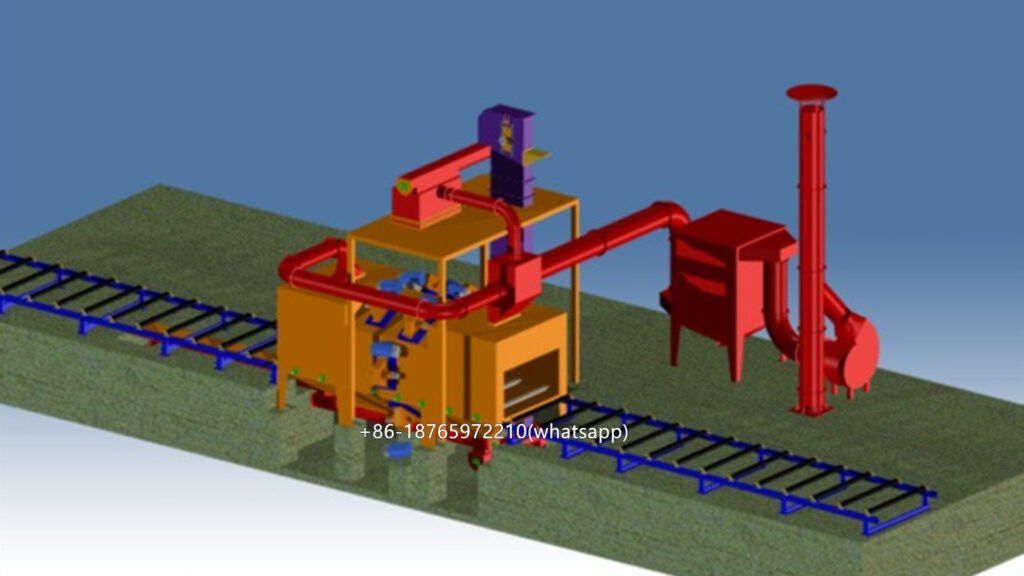
Why Choose a Roller Conveyor Shot Blasting Machine for Steel Plate & Structural Steel?
Steel plate and structural steel are easy to manufacture.
The difficult part is preparing their surfaces consistently before painting, coating, fabrication or corrosion protection.
Mill scale, rust, oxide, welding spatter and other contaminants can reduce coating performance if they are not properly removed.
Manual grinding may work for a small workshop.
But when production reaches hundreds of square meters—or hundreds of structural steel components per day—the limitations become obvious:
Too much labor. Too much variation. Too much downtime.
This is where a Roller Conveyor Shot Blasting Machine becomes a production tool rather than simply a cleaning machine.
By combining automatic conveying, high-speed abrasive blasting, abrasive recovery and dust collection, the system can continuously process steel plates, beams, profiles and fabricated structures with controlled surface preparation.
The real advantage is not simply “faster rust removal.”
It is:
Continuous Production + Repeatable Surface Quality + Lower Labor Cost + Better Coating Preparation.
What Is a Roller Conveyor Shot Blasting Machine?
Roller Conveyor Shot Blasting Machine is a continuous blast-cleaning system designed to transport workpieces through a blasting chamber on powered rollers.
As the steel workpiece passes through the machine, multiple blast wheels throw abrasive at high velocity onto the surface.
The system typically includes:
- Powered roller conveyor
- Blast wheels
- Blasting chamber
- Wear-resistant liners
- Abrasive recovery system
- Bucket elevator
- Abrasive separator
- Dust collector
- Control cabinet
- Safety system
The conveyor speed can be adjusted according to the material, surface condition and required blasting result.
This makes the machine particularly suitable for continuous steel surface preparation.
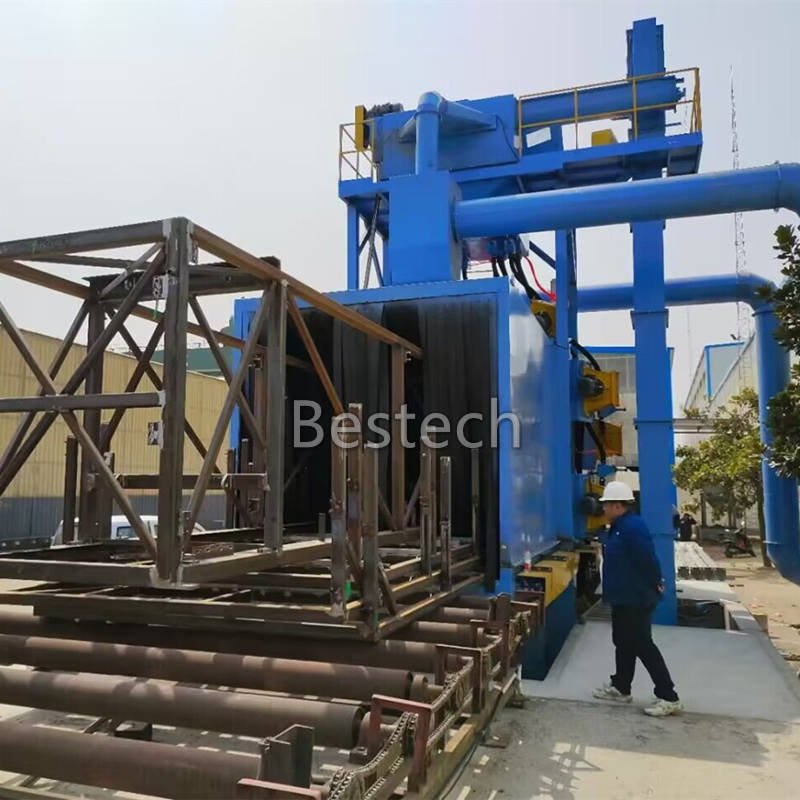
Why Roller Conveyor Blasting Is Better for Large Steel Production
The biggest difference between a conventional batch machine and a roller conveyor system is the production method.
Batch Blasting
Load
↓
Blast
↓
Stop
↓
Unload
↓
Reload
Every cycle requires handling time.
Continuous Roller Blasting
Loading
↓
Continuous Conveyor
↓
Blasting
↓
Abrasive Recovery
↓
Dust Collection
↓
Discharge
The workpiece keeps moving.
That means less non-productive handling time and a much easier path toward automated production.
7 Reasons to Choose a Roller Conveyor Shot Blasting Machine
1. Continuous Production
For steel service centers, fabrication plants and coating lines, continuous production is one of the biggest advantages.
Steel plates can enter the machine one after another without waiting for a complete batch cycle.
This is especially valuable when the blasting machine is connected to:
- Steel plate production
- CNC cutting
- Welding
- Painting
- Shot blasting
- Automatic coating
The blasting machine becomes part of the production line.
2. Excellent Surface Cleaning Efficiency
High-speed abrasive impact can effectively remove:
- Mill scale
- Rust
- Oxide
- Welding spatter
- Loose coating
- Surface contamination
The actual cleaning result depends on:
Abrasive type + abrasive flow + blast wheel power + conveyor speed + initial surface condition.
This is why simply increasing blast wheel power is not always the correct solution.
The entire blasting process must be balanced.
3. Consistent Surface Preparation
Manual grinding depends heavily on the operator.
Two workers may produce different results on the same steel plate.
An automatic roller conveyor system provides much better process repeatability because:
- Conveyor speed is controlled
- Abrasive flow can be regulated
- Blast wheel position is fixed
- Blasting coverage is predictable
- Production parameters can be recorded
For coating plants, this consistency is extremely important.
4. Better Coating Adhesion
Surface preparation is not just about making steel “look clean.”
The objective is to create a surface suitable for the next process.
After abrasive blasting, the steel surface contains a controlled roughened profile that can improve mechanical bonding with protective coating systems.
ISO 8501-1 defines visual preparation grades for steel substrates, including blast-cleaning grades such as Sa 2, Sa 2½ and Sa 3.
The required cleanliness level should always be determined by the coating system and project specification.
5. Lower Labor Requirements
Manual surface preparation can require a large workforce.
A continuous shot blasting line can significantly reduce the number of workers needed for repetitive cleaning operations.
Operators mainly handle:
- Loading
- Monitoring
- Inspection
- Maintenance
- Process adjustment
This allows the factory to move from labor-intensive cleaning toward automated surface preparation.
6. Automatic Abrasive Recycling
A roller conveyor shot blasting machine does not simply throw abrasive away.
The system normally collects the abrasive after blasting and returns reusable particles to the blast wheels.
A typical recycling process is:
Blasting
↓
Abrasive Collection
↓
Screw Conveyor
↓
Bucket Elevator
↓
Air-Wash Separator
↓
Reusable Abrasive
↓
Blast Wheel
Dust and broken particles are removed from the usable abrasive stream.
For metallic blast-cleaning abrasives, ISO 11124 provides requirements and classification for metallic abrasives. ISO 11124-3 specifically covers high-carbon cast-steel shot and grit.
7. Easy Integration into a Steel Production Line
A roller conveyor design is naturally suited to automation.
It can be connected with:
- Plate loading systems
- CNC cutting machines
- Welding lines
- Straightening machines
- Painting lines
- Drying chambers
- Shot blasting machines
- Roller conveyors
- Automatic transfer systems
For large fabrication plants, this can turn individual machines into a coordinated production system.
What Materials Can Be Processed?
A properly designed roller conveyor machine can process many types of steel products.
Steel Plate
Common applications:
- Shipbuilding
- Pressure vessels
- Steel fabrication
- Machinery manufacturing
- Structural components
H-Beams
Suitable for:
- Structural steel
- Industrial buildings
- Bridges
- Heavy fabrication
I-Beams
Used in:
- Construction
- Steel structures
- Infrastructure
Channels
Suitable for continuous surface preparation before painting.
Angle Steel
Can be processed depending on dimensions and machine configuration.
Welded Structures
Special roller arrangements can be designed for fabricated steel structures.

Typical Technical Parameters
The following values are reference ranges only. Final specifications should be calculated according to the customer’s workpiece dimensions, production capacity and surface preparation requirements.
| Parameter | Typical Range / Configuration |
|---|---|
| Machine Type | Roller Conveyor Shot Blasting Machine |
| Workpiece | Steel Plate / H-Beam / I-Beam / Structural Steel |
| Workpiece Width | Approx. 500–3500 mm |
| Workpiece Height | Approx. 50–1000 mm |
| Workpiece Length | Continuous / Customized |
| Blast Wheels | 4–12 units |
| Blast Wheel Power | Approx. 11–30 kW each |
| Abrasive Flow | Approx. 150–300 kg/min per wheel |
| Conveyor Speed | Approx. 0.5–5 m/min |
| Abrasive | Steel Shot / Steel Grit |
| Surface Cleanliness | Sa 2 / Sa 2½ / Sa 3, according to process |
| Dust Collector | Pulse Jet Bag Filter |
| Control System | PLC + Touch Screen |
| Conveyor | Heavy-Duty Powered Rollers |
| Abrasive Recycling | Automatic |
| Machine Layout | Customized |
Note: These are engineering reference values rather than guaranteed performance specifications. Actual parameters depend on plate thickness, steel grade, initial surface condition, required cleanliness, surface profile and production capacity.
Sa 2½ vs. Sa 3: Which Should You Choose?
For industrial steel surface preparation, buyers often ask for:
Sa 2½
or
Sa 3
But the difference matters.
| Requirement | General Meaning |
| Sa 2 | Thorough Blast Cleaning |
| Sa 2½ | Very Thorough / Near-White Blast Cleaning |
| Sa 3 | Blast Cleaning to Visually Clean Steel |
ISO 8501-1 provides the visual preparation grades used for evaluating blast-cleaned steel substrates.
For Most Coating Applications
Sa 2½ is often selected when a high level of surface cleanliness is required.
For More Demanding Applications
Sa 3 may be specified where the project requires the highest visual cleanliness grade.
However:
Do not choose Sa 3 simply because it sounds “better.”
The required grade should come from the coating specification, corrosion-protection system and project requirements.
Surface Profile: The Parameter Buyers Often Forget
A clean surface does not automatically mean a good coating surface.
Abrasive blasting creates a surface profile.
ISO 8503-2 provides a comparator method for grading the surface profile of abrasive blast-cleaned steel surfaces and includes application to surfaces prepared to Sa 2½ and Sa 3.0
A coating specification may require a particular profile range, for example:
40–75 μm
But this is not a universal setting.
The correct profile depends on:
- Coating type
- Coating thickness
- Primer system
- Corrosion category
- Project specification
For this reason, a professional machine supplier should ask about your coating system, not only your steel plate size.
What Happens If the Machine Is Undersized?
This is where cheap quotations can become expensive.
An undersized machine may cause:
Low Production Speed
The conveyor must run too slowly.
Incomplete Cleaning
Mill scale or rust may remain.
Uneven Surface Profile
Some areas receive insufficient abrasive impact.
High Rework Rate
Operators must manually reblast the workpiece.
Higher Abrasive Consumption
Poor process matching can increase operating cost.
Production Bottleneck
The blasting machine becomes slower than the upstream cutting or fabrication line.
The correct machine should therefore be selected based on production capacity, not only workpiece dimensions.
How to Calculate the Right Machine Capacity
Before buying, determine:
Required production = Workpiece area or weight per hour
For example, if your plant processes:
20 tons of structural steel per shift
the machine should be selected around the actual throughput requirement, taking into account:
- Workpiece dimensions
- Steel thickness
- Surface condition
- Conveyor speed
- Required cleanliness
- Number of blast wheels
- Loading/unloading time
For steel plate applications, m²/h can be a useful production metric.
For structural steel, tons/h may be more meaningful.
A professional supplier should provide a capacity calculation based on your actual material.
Roller Conveyor Shot Blasting vs. Other Shot Blasting Machines
| Machine Type | Best Application |
| Roller Conveyor | Steel Plate & Structural Steel |
| Hanger Type | Castings & Complex Components |
| Tumble Belt | Small/Medium Batch Components |
| Turntable | Medium Components |
| Wire Mesh Belt | Smaller Continuous Components |
| Pipe Blasting | Internal/External Pipe Surface |
| Floor Shot Blaster | Large Flat Floor Surfaces |
If your main products are steel plate, H-beams, I-beams, channels and structural steel, the roller conveyor configuration is usually the logical starting point.
Key Components of a Reliable Roller Conveyor Shot Blasting Machine
High-Efficiency Blast Wheels
The blast wheel determines how effectively abrasive is accelerated and distributed.
Key factors include:
- Wheel diameter
- Motor power
- Abrasive flow
- Throwing direction
- Wear resistance
Wear-Resistant Chamber
The blasting chamber receives continuous abrasive impact.
Critical areas should use suitable wear-resistant liners to reduce maintenance frequency.
Heavy-Duty Roller Conveyor
Structural steel can be extremely heavy.
The conveyor must be designed according to:
- Maximum workpiece weight
- Workpiece width
- Workpiece thickness
- Support spacing
- Conveyor speed
Abrasive Separator
The separator removes:
- Dust
- Broken abrasive
- Fine particles
while returning usable abrasive to the blasting system.
Dust Collector
A correctly sized dust collector is essential for:
- Dust control
- Visibility
- Equipment protection
- Workshop cleanliness
- Environmental compliance
Complete Steel Plate Surface Preparation Line
For high-volume production, a typical process can be:
Steel Plate Loading
        ↓
Roller Conveyor
        ↓
Shot Blasting
        ↓
Abrasive Recovery
        ↓
Dust Separation
        ↓
Steel Plate Cleaning
        ↓
Automatic Inspection
        ↓
Primer Painting
        ↓
Drying
        ↓
Fabrication / Cutting
For structural steel:
Steel Profile Loading
        ↓
Roller Conveyor
        ↓
Shot Blasting
        ↓
Dust Removal
        ↓
Inspection
        ↓
Primer Coating
        ↓
Drying
        ↓
Fabrication
This is where a roller conveyor shot blasting machine delivers the greatest value.
It becomes a production-line machine, not an isolated cleaning unit.

Common Applications
Shipbuilding
Steel plates require controlled surface preparation before protective coating.
Bridge Construction
Structural steel components need reliable corrosion protection.
Steel Structure Fabrication
H-beams, I-beams and other profiles can be continuously prepared before painting.
Heavy Machinery
Steel components can be cleaned before coating and assembly.
Pressure Vessel Manufacturing
Surface preparation can be integrated before coating or further fabrication.
Wind Tower Manufacturing
Large steel sections require consistent surface preparation before protective coating.
Oil & Gas Equipment
Steel structures and fabricated components often require high-quality surface preparation.
How to Choose the Right Roller Conveyor Shot Blasting Machine
Before requesting a quotation, prepare these specifications.
Workpiece Information
Minimum width: ___ mm
Maximum width: ___ mm
Minimum thickness: ___ mm
Maximum thickness: ___ mm
Maximum length: ___ mm
Maximum weight: ___ tons
Production Information
Required capacity: ___ tons/hour
or
Required capacity: ___ m²/hour
Surface Requirement
Initial condition: Rust / Mill Scale / Welded / Painted
Required cleanliness: Sa 2 / Sa 2½ / Sa 3
Required surface profile: ___ μm
Coating Information
Coating type: ___
Primer: ___
Factory Information
Power supply: ___ V / ___ Hz
Workshop space: ___ m × ___ m
Material handling method: Crane / Roller / Forklift / Automatic
This information allows the manufacturer to recommend a machine based on production reality instead of simply sending a standard catalog.
Buyer Checklist
Before purchasing, ask your supplier:
✔ What is the maximum workpiece weight?
✔ What is the maximum plate width?
✔ What is the actual blasting capacity in m²/h or tons/h?
✔ How many blast wheels are installed?
✔ What is the power of each blast wheel?
✔ What abrasive flow rate is available?
✔ What surface cleanliness can be achieved?
✔ How is surface profile controlled?
✔ What type of dust collector is included?
✔ How is abrasive recycled?
✔ What wear-resistant material is used inside the chamber?
✔ What spare parts are recommended?
✔ Can the machine be integrated with a painting line?
✔ Can you perform a factory test using our steel samples?
✔ Can you provide layout drawings before production?
These questions are far more useful than asking only:
“What is the machine price?”
Why Factory Testing Matters
For industrial shot blasting equipment, factory testing can reveal problems before shipment.
A professional FAT—Factory Acceptance Test—can verify:
- Conveyor operation
- Blast wheel rotation
- Abrasive circulation
- Dust collector operation
- PLC functions
- Safety interlocks
- Surface cleaning performance
- Production parameters
For buyers with strict surface requirements, sending actual steel samples for testing is even better.
The supplier can then evaluate:
Actual Steel → Actual Rust/Mill Scale → Actual Abrasive → Actual Blasting Parameters
This produces a much more meaningful machine proposal.
FAQ
What is a roller conveyor shot blasting machine used for?
It is mainly used for continuous surface preparation of steel plates, H-beams, I-beams, channels, structural steel and other long or flat steel products.
Can it remove mill scale from steel plate?
Yes. Abrasive blasting can remove mill scale when the machine is correctly configured for the material condition and required cleaning grade.
Can it achieve Sa 2½?
Yes. A properly designed and operated blasting process can achieve Sa 2½ requirements. Actual performance depends on abrasive, blasting parameters, initial surface condition and conveyor speed.
What abrasive is normally used?
Steel shot and steel grit are common metallic abrasives. Selection should be based on the required surface profile, cleaning performance and coating specification.
Can the machine process H-beams?
Yes. Roller conveyor shot blasting systems can be configured for H-beams, I-beams and other structural profiles within the specified dimensional and weight range.
What is the difference between shot and grit?
Steel shot is generally spherical, while steel grit is angular. Their different shapes influence cleaning behavior and surface profile.
Can the machine be connected to a painting line?
Yes. Roller conveyor shot blasting machines are particularly suitable for integration with automatic primer and painting lines.
How much does a roller conveyor shot blasting machine cost?
The price depends heavily on:
- Workpiece dimensions
- Blast wheel quantity
- Motor power
- Conveyor length
- Production capacity
- Dust collector
- Automation level
- Abrasive recycling configuration
Therefore, an accurate quotation requires your workpiece and production data.
Factory Direct Solution
For a steel fabrication company, buying a shot blasting machine should not start with:
“How much is it?”
It should start with:
“What do we need to process every hour?”
Then work backward:
Production Capacity
↓
Workpiece Dimensions
↓
Blasting Configuration
↓
Abrasive Flow
↓
Conveyor Speed
↓
Dust Collection
↓
Surface Cleanliness
↓
Coating Requirement
↓
Complete Machine Configuration
This engineering-first approach helps prevent both over-investment and under-capacity.
Get a Customized Roller Conveyor Shot Blasting Solution
Looking for a Roller Conveyor Shot Blasting Machine for steel plate or structural steel surface preparation?
Send us your material specifications and production target.
Please provide:
Workpiece: Steel Plate / H-Beam / I-Beam / Channel / Structure
Width: ___ mm
Thickness: ___ mm
Length: ___ mm
Maximum Weight: ___ tons
Production Capacity: ___ tons/hour or ___ m²/hour
Initial Surface: Rust / Mill Scale / Welded / Painted
Required Cleanliness: Sa 2 / Sa 2½ / Sa 3
Surface Profile: ___ μm
Coating: ___
Power Supply: ___ V / ___ Hz
Destination: ___
Based on your data, a customized proposal can include:
- Roller conveyor shot blasting machine
- Blast wheel configuration
- Conveyor system
- Abrasive recycling system
- Dust collector
- PLC control system
- Safety system
- Layout drawing
- Production capacity calculation
- Factory testing
- Installation guidance
- Spare parts recommendation
Send Your Steel Size & Production Target → Get a Customized Quote
Don’t choose a blasting machine by motor power alone. Choose it by production capacity, surface requirement and total operating cost.