
Introduction: How Can a Compact Floor Shot Blasting Machine Reduce Surface Preparation Costs?
Removing rust, mill scale, old coatings, and weak surface materials is a necessary step before painting, protective coating, or other surface treatment. For steel fabrication plants, industrial flooring contractors, maintenance companies, and equipment manufacturers, the challenge is to achieve the required surface condition without spending too much on labor, abrasive, energy, and equipment maintenance.
A cost-effective compact floor shot blasting machine provides a mechanical solution for preparing accessible horizontal surfaces. Using a high-speed centrifugal wheel, the machine projects steel abrasive onto the work surface, removes suitable contaminants, and collects reusable abrasive through a recovery system.
Depending on the machine configuration, floor shot blasting equipment can be used for concrete floors and selected flat steel plate applications. Compact machines are especially useful where equipment mobility, limited installation space, and straightforward operation are important.
However, concrete and steel plate preparation are not the same application. Concrete preparation focuses on substrate soundness, coating removal, and the required concrete surface profile. Steel plate preparation focuses on rust, mill scale, surface cleanliness, and the requirements of the subsequent coating system.
The most cost-effective solution is therefore not simply the machine with the lowest purchase price. It is the configuration that achieves the required surface quality at an acceptable cost per square meter.
This guide explains the working principle, technical parameters, surface preparation standards, operating costs, and equipment selection criteria for compact floor shot blasting machines.
1. What Is a Compact Floor Shot Blasting Machine?
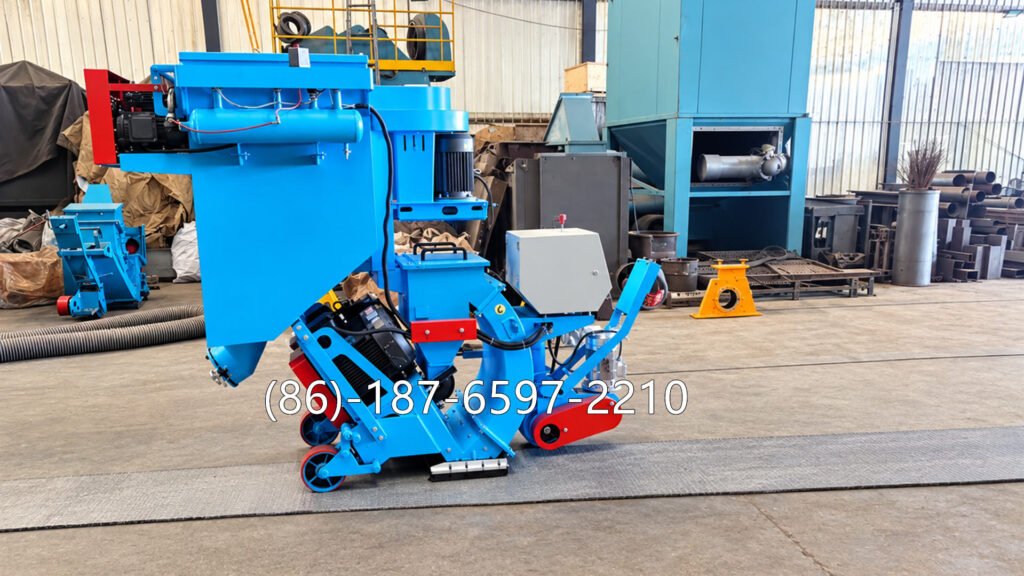
Compact floor shot blasting machine is a mechanical surface preparation unit designed to propel steel abrasive onto a horizontal work surface using a centrifugal blasting wheel.
A typical machine includes:
- One or more centrifugal blasting wheels
- Abrasive feeding and flow control components
- A blasting chamber with wear-resistant liners
- An abrasive recovery and separation system
- A dust collection system
- A mobile chassis or travel mechanism
- An electrical control system
During operation, the blasting wheel accelerates steel shot and projects it onto the surface. The impact removes suitable contaminants and prepares the substrate for the next process.
The abrasive and removed material are then collected. Usable steel shot is separated from dust and debris and returned to the blasting wheel.
This closed-circuit process reduces the need to replace abrasive after every pass and helps control loose shot around the machine.
A compact floor shot blaster is particularly useful for:
- Concrete floors in factories and warehouses
- Industrial floors requiring coating removal
- Horizontal steel plates suitable for the machine’s working configuration
- Maintenance projects requiring mobile surface preparation equipment
- Sites where a large stationary blasting line is not practical
Important: Not every floor shot blaster is suitable for both concrete and steel plate. Confirm the machine’s approved applications, abrasive specification, working width, and operating parameters before selecting a dual-purpose configuration.
2. How Does a Compact Floor Shot Blasting Machine Improve Cost Efficiency?
2.1 Reduces Manual Surface Preparation Work
Manual grinding, scraping, and brushing can require considerable labor when treating large floor areas or repeated batches of steel plate.
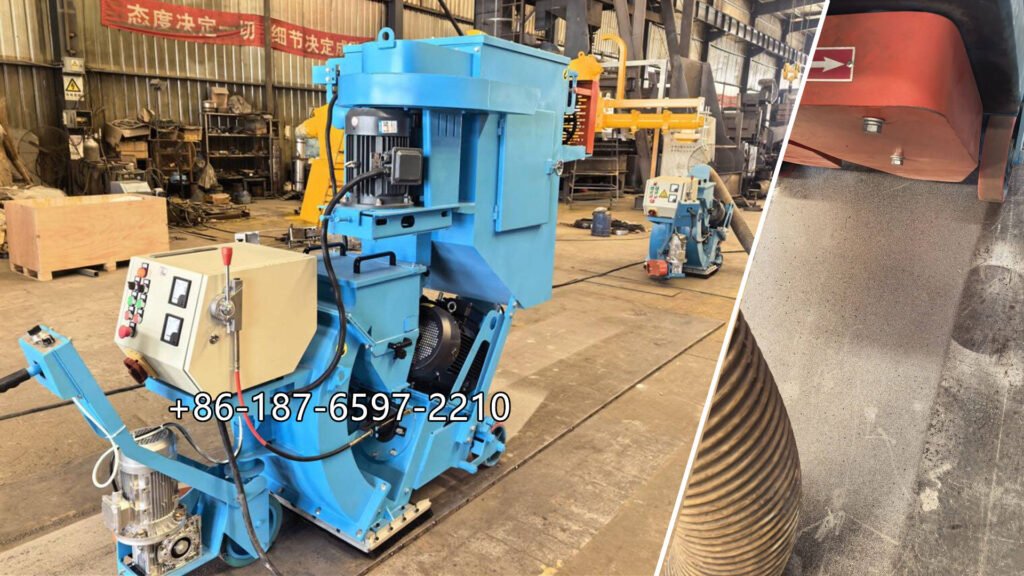
A compact shot blasting machine mechanizes the impact cleaning process. The operator guides the equipment across the work surface while the blasting wheel performs the main cleaning operation.
For suitable applications, this can reduce manual preparation time and make the cleaning procedure more consistent.
Actual labor savings depend on the existing preparation method, surface condition, required finish, and the amount of edge treatment or additional work still required.
2.2 Uses Recyclable Steel Abrasive
Abrasive consumption is an important part of the operating cost.
In a closed-circuit shot blasting system, reusable steel shot is recovered and returned to the wheel. The separator removes dust, broken abrasive, and other unwanted material.
This helps reduce abrasive waste compared with processes that consume and discard abrasive after a single pass.
To maintain recovery efficiency, operators should regularly inspect:
- Abrasive leakage around the blasting chamber
- Separator performance
- Steel shot size and condition
- Dust extraction and filter condition
- Abrasive return passages
Poor separation or excessive shot leakage can increase consumption and reduce cleaning consistency.
2.3 Provides a Repeatable Surface Preparation Process
Surface preparation must produce a result that meets the requirements of the next process.
For steel plates, this may involve rust and mill-scale removal before protective coating. For concrete floors, it may involve removing old coatings, weak laitance, and contaminants while creating the specified surface profile.
A properly configured machine can repeat the same operating procedure across multiple work areas or production batches.
The operator must still control travel speed, abrasive flow, wheel condition, and overlap. Consistency comes from the complete process, not the machine alone.
2.4 Reduces the Need for Large Fixed Installations
A compact mobile machine can be useful when surface preparation takes place at different locations or when workshop space is limited.
Compared with installing a large stationary blasting line, a mobile unit may reduce installation and material-handling requirements for suitable projects.
However, compact equipment may have a lower effective working width or production capacity. For continuous high-volume steel plate processing, a roller conveyor shot blasting machine may provide better overall productivity.
The correct comparison should include machine price, installation cost, handling time, output, and maintenance requirements.
2.5 Lowers Total Cost per Square Meter
The practical operating cost can be estimated using the following formula:
Cost per m² = Total preparation cost ÷ Accepted prepared area
Total preparation cost should include labor, electricity, abrasive replacement, wear parts, maintenance, dust collection, waste disposal, and any additional finishing operations.
For example, if a project costs $1,200 to prepare 1,000 m² of accepted surface, the preparation cost is $1.20/m². This is an illustrative calculation, not a machine performance claim.
When comparing machines, use the same surface condition, acceptance criteria, and production scope. A machine with a lower purchase price may become more expensive if it requires more passes or frequent maintenance.
3. Steel Plate vs. Concrete: Which Surface Can Be Prepared?
Although both applications can use centrifugal shot blasting, the abrasive impact and acceptance requirements must be matched to the substrate.
3.1 Steel Plate Surface Preparation
<AsyncImage query=”compact floor shot blasting machine cleaning flat steel plate surface in industrial workshop” aspectRatio=”16:9″ width=”100%”/>
For steel plate, the main objectives may include removing rust, mill scale, and old coatings before applying a protective coating or paint.
Important operating factors include:
- Initial rust and mill-scale condition
- Steel plate thickness and flatness
- Required surface cleanliness grade
- Required surface profile
- Steel abrasive size and condition
- Machine travel speed and abrasive flow
A compact floor shot blaster may be suitable for accessible horizontal plates when its sealing, abrasive containment, and recovery arrangements are designed for the application.
For thin sheets, irregular plate surfaces, or large continuous production volumes, confirm that the process will not cause unacceptable distortion or inconsistent cleaning.
For high-volume steel plate production, a roller conveyor shot blasting machine may be a more appropriate option.
3.2 Concrete Floor Surface Preparation
<AsyncImage query=”compact concrete floor shot blasting machine preparing industrial warehouse floor before epoxy coating” aspectRatio=”16:9″ width=”100%”/>
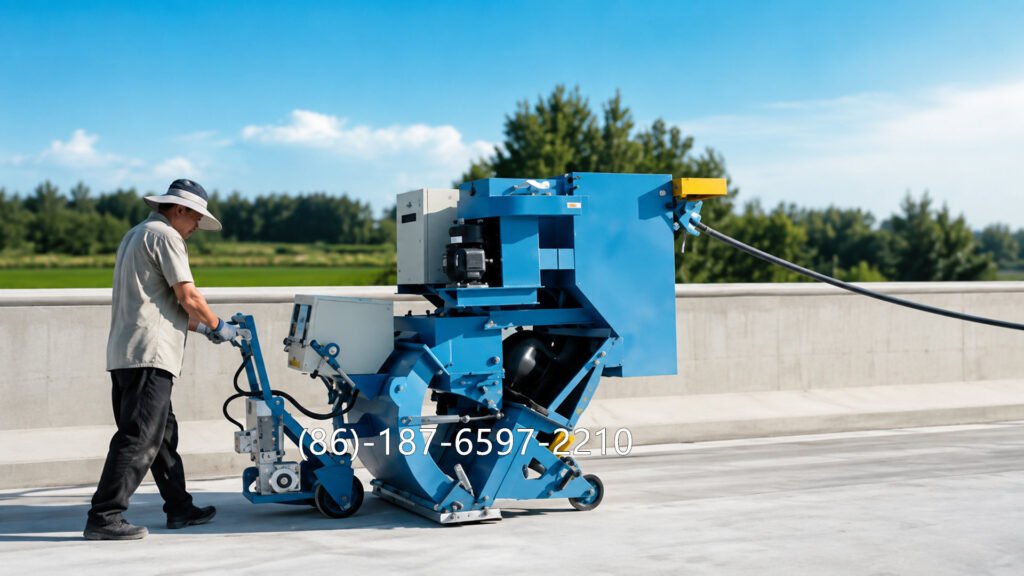
For concrete, shot blasting is commonly used to remove suitable coatings, weak surface material, and contaminants while producing a textured surface for a subsequent coating system.
The required result depends on:
- Concrete strength and condition
- Existing coating type and thickness
- Required concrete surface profile
- Abrasive size and wheel settings
- Machine travel speed
- Dust and debris removal
- Coating manufacturer’s preparation instructions
Concrete must remain sound after preparation. Excessive impact can remove too much material or expose defects that require repair.
A test area is recommended when the coating thickness, substrate condition, or required profile is uncertain.
3.3 Why the Difference Matters
| Item | Steel plate | Concrete floor |
|---|---|---|
| Main objective | Remove rust, mill scale, and specified contaminants | Remove coatings, weak material, and contaminants; create a suitable profile |
| Surface acceptance | Applicable steel cleanliness grade and profile requirements | Concrete cleanliness, soundness, profile, and coating-system requirements |
| Important risk | Incomplete cleaning, unsuitable profile, or possible distortion of thin material | Excessive substrate removal, weak concrete, or unsuitable profile |
| Typical follow-up | Protective painting or corrosion-control coating | Epoxy, polyurethane, overlay, or other floor treatment |
| Key verification | Visual cleanliness and specified profile inspection | Surface profile, cleanliness, substrate condition, and required tests |
If one machine is intended for both materials, request a technical confirmation from the manufacturer. The same abrasive size and machine settings should not automatically be used for both applications.
4. Typical Technical Parameters of a Compact Floor Shot Blasting Machine
The following figures are representative examples from published floor shot blasting equipment specifications. They are provided for preliminary comparison and are not guaranteed Bestech specifications.
| Parameter | Representative reference |
|---|---|
| Machine configuration | Single-wheel or double-wheel |
| Working width | Approximately 270–1,000 mm across selected models |
| Blasting wheel diameter | 200 mm on the referenced model range |
| Blasting wheel motor power | Approximately 11 kW for a single-wheel example; higher total power for double-wheel configurations |
| Concrete surface cleaning capacity | Approximately 180–800 m²/h across selected published models |
| Steel plate cleaning capacity | Approximately 15–160 m²/h across selected published configurations |
| Travel system | Manual or powered travel, depending on model |
| Abrasive | Recyclable steel shot of a suitable grade and size |
| Dust collection | Integrated or connected external dust collector, depending on configuration |
| Power supply | Confirm voltage, frequency, phase, and installed power with the manufacturer |
These reference values are based on published commercial model specifications and should be treated as preliminary data only. Actual output depends on the machine, surface condition, required finish, abrasive, and operating method. <Cite refs={[“turn254201search11″,”turn254201search13”]}/>
Why are the concrete and steel plate production figures different?
Concrete and steel plate have different surface conditions and acceptance requirements. Concrete cleaning capacity may be quoted under relatively favorable floor conditions, while steel plate cleaning capacity depends heavily on rust grade, mill scale, required cleanliness, and the machine’s suitability for the plate application.
Do not compare two machines using headline capacity alone. Ask the supplier to confirm the actual working width, wheel motor power, abrasive flow, dust collector airflow, travel speed, and expected output for your specific material.
5. Which Surface Preparation Standards Should You Follow?
The correct standard depends on the substrate and the intended coating system. Steel cleanliness standards and concrete preparation standards are not interchangeable.
5.1 ISO 8501-1:2007 for Steel Surface Cleanliness
ISO 8501-1 specifies visual assessment of rust grades and preparation grades for uncoated steel substrates and steel substrates after overall removal of previous coatings.
Common abrasive blast-cleaning grades include:
- Sa 1: Light blast cleaning
- Sa 2: Thorough blast cleaning
- Sa 2½: Very thorough blast cleaning
- Sa 3: Blast cleaning to visually clean steel
The required grade should be stated in the coating specification or project documentation. A machine must be tested under suitable conditions to confirm that it can consistently achieve the target.
ISO’s official page identifies ISO 8501-1:2007 as the published edition currently listed, while noting that a draft revision is expected to replace it. Verify the status before specifying the standard in a new contract. Official ISO reference. <Cite refs={[“turn254201search9”]}/>
5.2 AMPP SSPC-SP 13/NACE No. 6-2024 for Concrete
AMPP SSPC-SP 13/NACE No. 6-2024 covers concrete surface preparation before applying bonded protective coatings or lining systems.
It addresses the preparation method, cleanliness, surface profile, and other substrate acceptance considerations. The required preparation class should be selected according to the intended coating and service conditions.
The standard identifies shot blasting as a concrete surface preparation method and associates it with a range of concrete surface profiles. The actual result depends on the equipment, abrasive, and substrate condition. <Cite refs={[“turn254201search0″,”turn254201search10”]}/>
Official reference: AMPP — Surface Preparation of Concrete
5.3 ASTM D4259-24 for Concrete Abrasion
ASTM D4259-24, Standard Practice for Preparation of Concrete by Abrasion Prior to Coating Application, addresses the preparation of concrete before coatings are applied.
The practice is intended to create an appropriate concrete surface profile and remove foreign material and weak surface laitance. It can be used as a reference when specifying mechanical abrasion for concrete coating preparation. <Cite refs={[“turn254201search4”]}/>
Official reference: ASTM D4259-24
5.4 How to Verify the Prepared Surface
Before production, confirm the acceptance requirements with the coating manufacturer or project engineer.
For steel plate, verification may include visual cleanliness assessment and surface profile measurement.
For concrete, verification may include surface profile, cleanliness, substrate soundness, moisture condition, and other tests required by the coating specification.
Engineering recommendation: Specify the acceptance criteria first, then select the machine and process. A surface that looks clean is not necessarily ready for coating.
6. Compact Floor Shot Blasting Machine vs. Other Surface Preparation Equipment
| Comparison item | Compact floor shot blaster | Floor grinder | Roller conveyor shot blasting machine |
|---|---|---|---|
| Typical work | Accessible horizontal surfaces | Grinding, smoothing, and localized preparation | Continuous steel plate and profile processing |
| Main mechanism | Centrifugal abrasive impact | Grinding tools | Multiple blasting wheels in an enclosed conveyor system |
| Mobility | Often mobile | Often mobile | Generally stationary |
| Abrasive recovery | Reusable steel shot in a closed circuit | Grinding dust collection | Integrated abrasive circulation |
| Production setup | Suitable for on-site or workshop use | Suitable for local correction and smoothing | Suitable for repeat, high-volume production |
| Best selection factor | Mobility and required surface profile | Leveling, smoothing, or selected coating removal | Throughput and continuous material handling |
A compact floor shot blaster is a practical choice when mobility and flexibility matter. A roller conveyor machine may be better for a steel fabrication plant processing large quantities of plate every day.
The correct solution depends on the material, required output, and surface preparation specification—not simply on which machine is smaller or cheaper.
7. How to Select a Cost-Effective Compact Floor Shot Blasting Machine
7.1 Confirm the Main Application
Tell the supplier whether the machine will be used mainly for concrete floors, steel plate, or both.
A dual-application requirement must be confirmed against the actual machine design. Abrasive containment, sealing, material handling, and operating settings may differ.
7.2 Select the Correct Working Width
A narrow working width may be easier to maneuver in restricted areas. A wider machine can cover more surface per pass, provided the blasting system can maintain the required finish.
For a large workshop floor, compare effective output rather than working width alone.
7.3 Match Wheel Power to the Required Cleaning Result
Wheel power and abrasive flow influence the energy delivered to the surface, but they do not independently determine cleaning quality.
The correct configuration also depends on wheel design, abrasive size, surface condition, and travel speed.
Avoid choosing a machine solely because it has the highest motor power.
7.4 Confirm the Dust Collection Arrangement
The dust collector should match the machine’s required airflow and operating conditions.
Check filter cleaning, dust discharge, connection size, sealing, and maintenance access. When removing old coatings, assess whether hazardous substances may be present and determine the necessary collection and disposal controls.
7.5 Calculate Practical Output
For preliminary planning:
Theoretical coverage (m²/h) = Working width (m) × Travel speed (m/h)
For example, a 350 mm working width moving at 5 m/min has a theoretical coverage of 105 m²/h.
This is not a guaranteed cleaning capacity. Actual output depends on overlap, turns, surface condition, coating removal difficulty, inspection, and any additional passes.
Use a representative trial to establish realistic production capacity.
7.6 Check Wear Parts and After-Sales Support
Abrasive impact causes wear on the blasting wheel, blades, liners, seals, and other components.
Before purchasing, confirm spare-part availability, recommended maintenance intervals, electrical documentation, and support for installation and troubleshooting.
For export projects, also confirm voltage, frequency, phase, machine dimensions, and shipping arrangements.
8. Common Problems and Troubleshooting
| Problem | Possible cause | Recommended action |
|---|---|---|
| Uneven surface cleaning | Inconsistent travel speed or overlapping passes | Standardize travel speed and pass overlap |
| Rust remains on steel plate | Insufficient abrasive impact or unsuitable operating settings | Check wheel condition, abrasive supply, and the required cleaning grade |
| Paint remains on concrete | Coating is too thick, flexible, or strongly bonded | Test the coating and consider preliminary removal or a different process |
| Concrete profile is too rough | Excessive impact or unsuitable abrasive | Adjust operating conditions and test the surface again |
| High abrasive consumption | Shot leakage or poor separation | Inspect chamber seals, separator, and abrasive return system |
| Excessive dust escape | Damaged seals, clogged filters, or insufficient extraction | Inspect the dust collector and sealing system |
| Low production output | Difficult surface condition, too many passes, or unsuitable machine width | Reassess the application and select an appropriate configuration |
| Frequent wear-part replacement | Abrasive contamination or unsuitable operating conditions | Check abrasive quality, separator performance, and maintenance procedures |
Always isolate the machine before maintenance. Follow the manufacturer’s lockout procedure and never open the blasting chamber while hazardous moving components are operating.
9. How to Reduce Operating Costs After Installation
The machine’s purchase price is only one part of the total cost.
Maintain the blasting wheel. Inspect wear components at the intervals specified by the manufacturer. Worn parts can reduce blasting performance and affect abrasive distribution.
Keep the abrasive clean. Monitor abrasive size, contamination, and separator performance to reduce unnecessary replacement.
Prevent abrasive leakage. Damaged seals and recovery components can increase shot consumption and cleanup time.
Maintain the dust collector. Check filter condition, airflow, and dust discharge to support stable operation.
Optimize the blasting procedure. Standardize travel speed, overlap, abrasive settings, and inspection procedures.
Record actual operating costs. Track labor hours, electricity, abrasive replacement, wear parts, downtime, and accepted surface area.
These records allow the factory or contractor to compare the real cost per square meter and identify where operating improvements will have the greatest effect.
10. Frequently Asked Questions
Q1: Can one compact floor shot blasting machine prepare both steel plate and concrete?
Some configurations may be suitable for both applications, but this must be confirmed with the manufacturer. The abrasive, sealing arrangement, material handling, and operating parameters must suit each substrate. Do not assume a concrete floor machine is automatically suitable for steel plate.
Q2: What is the working width of a compact floor shot blasting machine?
Published models vary. Representative equipment ranges from approximately 270 mm to 1,000 mm working width. The correct width depends on the model, access conditions, required production output, and surface preparation specification.
Q3: Can a compact floor shot blaster achieve Sa 2½ on steel?
It may be possible for a suitable steel plate application, but the result depends on machine capability, initial rust condition, abrasive, and operating settings. Sa 2½ must be verified against ISO 8501-1 and the applicable project specification.
Q4: Which concrete surface profile can the machine achieve?
The profile depends on the machine, abrasive, concrete condition, and operating parameters. Select the target according to the coating manufacturer’s requirements and verify it on a test area.
Q5: Is a compact floor shot blaster cheaper than manual grinding?
It can reduce labor and improve repeatability on suitable areas, but total cost depends on coating condition, machine output, consumables, and additional preparation work. Compare the complete cost per accepted square meter rather than labor alone.
Q6: How much steel shot does the machine consume?
Consumption depends on the abrasive recovery efficiency, abrasive condition, surface type, and operating process. The manufacturer should provide a model-specific estimate, which should be checked during a representative production test.
Q7: Does the machine need a separate dust collector?
Some models use an integrated dust collector, while others require an external unit. Confirm the required airflow, filter type, duct connections, and collection arrangements with the supplier.
Q8: What information is needed to obtain a quotation?
Provide the substrate material, surface dimensions, initial condition, required cleanliness or profile, expected production output, available power supply, and site constraints. Photos or drawings help the manufacturer assess the application.
11. Request a Compact Floor Shot Blasting Machine Quotation from Bestech
If your project requires efficient surface preparation for steel plate, concrete floors, or industrial maintenance work, selecting the right compact floor shot blasting machine can help control labor, abrasive consumption, and maintenance costs.
Bestech can evaluate your application based on the required working width, blasting wheel configuration, abrasive recovery system, dust collector, and expected production output.
To receive a suitable machine recommendation, provide the following information:
- Workpiece material: Steel plate, concrete, or another substrate.
- Dimensions: Plate width and length, or total concrete floor area.
- Initial surface condition: Rust, mill scale, old paint, epoxy coating, laitance, or other contaminants.
- Required result: Steel cleanliness grade, concrete surface profile, or coating removal requirement.
- Production target: Square meters per hour, per shift, or per day.
- Power supply: Voltage, frequency, and phase.
- Site conditions: Available space, dust collection requirements, and whether the machine must be mobile.
Send your project photos, technical drawings, or surface preparation requirements for a more accurate evaluation.
Request a Technical Proposal
Receive a preliminary model recommendation, technical parameters, and a configuration matched to your production requirements.
The objective is to select a machine that achieves the required surface quality at a practical operating cost—not simply the lowest initial purchase price.