
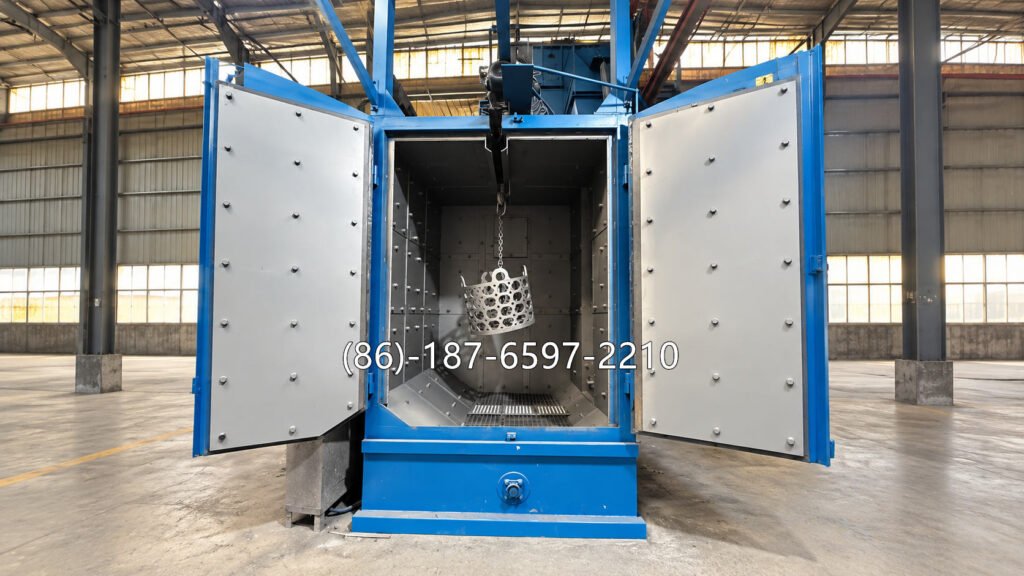
Are you looking for a hook shot blasting machine manufacturer that can customize equipment according to your workpieces, production capacity and factory layout?
A standard shot blasting machine may be suitable for common metal parts. However, when workpieces become larger, heavier or more complicated, standard configurations may not provide the required cleaning coverage or production efficiency.
For example, a foundry cleaning ductile iron castings may have different requirements from a steel fabrication plant cleaning welded structures. Even when both customers purchase a hook shot blasting machine, the hook capacity, blast wheel arrangement, chamber dimensions, abrasive recovery system and automation level can be completely different.
This is why OEM and ODM customization matters.
A properly engineered OEM & ODM hook shot blasting machine can be configured around actual workpiece dimensions, surface conditions, required cleanliness, cycle time and available installation space.
As a manufacturer, the goal should not be to supply the largest machine or the highest motor power. The goal is to build a blasting system that meets the customer’s production requirements without unnecessary equipment cost.
This guide explains how to select customized hook shot blasting equipment, which technical parameters matter, what international surface preparation standards to consider, and what information buyers should provide to obtain an accurate quotation.
1. What Is a Hook Shot Blasting Machine?
Hook shot blasting machine is industrial surface-treatment equipment that uses high-speed abrasive particles to clean metal workpieces suspended from a hook or overhead lifting system.
During operation, the workpiece enters the blasting chamber and rotates while one or more blast wheels project abrasive onto the required surfaces.
The process removes surface contaminants such as:
- Rust and iron oxide
- Mill scale
- Casting sand and foundry residues
- Surface deposits
- Selected old coatings, where the process is suitable
- Other removable contaminants specified for the application
The machine can be designed for batch operation, semi-automatic production or more automated material handling.
Typical applications include:
- Gray iron and ductile iron castings
- Steel castings and forgings
- Valves, pumps and pipe fittings
- Gears and machinery components
- Welded steel structures
- Automotive and agricultural machinery parts
- Construction machinery components
- Fabricated metal assemblies
The main advantage of a hook-type system is its ability to handle parts that should not be tumbled together. Workpieces are suspended individually or in controlled groups, reducing direct part-to-part impact compared with conventional tumble blasting.
Actual cleaning performance depends on the part geometry, abrasive, blast wheel arrangement and process settings.
2. Why Choose an OEM & ODM Hook Shot Blasting Machine Manufacturer?
When purchasing industrial equipment, buyers often compare machine prices first. However, the machine configuration determines whether it can actually meet the production target.
OEM and ODM cooperation provides more flexibility when standard equipment does not match the application.
2.1 Customized Chamber Dimensions
The blasting chamber must accommodate the maximum workpiece envelope, hook movement and abrasive impact zones.
For example, a customer processing a casting measuring 1,200 × 800 × 600 mm needs sufficient clearance for the part, suspension equipment and movement inside the chamber.
The chamber should not be designed according to the workpiece dimensions alone. The manufacturer’s engineering team must also consider:
- Maximum workpiece diagonal
- Hook and lifting clearance
- Rotation envelope
- Blast wheel positions
- Door opening and loading space
- Maintenance access
- Abrasive recovery arrangement
An oversized chamber increases equipment cost and may require unnecessary additional power. An undersized chamber restricts workpiece handling.
The correct chamber dimensions should be calculated from the complete operating envelope.
2.2 Customized Hook Capacity
Hook load capacity must include the suspended workpieces and the relevant lifting arrangement, according to the machine design.
The manufacturer should confirm:
- Maximum load per hook
- Total batch weight
- Maximum workpiece dimensions
- Hook rotation requirements
- Lifting mechanism capacity
- Loading and unloading method
For heavy castings, the lifting structure and hook assembly require particular attention.
Do not select a machine using only the average workpiece weight. The maximum load and actual loading arrangement must also be considered.
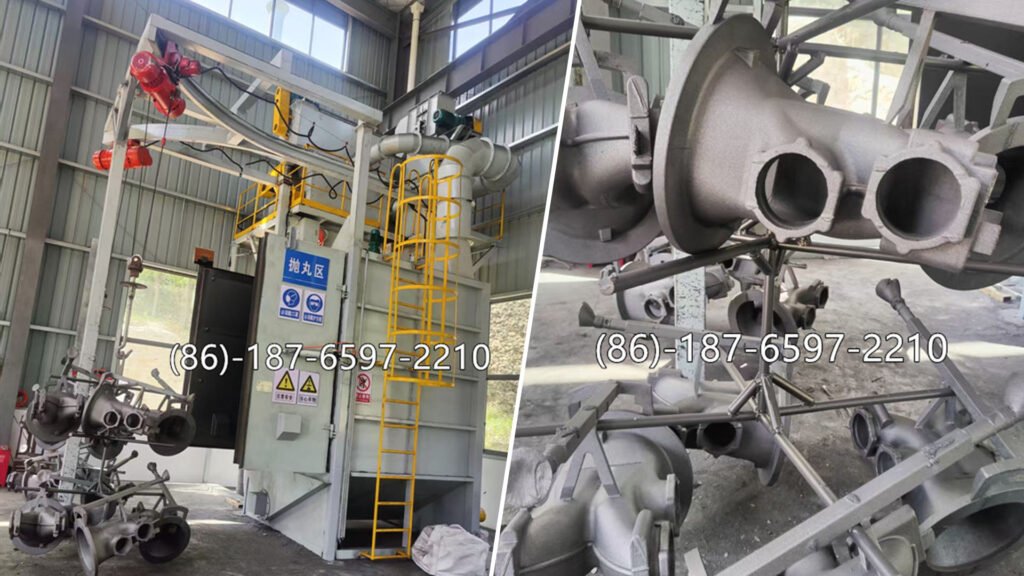
2.3 Customized Blast Wheel Configuration
The number, power and position of blast wheels affect cleaning coverage and production efficiency.
A machine may use one, two, three or more wheels, depending on its design and application.
The engineering team should evaluate:
- Workpiece geometry
- Required cleaning areas
- Abrasive impact direction
- Surface contamination
- Required cycle time
- Wheel maintenance access
Adding more blast wheels does not automatically improve the result. Their positions and abrasive streams must match the workpiece.
2.4 Customized Abrasive Recovery and Dust Collection
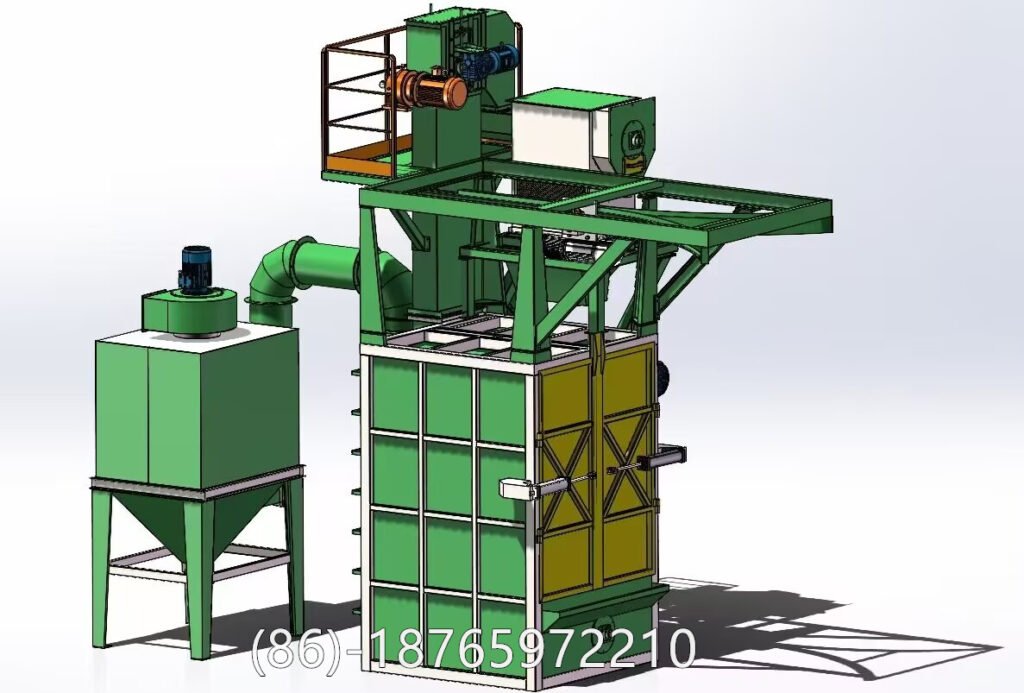
A hook shot blasting machine normally requires an abrasive recovery and separation system, together with dust extraction.
Typical components include:
- Abrasive collection hopper
- Screw conveyor, where applicable
- Bucket elevator
- Abrasive separator
- Abrasive storage and feed system
- Dust collector and exhaust fan
The recovery system returns reusable abrasive to the blasting process while separating dust, broken particles and other unwanted material.
The dust collection system must be sized according to chamber leakage, extraction points, filtration requirements and the overall airflow arrangement.
Correct system design helps reduce abrasive waste, dust leakage and unnecessary operating costs.
2.5 Customized Automation
Depending on production requirements, an OEM hook shot blasting machine can include:
- PLC control
- Automatic blasting cycle
- Hook rotation control
- Automatic door operation
- Double-hook arrangements
- Automated loading and unloading interfaces
- Cycle status monitoring
- Safety interlocks
Automation should be selected according to production volume, labor availability and the required operating sequence.
For small-batch production, a straightforward semi-automatic machine may be more economical. For higher production volumes, a double-hook or integrated material-handling system may reduce loading and unloading downtime.
3. OEM vs ODM: Which Customization Model Do You Need?
OEM and ODM are related but different purchasing arrangements. Their exact scope depends on the contract.
| Item | OEM Cooperation | ODM Cooperation |
|---|---|---|
| Basic concept | Manufacturing to the buyer’s requirements or design | Manufacturer develops a design for the buyer’s application |
| Buyer involvement | Buyer may provide drawings or specifications | Buyer mainly provides application requirements |
| Equipment design | Based on agreed buyer specifications | Developed or adapted by the manufacturer |
| Branding | Can be agreed by contract | Can be agreed by contract |
| Custom dimensions | Subject to the agreed design scope | Subject to the agreed design scope |
| Electrical configuration | Defined in the technical agreement | Developed around project requirements |
| Drawings and IP | Governed by contract | Governed by contract |
| Best suited for | Distributors and buyers with established specifications | Buyers requiring engineering support and a tailored solution |
OEM Hook Shot Blasting Machine
OEM cooperation is suitable when a buyer already has machine drawings, technical specifications or a defined equipment configuration.
The manufacturer produces the equipment according to the agreed scope.
Before production, both parties should confirm the approved drawings, component specifications, inspection requirements, branding arrangements and responsibility for design changes.
ODM Hook Shot Blasting Machine
ODM cooperation is suitable when a buyer knows the required output but needs help developing the machine configuration.
For example:
We need to clean ductile iron castings weighing 300–600 kg per piece. The required production capacity is 20 pieces per shift, and the machine must fit into our existing workshop.
The manufacturer can then evaluate the hook capacity, chamber dimensions, blast wheel arrangement, dust collection, loading method and cycle time.
The final configuration should be confirmed through technical review and, where necessary, workpiece testing.
4. Customized Hook Shot Blasting Machine Technical Parameters
The following table provides preliminary engineering reference ranges for discussing a customized machine. These are not guaranteed specifications for every model.
| Parameter | Preliminary Reference |
|---|---|
| Hook load capacity | Approximately 100–2,000 kg per hook, subject to design |
| Hook diameter | Approximately 600–1,500 mm, subject to workpiece envelope |
| Blast wheel quantity | Common configurations include 1–4 wheels |
| Blast wheel motor power | Approximately 7.5–30 kW per wheel |
| Abrasive flow rate | Approximately 80–250 kg/min per wheel, depending on wheel design |
| Blasting cycle | Approximately 3–30 minutes, depending on the workpiece and process |
| Dust collector airflow | Approximately 2,000–15,000 m³/h, subject to system calculation |
| Abrasive | Steel shot, steel grit or another compatible medium |
| Control system | Manual, semi-automatic or PLC-controlled |
| Loading system | Manual, crane-assisted or automated |
| Chamber dimensions | Customized |
| Maximum workpiece size | Customized |
| Total batch weight | Customized |
| Electrical supply | Configured for the installation site |
These ranges are intended for preliminary discussions only. Final values depend on machine construction, blast wheel specifications, abrasive properties, process testing and applicable safety requirements.
Which Parameters Determine Cleaning Capacity?
Production capacity is not determined by blast wheel power alone.
The main variables include:
- Workpiece size and geometry
- Initial rust, scale or casting residue
- Required surface preparation grade
- Abrasive type and condition
- Number and position of blast wheels
- Workpiece rotation and hanging arrangement
- Loading and unloading time
- Required blasting cycle
- Operator handling and production scheduling
For a realistic quotation, the manufacturer should distinguish between blasting time, complete batch cycle time and actual hourly production.
This prevents unrealistic production promises during equipment selection.
5. How to Design a Hook Shot Blasting Machine for Your Workpieces
A customized machine should be engineered around the actual production problem.
Step 1: Confirm Workpiece Information
Provide the workpiece name, material, dimensions, weight and photographs.
If the parts have deep recesses, ribs, blind holes or complicated geometry, provide detailed images or drawings.
These features can affect abrasive access and cleaning coverage.
Step 2: Define the Surface Preparation Requirement
Specify what needs to be removed and what the finished surface must achieve.
Examples include:
- Removal of loose rust and scale
- Removal of casting sand
- Cleaning before painting
- Surface preparation before protective coating
- A project-specific visual cleanliness grade
The required finish should be agreed before the machine is designed.
Step 3: Calculate the Production Target
The manufacturer needs to understand whether production is measured in pieces per hour, batches per shift or tonnes per day.
For example, if the target is 20 workpieces per shift, the engineering calculation should include loading, blasting, unloading and any required inspection time.
The theoretical blasting cycle alone does not represent total production capacity.
Step 4: Select the Hook and Lifting System
Determine the maximum suspended load and the clearance required for rotation.
For high-volume production, compare single-hook and double-hook configurations.
A double-hook arrangement may allow loading or unloading outside the chamber while another hook is being processed, subject to the machine’s design and safety sequence.
Step 5: Arrange the Blast Wheels
The blast wheel positions should be matched to the workpiece surfaces that require cleaning.
For complicated parts, the manufacturer may recommend sample testing to check for shadow areas or insufficient abrasive impact.
Step 6: Confirm the Complete System
The final proposal should include the blast chamber, wheels, hook system, abrasive recovery, separator, dust collector, control system and safety functions.
Only after these elements are confirmed can the buyer compare quotations fairly.
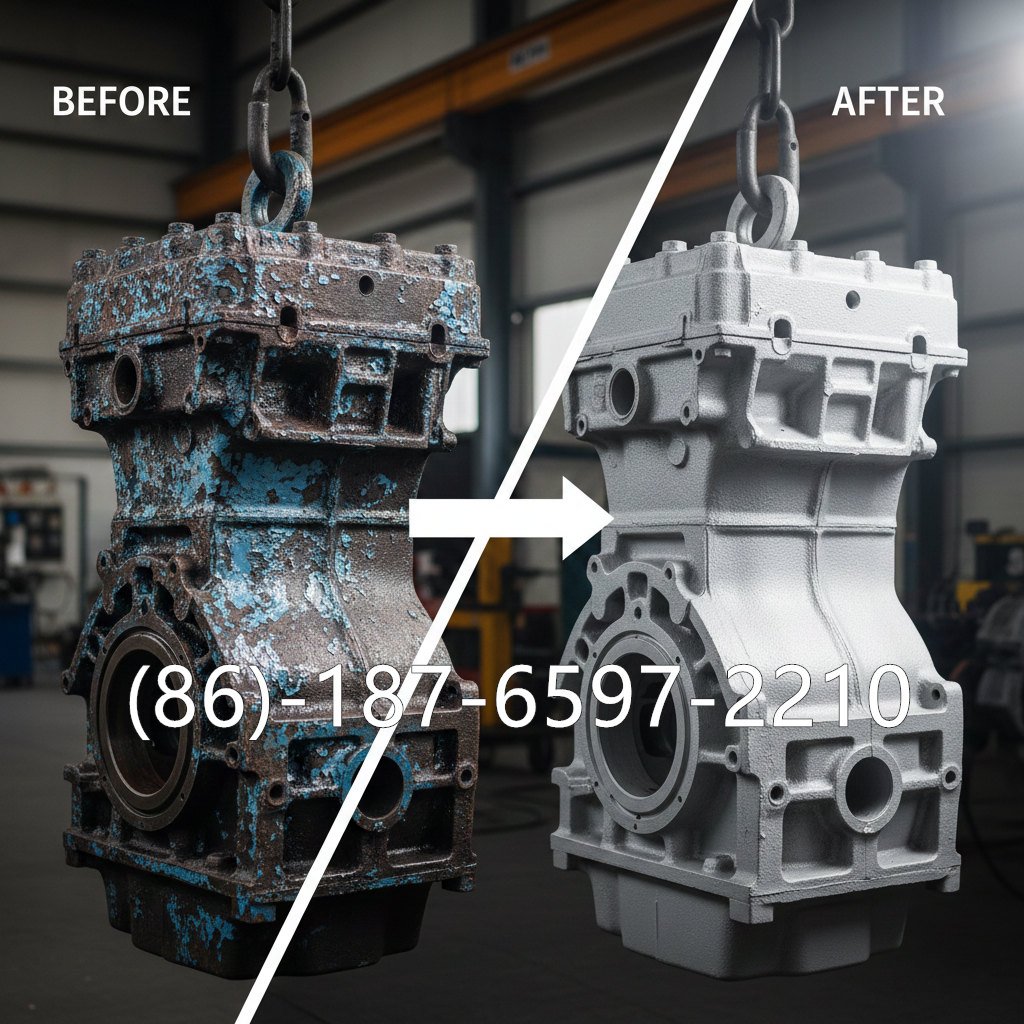
6. International Surface Preparation Standards and Acceptance Criteria
For international projects, the buyer should specify the required surface condition in the technical agreement.
One commonly referenced standard is ISO 8501-1:2007, which describes rust grades and preparation grades for steel surfaces through written descriptions and representative photographs. ISO lists this edition as published and notes that a replacement draft, ISO/DIS 8501-1, is under development.
Reference: https://www.iso.org/standard/43426.html
Common visual preparation grades include Sa 1, Sa 2, Sa 2½ and Sa 3.
The required grade depends on the project specification, substrate condition and coating system. It should not be selected only because a machine supplier commonly offers it.
For projects specifying near-white metal blast cleaning, buyers may also reference SSPC-SP 10/NACE No. 2-2024. This standard defines the required visible surface condition and related requirements for dry abrasive blast cleaning of carbon steel.
These standards describe surface preparation requirements, not a guarantee that any particular machine will achieve the specified result under all conditions.
A proper acceptance plan should define:
- The applicable standard and edition
- The required preparation grade
- The workpiece material and initial condition
- The abrasive and process settings
- The inspection method
- The inspection timing
- Any additional requirements for dust, soluble salts or surface profile
Where required by the coating specification, surface profile and non-visible contaminants should be evaluated using the applicable test methods. Visual cleanliness alone does not establish every aspect of coating readiness.
How to Verify the Machine Before Shipment
For customized equipment, we recommend a documented factory acceptance test when practical.
The test plan may include:
- Workpiece loading and unloading
- Hook movement and rotation
- Blast wheel operation
- Abrasive recovery
- Dust extraction
- Cycle time
- Surface cleanliness
- Safety interlocks
- Production capacity under agreed conditions
Using the buyer’s actual workpieces provides more useful evidence than testing with unrelated sample parts.
7. How OEM & ODM Customization Reduces Total Operating Cost
A low initial purchase price does not always mean a low-cost production process.
For a hook shot blasting machine, total operating cost is affected by energy consumption, abrasive losses, wear parts, labor, maintenance and production downtime.
Avoid Unnecessary Machine Capacity
If the blast wheels, chamber or lifting system are significantly larger than the application requires, the buyer may pay for capacity that is never used.
The correct design should satisfy the production target with a suitable operating margin.
Improve Abrasive Recycling
A correctly adjusted separator helps remove dust and broken particles from reusable abrasive.
Poor separation can increase abrasive consumption, reduce cleaning performance and contribute to unstable blasting conditions.
Reduce Loading and Unloading Time
The machine’s complete cycle includes material handling, not just blasting.
A better hook arrangement or suitable automation can reduce non-blasting time and improve output without simply increasing motor power.
Use Suitable Wear-Resistant Components
Blast wheel blades, liners, chamber protection and conveyor components are exposed to abrasive wear.
Their material and replacement arrangement should be selected according to the machine design and expected operating conditions.
Plan Spare Parts Before Production Starts
Ask the manufacturer for a recommended spare-parts list covering normal maintenance and likely wear items.
For overseas buyers, availability and delivery time can materially affect the cost of future downtime.
8. Hook Shot Blasting Machine Troubleshooting Guide
| Problem | Possible Cause | Recommended Check |
|---|---|---|
| Uneven cleaning | Poor hook arrangement or inadequate abrasive coverage | Review workpiece position and wheel direction |
| Rust or scale remains | Insufficient cycle time or unsuitable process settings | Check initial surface condition, abrasive and blasting time |
| High abrasive consumption | Separator or abrasive flow problem | Inspect separator adjustment and abrasive condition |
| Low blasting efficiency | Worn blades or incorrect abrasive flow | Inspect blast wheel wear parts and feed system |
| Excessive dust leakage | Poor sealing or inadequate extraction | Check chamber seals and dust collection airflow |
| Hook rotation is unstable | Mechanical wear, overload or drive issue | Inspect drive, bearings and loading balance |
| Excessive vibration | Imbalance or mechanical damage | Stop the machine and inspect rotating components |
| Abrasive recovery is poor | Conveyor, elevator or separator malfunction | Inspect material flow through the recovery system |
| Frequent downtime | Inadequate maintenance or unsuitable wear parts | Review maintenance records and component life |
Safety note: Isolate electrical and mechanical energy before inspection or maintenance. Do not open the blasting chamber while the blast wheels are running. Follow the manufacturer’s lockout and maintenance procedures.
9. Hook Shot Blasting Machine vs. Tumble Shot Blasting Machine
Choosing the correct machine type is as important as choosing the right manufacturer.
| Selection Factor | Hook Shot Blasting Machine | Tumble Shot Blasting Machine |
|---|---|---|
| Large workpieces | Generally more suitable | Often limited by chamber and belt capacity |
| Heavy castings | Suitable when lifting capacity is adequate | Depends on the machine and workpiece |
| Fragile or easily damaged parts | Often preferable due to reduced tumbling | Part-to-part impact may be a concern |
| Small bulk components | Can be used with suitable hanging arrangements | Often more efficient for bulk batches |
| Workpiece handling | Hooks, cranes or automated lifting | Loading into a tumbling chamber |
| Complicated geometry | Good when blast streams reach the required surfaces | Depends on tumbling and abrasive access |
| Automation | Hook transfer and loading systems can be integrated | Batch loading and discharge can be automated |
Neither design is universally better. The selection depends on part size, weight, fragility, geometry, production volume and the required cleaning result.
10. Why Work Directly With a Hook Shot Blasting Machine Manufacturer?
Buying directly from a manufacturer can make technical communication and customization more straightforward.
Engineering Communication
The buyer can discuss workpiece drawings, machine layout, hook capacity, blast wheel arrangement and automation requirements with the technical team responsible for the design.
Customized Configuration
The machine can be specified around the buyer’s actual production requirements instead of forcing the workpieces into a standard configuration.
Factory Inspection
Where agreed, the buyer can review machine assembly, inspect key components and participate in a factory acceptance test before shipment.
Spare Parts and Technical Support
A complete supply agreement should identify recommended spare parts, documentation, troubleshooting support and warranty conditions.
OEM & ODM Project Coordination
For distributors and industrial equipment brands, the agreement should clearly define branding, drawings, design ownership, approved changes, inspection procedures and after-sales responsibilities.
The value of factory-direct cooperation is not only the purchase price. It is the ability to confirm the equipment configuration, production target and acceptance requirements before manufacturing begins.
11. What Information Should You Send for a Customized Quotation?
To prepare an accurate OEM or ODM proposal, provide the following details.
Workpiece Information
- Workpiece name
- Material
- Maximum length × width × height
- Maximum weight per piece
- Average weight per piece
- Photographs or technical drawings
- Initial surface condition
Production Requirements
- Required pieces per hour or tonnes per shift
- Working hours per day
- Required surface preparation grade
- Maximum acceptable blasting cycle
- Batch size
- Manual or automatic loading
Factory Requirements
- Available installation space
- Factory voltage, frequency and phase
- Dust collection requirements
- Local safety or electrical requirements
- Installation location and country
Commercial Requirements
- OEM or ODM cooperation
- Required branding or nameplate
- Preferred delivery schedule
- Installation and commissioning requirements
- Spare-parts package
- Warranty and technical documentation
Providing these details at the beginning reduces repeated quotation revisions and helps the manufacturer identify technical issues before production.
12. What Should a Professional Manufacturer’s Quotation Include?
A serious quotation should contain more than the model name and total price.
Ask for a clear technical proposal covering:
Machine Configuration
- Machine model and chamber dimensions
- Hook load capacity and lifting arrangement
- Blast wheel quantity and motor power
- Abrasive recovery and separation system
- Dust collector and fan
- Control system and safety devices
Process Requirements
- Workpiece dimensions and weight
- Target batch size
- Expected cycle time
- Production capacity and calculation basis
- Abrasive specification
- Required surface preparation grade
- Factory test and acceptance criteria
Commercial Terms
- Equipment price and supply scope
- Spare parts and consumables
- Delivery schedule
- Packing and shipping
- Installation and commissioning
- Warranty
- Payment terms
- Technical documentation and training
When comparing suppliers, make sure the quoted machines have comparable specifications and supply scope. A lower quotation may exclude important components or services.
13. Frequently Asked Questions
What is a customized hook shot blasting machine?
It is a hook-type abrasive blasting system designed or adapted to suit a customer’s workpiece dimensions, weight, surface condition, production target and factory layout.
What is the difference between OEM and ODM shot blasting equipment?
OEM cooperation generally involves manufacturing according to agreed buyer specifications or designs. ODM cooperation generally involves the manufacturer developing or adapting the design for the buyer’s application. The exact scope depends on the contract.
Can the machine be designed for heavy castings?
Yes, subject to engineering review. The hook capacity, lifting mechanism, chamber clearance, drive system and loading method must be selected according to the maximum suspended load and workpiece dimensions.
Can a hook shot blasting machine achieve Sa 2½?
A properly configured machine may be able to achieve the required visual cleanliness grade for a specific application. The result depends on the substrate, initial contamination, abrasive, blast wheel arrangement and process settings. Confirm performance through agreed testing and inspection criteria.
How many blast wheels are required?
There is no universal number. The selection depends on the workpiece geometry, required coverage, blasting cycle and production target. More wheels are not automatically better if their abrasive streams are poorly positioned.
Can the machine use automatic loading and unloading?
Yes. Depending on the design, the system can incorporate crane-assisted handling, automatic doors, double-hook arrangements or other material-handling interfaces. The automation scope should be defined during technical review.
How much does a customized hook shot blasting machine cost?
The price depends on hook capacity, chamber size, blast wheel configuration, abrasive recovery, dust collection, automation and the agreed supply scope. A meaningful quotation requires workpiece and production information.
What documents should be supplied with the machine?
The supply agreement should identify the required general arrangement drawings, electrical documentation, operating and maintenance manuals, spare-parts lists, inspection records and any agreed test reports or compliance documents.
How long does manufacturing take?
Lead time depends on the design, component availability, customization scope and factory workload. Request a project-specific schedule after the technical configuration has been approved.
Conclusion: Build the Machine Around Your Production Requirements
A customized hook shot blasting machine should be selected according to the actual workpiece, not just a catalog model.
The engineering process starts with the maximum workpiece dimensions and weight. It then considers hook capacity, blast wheel positions, abrasive recovery, dust collection, handling time and the required surface preparation result.
For OEM and ODM buyers, these decisions directly affect equipment cost, production stability and future maintenance.
A factory-direct manufacturer should help translate your production requirements into a clear technical configuration, a realistic production target and an agreed acceptance plan.
Before choosing a supplier, confirm three things:
- Can the machine handle your actual workpieces safely?
- Can it achieve the required surface condition within the target cycle?
- Does the quotation include the systems and support needed for reliable production?
If these points are confirmed, you can compare suppliers on engineering value instead of purchase price alone.
Request an OEM & ODM Hook Shot Blasting Machine Proposal
Looking for a hook shot blasting machine manufacturer for your foundry, steel fabrication plant or industrial equipment business?
Send us your workpiece details to discuss a customized surface-treatment solution.
RFQ Template
- Workpiece:
- Material:
- Maximum Size (L × W × H):
- Maximum Weight per Piece:
- Required Capacity:
- Surface Condition:
- Required Cleaning Grade:
- Loading Method:
- Factory Power Supply:
- Available Installation Space:
- OEM or ODM Requirement:
- Installation Country:
Based on your information, the proposed configuration can be evaluated for chamber dimensions, hook capacity, blast wheel arrangement, abrasive recovery, dust collection and automation.
OEM & ODM Customization | Factory Direct Supply | Application-Based Engineering | Factory Testing by Agreement | Technical Support
Contact our sales team to discuss your workpieces and obtain a project-specific quotation.