
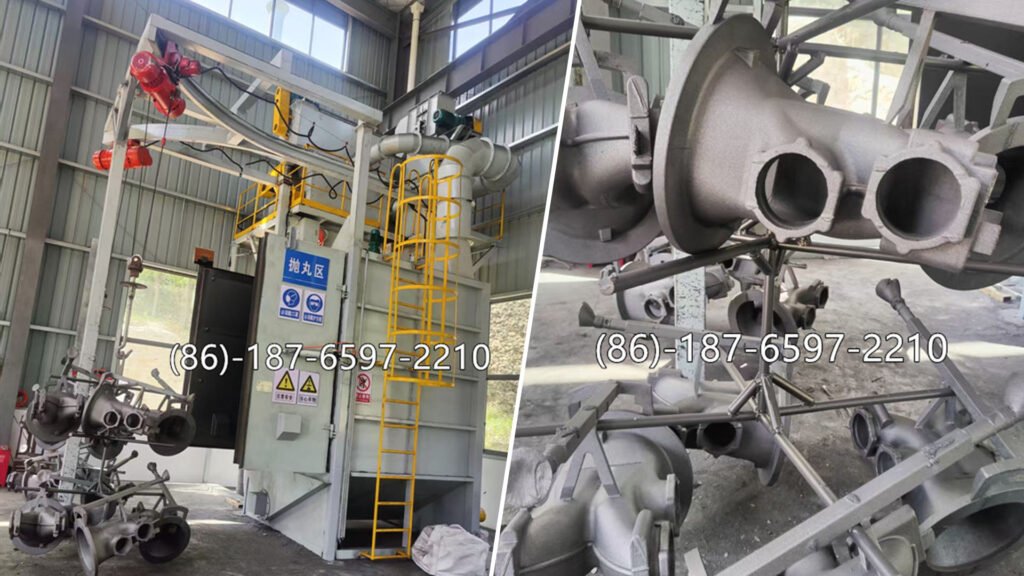
If your production includes castings, steel structures, fabricated components, gears, engine parts, valves, or other irregular metal workpieces, manual grinding and open blasting can quickly become expensive.
The problem is not only labor cost.
It is also:
- inconsistent surface cleaning,
- difficult access to complex surfaces,
- high abrasive consumption,
- unstable production capacity,
- excessive dust,
- and inconsistent preparation before painting or coating.
Hook Shot Blasting Machine solves these problems by suspending workpieces on rotating hooks and automatically blasting them with high-speed abrasive particles.
For foundries and metal fabrication plants, the machine provides a more repeatable process for removing casting sand, rust, mill scale, oxide, old coating and surface contaminants.
For buyers looking for a factory direct hook shot blasting machine manufacturer, the key is not simply finding the cheapest machine.
The correct question is:
Can the machine achieve the required cleaning grade, cycle time and production capacity with reasonable operating cost?
That is where machine configuration becomes important.
What Is a Hook Shot Blasting Machine?
Hook Shot Blasting Machine is an abrasive blasting system designed for cleaning and surface preparation of metal components suspended from one or more hooks.
The workpiece is loaded onto the hook, and the hook moves or rotates inside the blasting chamber.
Inside the chamber, high-speed abrasive is projected from the blast wheel onto the workpiece surface.
The basic process is:
Loading → Hook Rotation → Shot Blasting → Abrasive Separation → Dust Collection → Unloading
The rotating hook changes the position of the workpiece during blasting, allowing abrasive to reach different surfaces.
This makes hook-type equipment particularly suitable for:
- castings
- forgings
- valves
- gears
- engine components
- steel structures
- fabricated parts
- pumps
- agricultural machinery components
- automotive components
- construction machinery parts
The exact hook arrangement, wheel position, chamber size and loading capacity should be selected according to the actual workpiece.
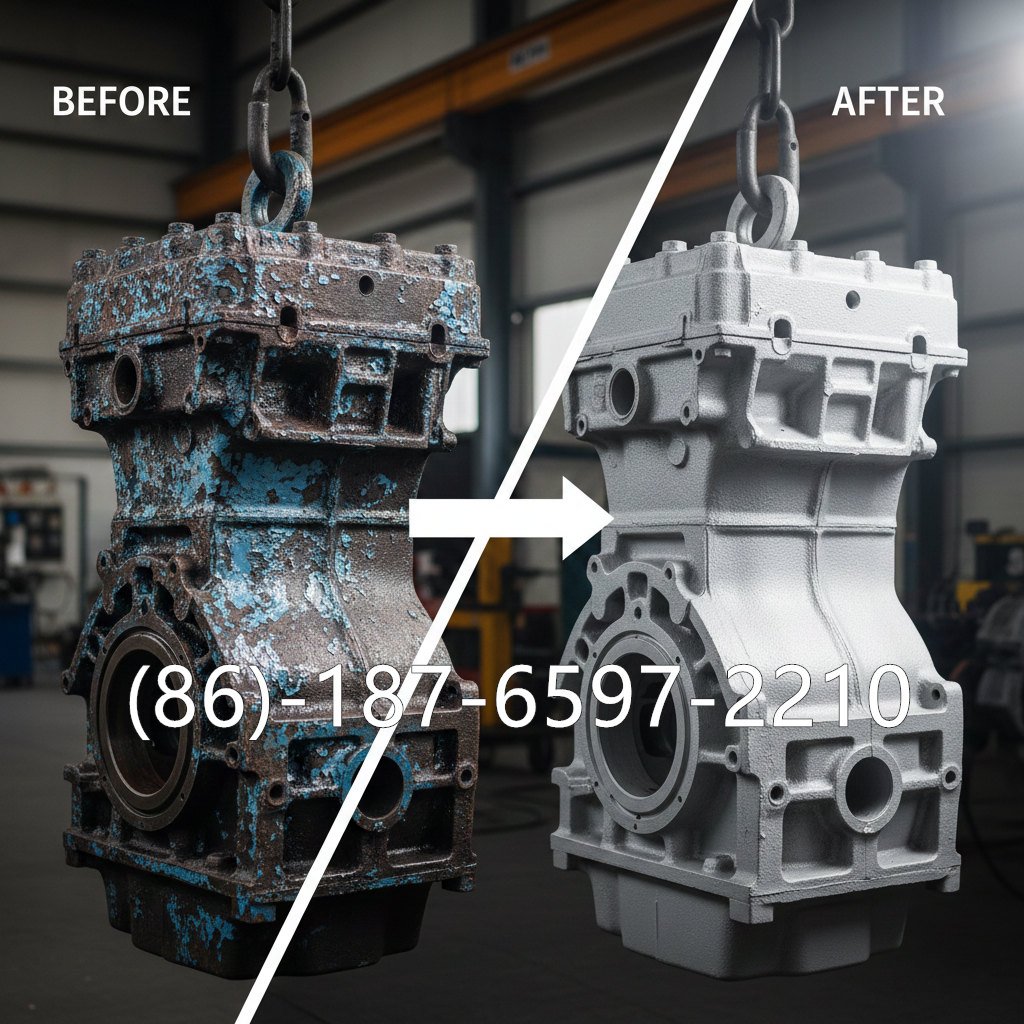
Why Choose a Hook Shot Blasting Machine?
A hook machine is not suitable for every metal part.
But when the workpiece is large, heavy, irregular or difficult to tumble, a hook system can be a much better solution than a tumble belt machine.
1. Better for Large and Irregular Workpieces
Large castings cannot always be loaded into a tumble blasting machine.
Some parts may also have:
- thin sections,
- protruding structures,
- machined surfaces,
- fragile edges,
- complicated geometry.
Suspending the part from a hook reduces direct part-to-part impact.
This is one of the main reasons hook shot blasting machines are widely considered for larger and more delicate components.
2. 360° Surface Treatment
The workpiece can rotate during blasting.
At the same time, the blast wheels are positioned to cover the required blasting zones.
This helps improve abrasive distribution around:
- external surfaces,
- corners,
- ribs,
- holes,
- casting surfaces,
- weld areas,
- complicated geometries.
However, 360° coverage does not mean every hidden internal cavity is automatically cleaned.
Deep holes and enclosed cavities may require additional blasting equipment or another process.
This point should be confirmed during technical evaluation.
3. Lower Manual Cleaning Requirements
Traditional manual cleaning may require workers to use:
- grinders,
- wire brushes,
- pneumatic tools,
- hand blasting equipment.
This creates higher labor requirements and makes surface quality dependent on operator skill.
An automatic hook shot blasting machine transfers the main cleaning process to a controlled mechanical system.
The operator mainly handles:
Loading → Unloading → Inspection
This can reduce repetitive manual surface preparation work.
4. More Consistent Surface Quality
The blasting process can be controlled through:
- blast wheel speed,
- abrasive flow,
- blasting time,
- hook rotation,
- workpiece arrangement,
- abrasive type and size.
When these parameters are properly established, the machine can provide more repeatable results than manual cleaning.
For coating applications, this is particularly important because surface preparation directly affects coating adhesion and service performance.
Hook Shot Blasting Machine Working Principle
A typical hook shot blasting system contains several key components.
Step 1 — Loading
The workpiece is attached to the hook.
For heavier parts, a crane or lifting device can be used.
The loading method should ensure that:
- the part is securely suspended;
- the center of gravity is reasonably positioned;
- parts do not collide excessively;
- the blast stream can reach the required surfaces.
Step 2 — Entering the Blast Chamber
The hook carries the workpiece into the blasting chamber.
Depending on the machine design, the hook may:
- rotate,
- move between positions,
- continuously travel,
- or operate in a double-hook arrangement.
Double-hook systems can improve production efficiency because one hook can be loaded or unloaded while another is being blasted.
Step 3 — Abrasive Blasting
The blast wheel accelerates steel shot or other suitable abrasive to high velocity.
The abrasive impacts the workpiece surface and removes contaminants.
Typical contaminants include:
- rust,
- mill scale,
- casting sand,
- oxide,
- old coating,
- burr-related surface contamination,
- foundry residues.
Step 4 — Abrasive Recovery
After impact, abrasive and removed contaminants fall to the bottom of the chamber.
The recovery system sends the material toward the separator.
A typical system includes:
Bucket Elevator + Separator + Screw Conveyor
The separator removes dust and broken or unsuitable particles from reusable abrasive.
Step 5 — Dust Collection
Fine dust generated during blasting is extracted by the dust collector.
A properly designed ventilation system helps maintain:
- chamber negative pressure,
- cleaner working conditions,
- improved visibility,
- reduced dust leakage.
Dust collection capacity must be matched to chamber size and blasting intensity rather than selected only by fan power.
Typical Hook Shot Blasting Machine Parameters
The following table can be used as a preliminary engineering reference.
Actual values should be confirmed according to workpiece dimensions, weight, surface condition, production capacity and required cleaning grade.
| Parameter | Typical Reference Range |
|---|---|
| Hook Load Capacity | 100–2,000 kg/hook |
| Hook Diameter | Approx. 600–1,500 mm |
| Chamber Size | Customized |
| Blast Wheel Power | Approx. 7.5–30 kW/wheel |
| Number of Blast Wheels | 1–4 |
| Hook Rotation | Variable according to design |
| Abrasive Type | Steel Shot / Steel Grit / Suitable Abrasive |
| Abrasive Flow | Approx. 80–250 kg/min/wheel |
| Blasting Time | Approx. 3–30 min/cycle |
| Dust Collector Capacity | Approx. 2,000–15,000 m³/h |
| Workpiece Weight | Customized |
| Workpiece Diameter | Customized |
| Workpiece Height | Customized |
| Control System | PLC / Automatic or Semi-Automatic |
Important: These are general engineering ranges rather than a fixed machine specification.
For quotation, a professional manufacturer should calculate the machine based on the customer’s actual workpieces.
How to Select the Right Hook Shot Blasting Machine?
This is where many purchasing projects go wrong.
Buyers often send only:
“Please quote one hook shot blasting machine.”
That information is not enough for proper equipment selection.
A manufacturer needs at least the following information.
1. Maximum Workpiece Weight
Example:
- 80 kg
- 300 kg
- 800 kg
- 1,500 kg
This directly affects hook capacity, structure, motor selection and lifting system.
2. Maximum Workpiece Dimensions
Provide:
Length × Width × Height
For example:
1,200 × 800 × 600 mm
The maximum diagonal dimension is also useful for determining chamber clearance.
3. Workpiece Material
Typical materials include:
- carbon steel,
- cast iron,
- ductile iron,
- alloy steel,
- aluminum,
- fabricated steel.
Different materials may require different blasting intensity.
4. Surface Condition
Tell the manufacturer what needs to be removed.
For example:
Heavy casting sand + rust + oxide
or:
Mill scale + light rust before painting
This is much more useful than simply saying “clean the surface.”
5. Required Surface Preparation Grade
For steel surfaces that will receive protective coatings, buyers may specify a visual cleanliness grade according to ISO 8501-1.
ISO 8501-1:2007 defines rust grades and preparation grades using written descriptions and representative photographic examples. The standard is applicable to steel surfaces prepared by methods including abrasive blast cleaning.
Commonly referenced blast-cleaning grades include:
| ISO Grade | General Description |
|---|---|
| Sa 1 | Light blast cleaning |
| Sa 2 | Thorough blast cleaning |
| Sa 2½ | Very thorough / near-white blast cleaning |
| Sa 3 | Blast cleaning to visually clean steel |
For example, Sa 2½ is commonly selected for demanding coating preparation.
However, the exact project specification should always be checked rather than assuming one grade is suitable for every application.
ISO 8501-1 Sa 2.5 vs SSPC-SP 10
For international B2B projects, buyers may use either ISO or SSPC/NACE terminology.
ISO 8501-1 provides visual assessment grades for prepared steel surfaces.
SSPC-SP 10/NACE No. 2 defines Near-White Metal Blast Cleaning for carbon steel using dry abrasive blasting. The current 2024 edition is listed by ANSI as the most recent revision.
In practical purchasing discussions:
ISO Sa 2.5 ≈ SSPC-SP 10 / NACE No. 2
But do not treat the terminology as a reason to skip the actual project specification.
For SSPC-SP 10/NACE No. 2, near-white blast cleaning requires the visible surface to be free of specified contaminants, with random staining limited to no more than 5% of each unit area.
This matters when selecting a shot blasting machine because the machine should be designed around the required final surface condition, not only the workpiece dimensions.
What Abrasive Should Be Used?
The abrasive affects both cleaning efficiency and operating cost.
Common options include:
Steel Shot
Suitable for:
- general cleaning,
- casting cleaning,
- rust removal,
- scale removal,
- surface strengthening applications.
Steel shot provides repeated impact and is commonly used in wheel blasting systems.
Steel Grit
Suitable when a more aggressive cutting action is required.
It can be considered for:
- heavy scale,
- strong rust,
- coating removal,
- rougher surface preparation.
Abrasive Size
Typical selection may involve different grades of steel shot or grit.
The correct abrasive depends on:
- material hardness,
- contamination thickness,
- required surface profile,
- machine design,
- blast wheel,
- coating specification.
Do not select abrasive only by particle size.
The complete blasting system must be considered.

Factory Direct Manufacturing: Why Does It Matter?
Buying directly from a manufacturer can provide several advantages.
Direct Technical Communication
Instead of communicating through multiple trading companies, the buyer can discuss:
- workpiece dimensions,
- cycle time,
- blast wheel arrangement,
- hook load,
- dust collector,
- abrasive recovery,
- automation.
This reduces misunderstandings during quotation.
Customized Machine Design
A professional factory can modify:
- chamber dimensions,
- hook capacity,
- hook diameter,
- blast wheel quantity,
- wheel position,
- automatic loading,
- automatic unloading,
- dust collector,
- abrasive recovery,
- PLC control,
- safety interlocks.
This is especially important when your workpiece does not match standard catalog dimensions.
Better Spare Parts Support
A factory-direct supplier should be able to provide replacement parts such as:
- blast wheel blades,
- blast wheel liners,
- chamber liners,
- elevator buckets,
- separator screens,
- bearings,
- hook components,
- wear plates.
For a production machine, spare-parts availability can be more important than the initial machine price.
Hook Shot Blasting Machine Cost: What Really Determines the Price?
Searching for the cheapest hook shot blasting machine is usually not the best purchasing strategy.
Machine price depends on:
- Hook loading capacity
- Number of blast wheels
- Blast wheel power
- Chamber dimensions
- Automation level
- Dust collector capacity
- Abrasive recovery system
- Hook rotation system
- Loading/unloading configuration
- Electrical components
- Wear-resistant lining
- Safety protection
- Installation requirements
A small machine with a low initial price may become expensive if it has:
- high abrasive consumption,
- frequent liner replacement,
- low productivity,
- poor dust collection,
- difficult maintenance,
- unstable blasting quality.
Therefore, compare total operating cost, not only purchase price.
How to Reduce Hook Shot Blasting Operating Cost?
A properly configured machine can reduce unnecessary operating expenses.
1. Avoid Oversized Blast Wheels
Too much blasting power does not automatically mean better cleaning.
The machine should match:
Workpiece + abrasive + cycle time + required cleaning grade
2. Maintain Correct Abrasive Flow
Excessive abrasive flow increases energy and abrasive consumption.
Insufficient abrasive flow reduces cleaning efficiency.
The abrasive flow gate should be adjusted according to the blast wheel capacity and process requirement.
3. Keep the Separator Properly Adjusted
The separator removes:
- dust,
- broken abrasive,
- fine particles,
- foreign material.
Poor separation can cause excessive abrasive waste or allow unsuitable particles to return to the blast wheel.
4. Check Wear Parts Regularly
The main wear areas include:
- chamber liners,
- blast wheel liners,
- wheel blades,
- shot gates,
- screw conveyors,
- elevator buckets.
Early replacement can prevent secondary damage.
Hook Shot Blasting Machine Troubleshooting Guide
| Problem | Possible Cause | Recommended Action |
|---|---|---|
| Uneven blasting | Poor workpiece positioning | Adjust hook loading arrangement |
| Rust remains after blasting | Insufficient blasting time | Increase cycle time or optimize abrasive flow |
| Heavy abrasive consumption | Separator adjustment problem | Check separator airflow and screens |
| Low cleaning efficiency | Worn blast wheel blades | Inspect and replace blades |
| Excessive dust | Dust collector problem | Check filter, fan and airflow |
| Dust leakage from chamber | Negative pressure insufficient | Inspect seals and ventilation |
| Excessive machine vibration | Unbalanced rotating components | Check hook and blast wheel balance |
| Abnormal noise | Bearing or mechanical wear | Stop machine and inspect bearings |
| Poor abrasive recovery | Conveyor/elevator issue | Check screw conveyor and elevator |
| Workpiece collision | Incorrect loading | Reduce load density and improve hanging arrangement |
Hook Shot Blasting Machine Maintenance Checklist
For continuous industrial production, maintenance should not wait until the machine stops.
Daily Inspection
Check:
- blast wheel noise,
- hook rotation,
- door sealing,
- abrasive flow,
- dust collector pressure,
- abnormal vibration,
- machine liner condition.
Weekly Inspection
Check:
- blast wheel blades,
- bearings,
- elevator buckets,
- separator,
- screw conveyor,
- electrical connections.
Periodic Inspection
Check:
- chamber wear liners,
- blast wheel housing,
- hook structure,
- lifting components,
- safety interlocks,
- dust collector filters,
- gearbox and transmission components.
A preventive maintenance schedule is usually much cheaper than repairing a major failure after production stops.
Safety Requirements for Hook Shot Blasting Machines
A hook shot blasting machine operates with high-speed abrasive and rotating mechanical components.
The machine should therefore include appropriate safety functions such as:
- blast chamber door interlock,
- emergency stop,
- overload protection,
- hook rotation protection,
- motor protection,
- lifting-system protection,
- dust extraction,
- secure workpiece hanging system.
The blast wheel must not operate while the chamber door is open.
Operators should also follow the manufacturer’s operating procedures and site-specific safety requirements.
Hook Shot Blasting Machine vs Tumble Shot Blasting Machine
| Item | Hook Shot Blasting Machine | Tumble Shot Blasting Machine |
|---|---|---|
| Large Parts | Excellent | Limited |
| Heavy Parts | Excellent | Limited |
| Complex Castings | Excellent | Good |
| Fragile Parts | Better | Not always suitable |
| Small Bulk Parts | Possible | Excellent |
| Part-to-Part Collision | Lower | Higher |
| Loading Method | Hook/Crane | Batch Loading |
| Production Mode | Batch / Automatic | Batch |
| Surface Coverage | Excellent with rotation | Good through tumbling |
| Best Application | Large & irregular parts | Small/medium bulk parts |
The selection should be based on the workpiece rather than simply machine price.
Who Should Buy a Hook Shot Blasting Machine?
A hook machine is especially suitable for companies producing:
Foundry Castings
- ductile iron castings
- steel castings
- gray iron castings
- pump castings
- valve castings
- machinery castings
Fabricated Steel
- welded structures
- frames
- brackets
- machinery components
- steel assemblies
Automotive & Machinery Components
- gears
- housings
- engine components
- transmission components
- agricultural machinery parts
Surface Preparation
For components that require subsequent:
Painting → Powder Coating → Plating → Protective Coating
a controlled blast cleaning process can improve surface cleanliness and coating preparation.
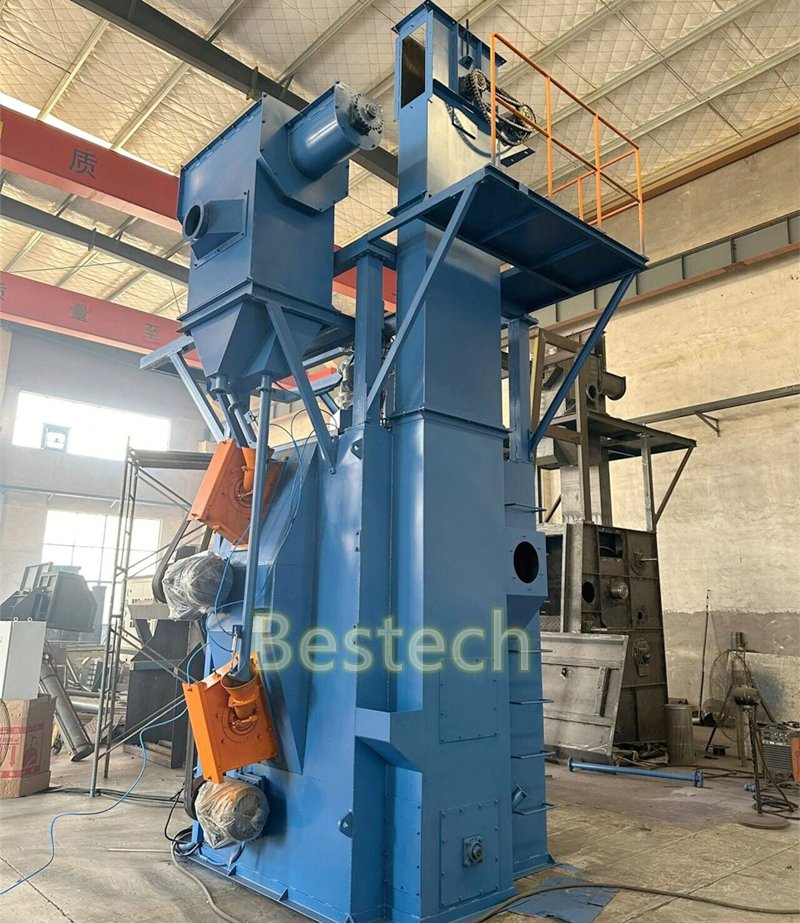
What Should You Send to a Hook Shot Blasting Machine Manufacturer?
If you want a fast and accurate quotation, send the following information.
B2B RFQ Checklist
1. Workpiece name:
Example: Ductile iron valve body
2. Material:
Cast iron / carbon steel / alloy steel / etc.
3. Maximum size:
L × W × H
4. Maximum weight:
kg/pc
5. Average weight:
kg/pc
6. Production capacity:
pcs/hour or tons/day
7. Surface condition:
Rust / casting sand / mill scale / old coating
8. Required surface preparation:
Sa 2 / Sa 2.5 / Sa 3 / project-specific requirement
9. Loading method:
Crane / forklift / automatic loading
10. Working hours:
8 h/day / 16 h/day / 24 h/day
11. Factory power supply:
Voltage / frequency / phase
12. Installation location:
Country + available installation space
With these details, a manufacturer can recommend a more accurate chamber size, hook capacity, blast wheel configuration and dust collection system.
How We Configure a Factory Direct Hook Shot Blasting Machine
A better technical quotation should include:
Machine Configuration
- Model
- Chamber dimensions
- Hook capacity
- Hook diameter
- Blast wheel quantity
- Blast wheel power
- Hook rotation power
- Abrasive recovery system
- Separator
- Dust collector
- Electrical control system
Process Parameters
- Workpiece size
- Workpiece weight
- Batch weight
- Blasting time
- Abrasive type
- Abrasive consumption
- Expected production capacity
- Required surface preparation grade
Commercial Information
- Machine price
- Spare parts
- Warranty
- Delivery time
- Installation
- Commissioning
- Training
- Payment terms
- Shipping terms
This gives the buyer enough information to compare suppliers on an engineering basis.
Why Work With a Factory Direct Hook Shot Blasting Machine Manufacturer?
For a long-term production project, the supplier should be able to provide more than a machine.
You should look for:
Engineering Design
Machine dimensions and blasting configuration based on your workpieces.
Factory Production
Core components manufactured and assembled under controlled production conditions.
Process Testing
Testing with actual workpieces is highly recommended before final acceptance.
Customized Configuration
Hook capacity, chamber size, wheel arrangement, dust collector and automation can be adjusted.
After-Sales Support
Spare parts, operation guidance, troubleshooting and technical support.
The goal is not simply to purchase a shot blasting machine.
The goal is to build a stable surface-treatment process.
Factory Test Before Shipment
For B2B equipment purchasing, a factory test can significantly reduce project risk.
We recommend testing:
- Workpiece loading
- Hook rotation
- Blast coverage
- Abrasive flow
- Dust collection
- Cleaning time
- Surface cleanliness
- Production capacity
- Machine vibration
- Safety interlocks
For demanding projects, send actual workpieces to the manufacturer for testing.
The test result can then be used to confirm:
Cycle Time + Surface Quality + Production Capacity
before shipment.
FAQ About Hook Shot Blasting Machines
What is a hook shot blasting machine used for?
A hook shot blasting machine is mainly used for cleaning and surface preparation of large, heavy or irregular metal parts. Typical applications include castings, forgings, valves, gears, fabricated steel components and machinery parts.
What can a hook shot blasting machine remove?
Depending on abrasive type and process parameters, it can remove casting sand, rust, mill scale, oxide, old coating and other surface contaminants.
Is a hook shot blasting machine suitable for castings?
Yes. Hook machines are commonly considered for large and irregular castings because parts can be suspended and rotated during blasting.
Can the machine achieve Sa 2.5?
The machine can be designed and process-tested to target a specified blast-cleaning grade. However, the actual result depends on workpiece material, initial surface condition, abrasive, blasting time, wheel configuration and other process variables.
ISO 8501-1 provides visual preparation grades for blast-cleaned steel surfaces, while SSPC-SP 10/NACE No. 2 defines near-white metal blast cleaning requirements.
How much does a hook shot blasting machine cost?
There is no reliable single price because machine cost depends heavily on hook load, chamber size, blast wheel quantity, automation, dust collection and abrasive recovery requirements.
For a meaningful quotation, provide the workpiece size, weight, material, surface condition and required production capacity.
Can the hook shot blasting machine be customized?
Yes. Industrial hook blasting systems can be customized according to workpiece dimensions, hook capacity, blast wheel arrangement, loading method, dust collection and automation requirements.
What information is needed for a quotation?
At minimum:
Workpiece dimensions + weight + material + surface condition + production capacity + required cleaning grade.
Conclusion: Choose the Machine Around the Workpiece
A Hook Shot Blasting Machine is not simply a machine for throwing abrasive at metal.
A correctly designed system must balance:
Workpiece Size
↓
Hook Load
↓
Blast Wheel Arrangement
↓
Abrasive Flow
↓
Blasting Time
↓
Surface Preparation Grade
↓
Production Capacity
↓
Operating Cost
This is why factory-direct purchasing can be valuable for industrial buyers.
Instead of selecting a standard machine only from a catalog, you can provide the actual workpiece information and have the manufacturer calculate the required configuration.
If your target is efficient surface treatment with controlled operating cost, the best machine is not necessarily the machine with the lowest purchase price.
It is the machine that delivers the required surface quality at the required production rate with manageable maintenance and abrasive consumption.
Get a Factory Direct Hook Shot Blasting Machine Quote
Send us your workpiece information for machine selection and quotation.
Please provide:
Workpiece:
Material:
Max. Size (L×W×H):
Max. Weight:
Average Weight:
Production Capacity:
Surface Condition:
Required Surface Grade:
Loading Method:
Factory Power Supply:
Country:
We can then recommend the appropriate hook shot blasting machine configuration, blast wheel power, hook capacity, dust collector and abrasive recovery system based on your actual production requirements.
Factory Direct • OEM/ODM • Customized Design • Production Testing • Technical Support