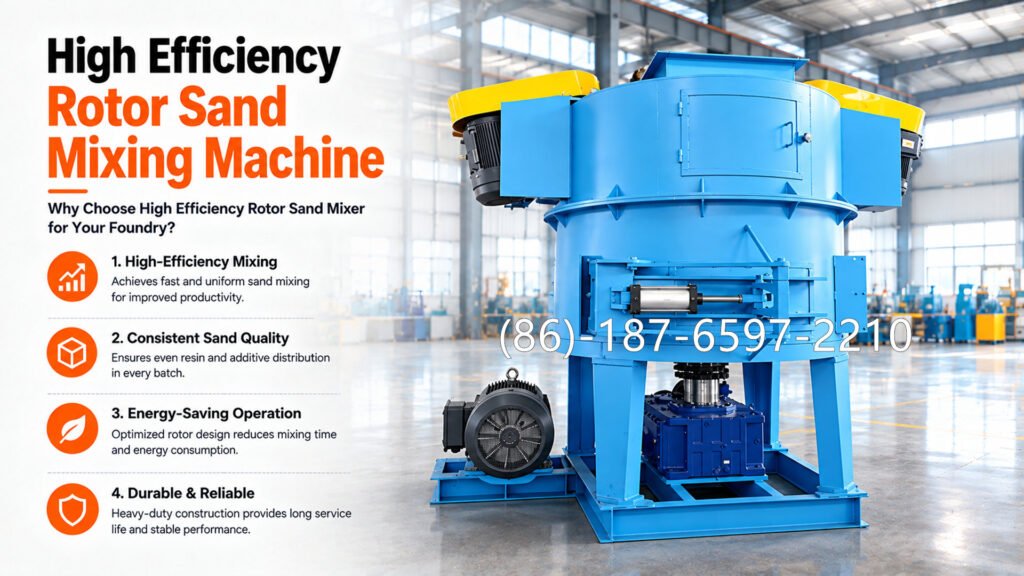
High Efficiency Rotor Sand Mixing Machine | Foundry Sand Mixer
Improve foundry sand mixing performance with a high efficiency rotor sand mixing machine. Learn about mixing principles, technical parameters, moisture control, energy savings, automation and B2B selection.Skip to content
A high-efficiency rotor sand mixing machine is designed to provide intensive mechanical mixing of foundry sand and process additives, helping the foundry achieve more consistent sand preparation within a controlled production cycle.
The real objective is not simply:
Mix Sand Faster
It is:
Produce more qualified molding sand with consistent properties, controlled cycle time and reasonable operating cost.
For foundries using green sand, reclaimed sand or automated molding lines, this difference is important.
What Is a High Efficiency Rotor Sand Mixing Machine?
High efficiency rotor sand mixing machine is a foundry mixer that uses a rotating mixing system to move and intensively blend sand with water, bentonite and other additives.
ISO 23062:2022 specifically covers foundry machinery used to condition and/or reclaim foundry sands for mold and coremaking. It also defines a sand mixer as a machine in which sand with bonding agents is mixed and conveyed to the discharge gate, either in batch or continuous operation.
Why Foundry Sand Mixing Performance Matters
A sand mixer can be running normally while the molding sand quality is still unstable.
The reason is that machine operation and process performance are not the same thing.
A mixer may have:
High motor power
Large mixing chamber
High advertised capacity
But if the water and additives are not distributed properly, the foundry may still experience inconsistent sand quality.
Therefore, evaluate the complete process:
Feeding
→ Dosing
→ Mixing
→ Discharge
→ Sand Testing
→ Molding
This is the real sand mixing performance chain.
8 Benefits of a High Efficiency Rotor Sand Mixing Machine
1. Intensive Sand Mixing
The rotor creates continuous mechanical movement inside the mixing chamber.
Sand particles are repeatedly lifted, moved and redistributed through the active mixing area.
This helps improve contact between:
Sand + Water + Bentonite + Additives
The result is a more uniform mixture when the machine is correctly matched to the recipe and batch size.
2. Better Moisture Distribution
Water distribution is one of the most important factors in green sand preparation.
Too little water may cause:
Low compactability
Poor mold strength
Difficult molding
Too much water may cause:
Reduced permeability
Sand sticking
Gas-related casting problems
Unstable molding behavior
A rotor mixer can provide the mechanical mixing required to distribute water through the sand mass.
However, the mixer cannot compensate for inaccurate water dosing.
For this reason, high-production systems should consider:
Water Metering + Spray System + Rotor Mixing + Sand Testing
as one complete process.
3. More Uniform Bentonite Distribution
Bentonite must be distributed consistently throughout the sand.
Uneven distribution can produce differences in:
Green strength
Compactability
Permeability
Mold hardness
Sand behavior during molding
The rotor mixing system provides intensive movement to help distribute bentonite and other additives.
For automatic molding lines, repeatability from batch to batch is particularly important.
4. Better Reclaimed Sand Mixing
Reclaimed sand can significantly reduce new sand consumption, but it also introduces process variables.
Reclaimed sand may differ in:
Temperature
Moisture
Grain size
Fines content
Residual binder
Additive content
A high-efficiency mixer should therefore be selected according to the actual reclaimed-sand condition.
A typical process is:
Shakeout
→ Separation
→ Reclamation
→ Cooling
→ Storage
→ Weighing
→ Rotor Mixing
→ Molding
The mixer becomes part of the complete sand-management system rather than an isolated machine.
5. Shorter and More Controlled Mixing Cycles
Mixing time directly affects production capacity.
For batch equipment:
Production Capacity = Effective Batch Weight × 60 ÷ Total Cycle Time
For example:
Effective batch weight: 500 kg
Total cycle time: 6 minutes
The theoretical capacity is:
500 × 60 ÷ 6 = 5,000 kg/h
or:
5 tons/hour
But this is only a theoretical value.
Actual production also depends on:
Sand feeding
Water dosing
Additive dosing
Discharge
Operator handling
Cleaning
Maintenance
Production interruptions
Therefore, when comparing machines, ask the manufacturer for the complete practical cycle time, not only the maximum batch weight.
6. More Stable Molding Sand Quality
The objective of mixing is not simply to produce a homogeneous-looking sand.
The prepared sand should meet the process requirements of the molding system.
Depending on the foundry process, important control parameters may include:
Moisture
Compactability
Green compression strength
Permeability
Active clay
Dead clay
Grain fineness
Sand temperature
The mixer provides the mechanical conditioning process.
The following figures are typical engineering reference ranges for preliminary equipment selection. They are not universal specifications for every rotor mixer.
Parameter
Typical Reference
Machine Type
High Efficiency Rotor Sand Mixing Machine
Application
Green molding sand preparation
Mixing Method
Rotor intensive mixing
Sand
New / reclaimed / blended
Batch Capacity
Approx. 100–1,500 kg/batch
Production Capacity
Approx. 2–20 tons/hour
Main Motor
Approx. 11–55 kW
Mixing Time
Approx. 2–8 min/batch
Water Dosing
Manual / automatic
Additive Dosing
Manual / automatic
Control System
Electrical / PLC + HMI
Discharge
Mechanical / pneumatic / hydraulic
Sand Temperature
Process dependent
Moisture Control
Manual / automatic
Installation
Stand-alone / production line
Customization
Available
Final Machine Selection Should Confirm
Required tons/hour
Effective batch weight
New/reclaimed sand ratio
Sand temperature
Initial moisture
Target moisture
Bentonite dosage
Additive dosage
Required mixing time
Molding machine capacity
Discharge height
Available installation space
Effective Capacity vs Maximum Capacity
This is one of the most important points when purchasing a sand mixer.
A supplier may state:
Maximum Batch Capacity: 1,000 kg
But that does not mean:
1,000 kg × 60 ÷ mixing time = actual production capacity
The complete production cycle must be considered.
Total Cycle Time
Loading
Dry Mixing
Water/Additive Dosing
Intensive Mixing
Discharge
=
Total Cycle Time
For example:
500 kg effective batch
6-minute complete cycle
≈ 5 t/h theoretical output
If the molding line requires 8 t/h, a 5 t/h mixer will become a production bottleneck.
Therefore:
Select the mixer according to required continuous output, not only chamber volume.
How to Improve Foundry Sand Mixing Performance
If your current sand mixer is not producing stable results, changing the machine may not be the first solution.
Check these variables first.
1. Check Sand Temperature
Temperature changes can affect moisture behavior and molding performance.
2. Check Initial Moisture
If incoming reclaimed sand already contains excessive moisture, the water recipe may become unstable.
3. Check Water Dosing
Verify:
Flowmeter
Pump
Valve
Spray nozzle
Dosing time
4. Check Bentonite Dosing
Incorrect additive dosing can create large batch-to-batch differences.
5. Check Batch Weight
Overloading the mixer can increase mixing time and reduce uniformity.
6. Check Mixing Time
Longer mixing is not automatically better.
The target is the required sand condition within the shortest practical cycle.
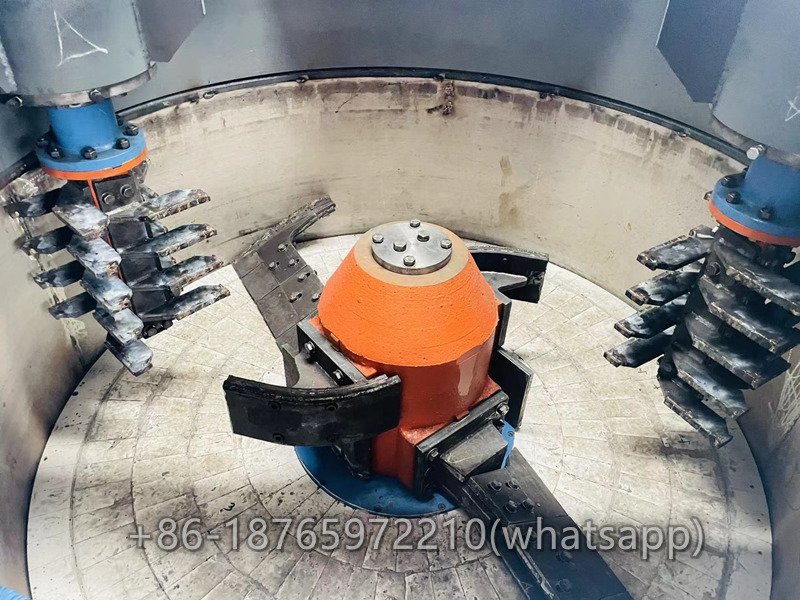
7. Check Rotor Wear
Worn mixing components can affect the movement pattern inside the chamber.
Rotor Wear: A Hidden Cause of Poor Mixing Performance
Many foundries monitor motor current but forget to inspect the mixing tools.
Rotor components gradually wear because of continuous contact with abrasive sand.
Possible consequences include:
Reduced mixing intensity
Longer mixing time
Higher energy consumption
Uneven material movement
Increased maintenance frequency
Therefore, maintenance should include regular inspection of:
Rotor
Mixing blades/tools
Shafts
Bearings
Liners
Seals
Discharge components
For high-hour production, keep critical wear parts available to reduce downtime.
Green Sand Mixing and Reclaimed Sand
Using reclaimed sand can reduce raw-material consumption, but the mixer must work with the actual sand condition.
Important parameters include:
Reclaimed Sand Ratio
_____ %
Sand Temperature
_____ °C
Moisture
_____ %
Fines Content
_____ %
Grain Fineness
_____
Residual Binder / Additives
Process dependent
The higher the variation in incoming sand, the more important process monitoring becomes.
Rotor Sand Mixer + Sand Cooler: Why They Should Be Considered Together
A common mistake is selecting the mixer without checking the sand cooler.
If reclaimed sand enters the mixer at inconsistent temperatures, the same water recipe may produce different final moisture conditions.
A better system is:
Reclamation
→ Sand Cooling
→ Temperature Stabilization
→ Weighing
→ Rotor Mixing
→ Molding
This provides better control over the entire preparation process.
For high-volume foundries, the sand cooler and mixer should be sized according to the same production target.
Automatic Water Dosing for Better Mixing Consistency
For manual production, operators may add water according to experience.
For high-volume production, this approach can create unnecessary variation.
An automatic water system may include:
Water tank
Pump
Flowmeter
Solenoid valve
Spray nozzles
PLC
HMI
Recipe setting
The PLC can control the required water quantity according to the batch recipe.
The actual dosing accuracy should be verified during commissioning and routine calibration.
PLC + HMI Control
For automated foundries, PLC control can coordinate the complete mixing cycle.
Typical functions include:
Automatic Sequence
Sand Feeding
↓
Dry Mixing
↓
Bentonite Addition
↓
Water Addition
↓
Intensive Mixing
↓
Discharge
The HMI can display:
Current recipe
Batch weight
Water dosage
Mixing time
Motor status
Alarm status
Production cycle
Maintenance reminders
For multiple sand recipes, recipe management can reduce operator adjustment errors.
Rotor Sand Mixer for Automatic Molding Lines
An automatic molding line requires more than a high-capacity mixer.
The complete system must maintain synchronized material flow.
For example:
Sand Preparation Capacity ≥ Molding Line Demand
If the molding line requires:
10 t/h
but the mixer can practically supply only:
7 t/h
the mixer becomes the bottleneck.
Therefore, equipment selection should consider:
Molding machine cycle
Mold weight
Sand consumption per mold
Molding speed
Required hourly production
Buffer hopper capacity
Conveyor capacity
Mixer cycle
This is where an equipment supplier should work from the customer’s production data rather than simply recommend a standard model.
High Efficiency Rotor Mixer vs Conventional Sand Mixer
Item
High Efficiency Rotor Mixer
Conventional Sand Mixer
Mixing Intensity
High, design dependent
Design dependent
Moisture Distribution
Designed for intensive mixing
Process dependent
Cycle Time
Potentially shorter
Process dependent
Reclaimed Sand
Suitable with correct configuration
Depends on machine
Automation
Available
Available
Automatic Dosing
Available
Optional
PLC/HMI
Available
Optional
Production Line Integration
Suitable
Depends on design
Maintenance
Rotor/wear parts require inspection
Depends on design
Best Application
Higher-performance sand preparation
Depends on process
The correct choice should always be based on actual process requirements.
How to Calculate the Real Cost of Sand Mixing
Do not compare only machine purchase prices.
Calculate:
Total Sand Preparation Cost =
Material Cost
Electricity
Labor
Maintenance
Wear Parts
Downtime
Re-Mixing
Rejected Molds / Process Losses
Then calculate:
Cost per Ton of Qualified Molding Sand
This provides a more useful B2B purchasing KPI.
Example: Where Efficiency Creates Savings
Assume a foundry produces:
8 tons/hour
and operates:
4,000 hours/year
Annual sand preparation volume:
8 × 4,000 = 32,000 tons/year
Even a small difference in:
Electricity consumption
Additive consumption
Labor
Re-mixing
Downtime
can become significant at this production volume.
Therefore, when evaluating a rotor mixer, ask suppliers for the data required to calculate:
Cost per Ton
rather than asking only:
Machine Price
Safety Requirements for Rotor Sand Mixing Equipment
ISO 23062:2022 is directly relevant to foundry machinery used for sand conditioning/reclamation and molding/coremaking. It addresses foreseeable significant hazards and risk-reduction measures over the machine life cycle. The standard also states that electrical hazards are covered by IEC 60204-1:2016.
A properly engineered rotor mixer should consider:
Machine guarding
Emergency stop
Access protection
Interlocks where required
Motor overload protection
Safe maintenance access
Electrical protection
Warning labels
Dust-control interfaces
Noise and vibration control
The final safety configuration should be based on the actual machine design, installation and destination-market requirements.
ISO 9001:2026 and Foundry Equipment Quality Control
ISO 9001:2026 is now the current sixth edition of ISO 9001, published on September 16, 2026. ISO describes it as a quality-management-system standard focused on consistent processes, customer confidence, continual improvement and organizational performance.
For a foundry equipment buyer, ISO 9001 certification should not be treated as proof that a particular mixer will automatically meet the required process performance.
Instead, ask the manufacturer how it controls:
Raw material inspection
Welding
Machining
Purchased components
Assembly
Electrical installation
Factory testing
Final inspection
Documentation
Corrective actions
A useful question is:
Can the manufacturer demonstrate a controlled manufacturing and testing process for the actual machine being supplied?
CE Compliance for EU-Bound Rotor Sand Mixers
For machinery placed on the EU market, Regulation (EU) 2023/1230 establishes machinery health and safety requirements and applicable conformity procedures.
Where the applicable conformity assessment demonstrates compliance, the manufacturer draws up the EU Declaration of Conformity and affixes the CE marking. The regulation also requires manufacturers to retain technical documentation and the EU Declaration of Conformity for at least 10 years.
Therefore, B2B buyers should ask for:
Risk assessment
Technical documentation
EU Declaration of Conformity
User manual
Electrical drawings
Safety information
Applicable CE documentation
Do not treat “CE” as simply a generic quality certificate.
Factory Acceptance Test for a Rotor Sand Mixing Machine
Before shipment, a factory acceptance test should verify more than whether the motor can rotate.
Mechanical Test
Check:
Rotor rotation
Abnormal vibration
Abnormal noise
Bearing condition
Gearbox operation
Discharge operation
Structural condition
Electrical Test
Check:
Motor current
Rotation direction
Emergency stop
Interlocks
Control cabinet
PLC/HMI
Alarm functions
Mixing Test
Where practical, use representative production materials.
Check:
Batch weight
Mixing time
Water dosing
Additive dosing
Sand temperature
Moisture
Discharge consistency
For a serious foundry project:
Actual material testing is more valuable than an empty-machine running test.
Maintenance Checklist
Daily Inspection
Check rotor operation
Check vibration
Check abnormal noise
Clean residual sand
Inspect discharge
Check water spray system
Check electrical alarms
Weekly Inspection
Inspect rotor/blades
Check bearings
Inspect seals
Check gearbox
Check spray nozzles
Inspect wear surfaces
Monthly Inspection
Check motor
Check gearbox oil
Inspect shafts
Check electrical connections
Inspect fasteners
Verify dosing system
Periodic Maintenance
Replace worn rotor components
Calibrate water dosing
Check safety interlocks
Inspect mixing chamber
Check structural components
Actual intervals should follow operating hours, sand abrasiveness and the manufacturer’s maintenance instructions.
Common Foundry Sand Mixing Problems
Problem
Possible Cause
Recommended Check
Uneven moisture
Poor water distribution
Check water spray and dosing
Sand too dry
Insufficient water
Verify water quantity
Sand too wet
Excessive water
Calibrate dosing
Long mixing cycle
Overloading / poor recipe
Check batch weight and recipe
High energy consumption
Excessive mixing time
Check cycle and output
Uneven additive distribution
Incorrect feeding sequence
Check dosing sequence
Rotor wear
Abrasive sand
Inspect mixing tools
High vibration
Rotor imbalance / bearing issue
Inspect rotor and bearings
Discharge blockage
Wet sand / buildup
Inspect discharge
Unstable molding performance
Variable incoming sand
Check moisture and temperature
When Should You Choose a High Efficiency Rotor Sand Mixing Machine?
A rotor mixer is worth considering when your foundry needs:
Higher Production Capacity
Your existing mixer cannot keep up with the molding line.
Better Sand Uniformity
Sand moisture and additives need more consistent distribution.
Reclaimed Sand Utilization
You are increasing the proportion of reclaimed sand.
Automatic Molding
Your molding line requires stable and repeatable sand preparation.
Reduced Manual Operation
You want automatic dosing and discharge.
Better Process Control
You need PLC/HMI control and recipe management.
Production Expansion
Your current sand preparation system is becoming a bottleneck.
When a Rotor Mixer May Not Be Necessary
A high-efficiency rotor mixer is not automatically the correct choice for every foundry.
A different machine may be sufficient when:
Production volume is very low
Batch sizes are small
Manual production is acceptable
Available installation space is limited
Existing equipment already meets production requirements
The sand recipe does not require intensive mixing
The correct machine is the one that meets the required process performance at an acceptable total operating cost.
How to Select the Right Rotor Sand Mixing Machine
Before requesting a quotation, prepare these technical parameters.
Buyer Information
Required Data
Required Output
___ tons/hour
Batch Weight
___ kg/batch
New Sand
___ %
Reclaimed Sand
___ %
Initial Moisture
___ %
Target Moisture
___ %
Sand Temperature
___ °C
Bentonite Dosage
___ %
Other Additives
___
Mixing Time
___ min
Molding Machine
___
Discharge Height
___ mm
Automation
Manual / Semi-Auto / Automatic
Voltage
___ V / ___ Hz
Installation Space
___
This information allows the manufacturer to select the machine based on the actual production process.
OEM Rotor Sand Mixing Machine Configuration
For industrial projects, customization may include:
Feeding System
Manual hopper
Conveyor
Screw conveyor
Automatic weighing
Storage hopper
Water System
Manual water addition
Flowmeter
Automatic dosing
Spray nozzles
Multi-point spraying
Additive System
Manual feeding
Automatic weighing
Screw dosing
Recipe-controlled dosing
Discharge
Bottom discharge
Side discharge
Pneumatic
Hydraulic
Conveyor-integrated
Control
Electrical control
PLC
HMI
Automatic recipes
Batch management
Alarm recording
Integrating the Rotor Mixer Into a Complete Sand Preparation Line
For a modern foundry, the mixer should be considered as part of the complete material flow.
A typical system can be:
Shakeout
↓
Sand Separation
↓
Magnetic Separation
↓
Reclamation
↓
Sand Cooling
↓
Storage Hopper
↓
Automatic Weighing
↓
Rotor Sand Mixing Machine
↓
Molding Machine
This approach helps connect:
Sand Quality + Production Capacity + Automation + Material Handling
rather than treating the mixer as an independent machine.
RFQ Template for High Efficiency Rotor Sand Mixing Machine
When contacting a manufacturer, send the following information:
Project: High Efficiency Rotor Sand Mixing Machine Application: Green Sand Preparation Required Capacity: ___ tons/hour Batch Weight: ___ kg/batch New Sand Ratio: ___% Reclaimed Sand Ratio: ___% Initial Moisture: ___% Target Moisture: ___% Sand Temperature: ___ °C Bentonite: ___% Other Additives: ___ Required Mixing Time: ___ min Molding Machine: ___ Discharge Height: ___ mm Automation: Manual / Semi-Automatic / Automatic Voltage: ___ V / ___ Hz Installation Space: ___ Destination Country: ___
Please Request These From the Supplier
Recommended model
Effective batch capacity
Practical production capacity
Main motor power
Mixing cycle
Machine dimensions
Machine weight
Water dosing system
Additive dosing system
PLC/HMI configuration
Wear parts
Spare-parts list
Factory test procedure
Installation requirements
Warranty
Technical documentation
Applicable conformity documents
10 Questions to Ask Before Buying
1. What is the actual production capacity?
Ask for capacity based on the complete production cycle.
2. What is the effective working batch?
Do not select the machine only according to maximum chamber capacity.
3. What is the recommended mixing time?
Ask how the cycle time was determined.
4. Can you test our actual sand?
Especially important when using reclaimed sand.
5. How accurate is the water dosing?
Ask how the dosing system is calibrated.
6. How are bentonite and additives dosed?
Check whether the dosing sequence can be automated.
7. What are the main wear parts?
Request material, dimensions and replacement recommendations.
8. Can the mixer connect to our molding line?
Provide discharge height and layout information.
9. Can you provide a factory acceptance test?
Ask for a documented FAT procedure.
10. What technical documents are supplied?
Request:
User manual
Electrical drawings
Spare-parts list
Test report
Maintenance instructions
Applicable conformity documents
FAQ: High Efficiency Rotor Sand Mixing Machine
What is a high efficiency rotor sand mixing machine?
It is a foundry sand mixer using a rotating mixing system to intensively mix sand with water, bentonite and other additives for molding sand preparation.
What type of sand can it process?
Depending on configuration, the machine can process new sand, reclaimed sand and blended sand for green molding applications.
Is a rotor mixer suitable for reclaimed sand?
Yes, when the machine is correctly configured for the actual reclaimed-sand temperature, moisture, fines and other characteristics.
What is the typical production capacity?
As a preliminary engineering reference, rotor sand mixers can range from approximately 100–1,500 kg/batch and 2–20 tons/hour depending on machine size and process configuration. Final capacity should be confirmed by actual production requirements and testing.
How long does the mixing process take?
A preliminary reference range may be approximately 2–8 minutes per batch, but actual mixing time depends on batch weight, sand condition, recipe, moisture and required sand properties.
Can the rotor mixer be automated?
Yes. Automatic weighing, water dosing, additive dosing, PLC/HMI control, recipe management and automatic discharge can be integrated.
Can it be connected to a green sand molding line?
Yes. The mixer can be configured with conveyors, hoppers, weighing systems and discharge arrangements according to the molding-line layout.
How can a rotor mixer improve sand mixing performance?
It provides intensive mechanical movement that helps distribute water and additives through the sand. Actual improvement depends on correct machine selection, recipe control, dosing accuracy and incoming sand condition.
What standard is relevant to foundry sand mixing machinery?
ISO 23062:2022 is directly relevant to safety requirements for foundry machinery used for sand conditioning/reclamation and molding/coremaking equipment.
What should EU buyers check?
For applicable EU machinery, buyers should request the relevant conformity documentation and EU Declaration of Conformity. Regulation (EU) 2023/1230 establishes the applicable machinery safety and conformity framework and defines the CE marking as an indication of conformity with applicable Union harmonization legislation.
We’re here to help! Whether you need more information about our products or services, our team is ready to assist. Don’t hesitate to reach out—we’re just a message away!