
Introduction: Reduce Metal Cleaning Costs Without Sacrificing Surface Quality
For foundries and metal fabrication plants, metal cleaning is not simply a surface preparation process. It directly affects production efficiency, labor requirements, abrasive consumption and the cost of downstream operations.
When castings, forgings or fabricated steel components require cleaning, an inefficient blasting process can create several problems:
- Long cleaning cycles reduce production capacity.
- Excessive abrasive consumption increases operating expenses.
- Poor abrasive separation reduces blasting efficiency.
- Frequent replacement of wear parts increases maintenance costs.
- Manual cleaning creates additional labor requirements.
- Inconsistent surface preparation can affect subsequent coating operations.
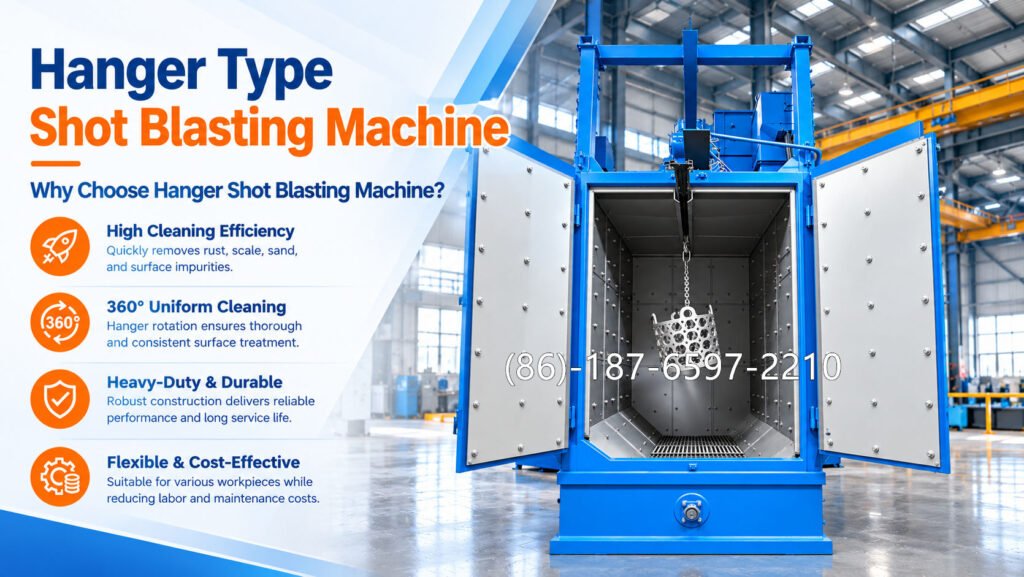
A cost-effective hook shot blasting machine helps address these problems by combining controlled abrasive blasting, workpiece rotation, abrasive recovery and dust collection in one integrated system.
Unlike tumble blasting equipment, a hook shot blasting machine suspends the workpieces during cleaning. This makes it particularly suitable for large, heavy, irregular or easily damaged metal components that should not be tumbled together.
However, purchasing the lowest-priced machine does not necessarily deliver the lowest production cost.
The real objective is to achieve the required surface cleanliness and production capacity while controlling electricity consumption, abrasive losses, maintenance expenses and labor.
This guide explains how to select a cost-effective hook shot blasting machine, optimize operating parameters, reduce consumable costs and evaluate the equipment before purchasing.
Looking for a hook shot blasting machine for your production line? Start with the workpiece dimensions, weight, surface condition and required output. These factors determine the machine configuration more accurately than price alone.
1. What Is a Hook Shot Blasting Machine?
Hook shot blasting machine is industrial surface treatment equipment that uses high-speed abrasive particles to remove contaminants from metal workpieces.
The workpieces are suspended from a hook or lifting system and moved into a blasting chamber. During the blasting cycle, one or more blast wheels project abrasive onto the surfaces requiring treatment.
Depending on the application, the machine can remove:
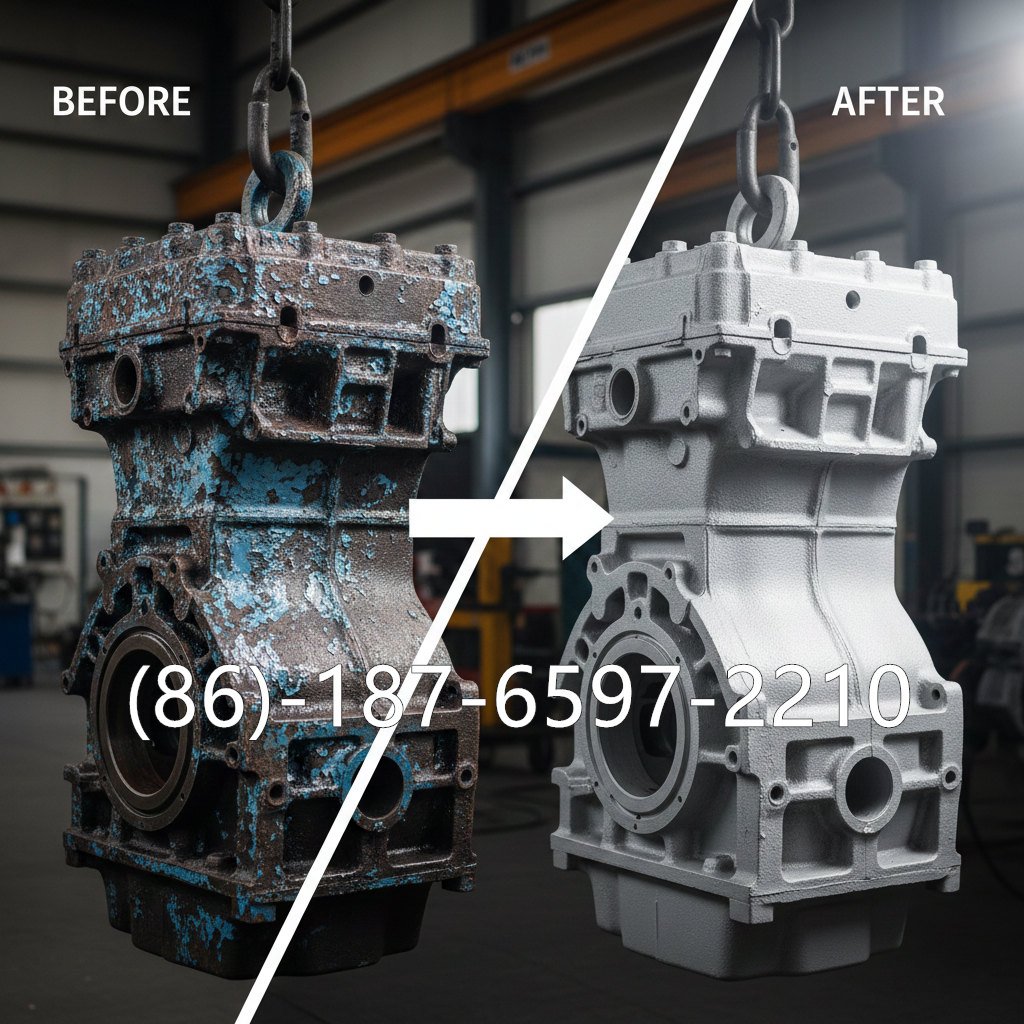
- Rust and oxide
- Mill scale
- Casting sand
- Foundry residues
- Surface deposits
- Selected old coatings, where suitable
Typical applications include:
- Ductile iron and gray iron castings
- Steel castings and forgings
- Valves and pump components
- Gears and machinery parts
- Welded steel structures
- Automotive components
- Agricultural machinery parts
- Construction equipment components
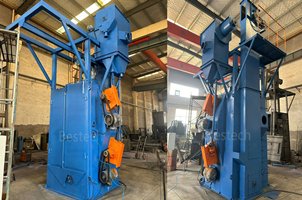
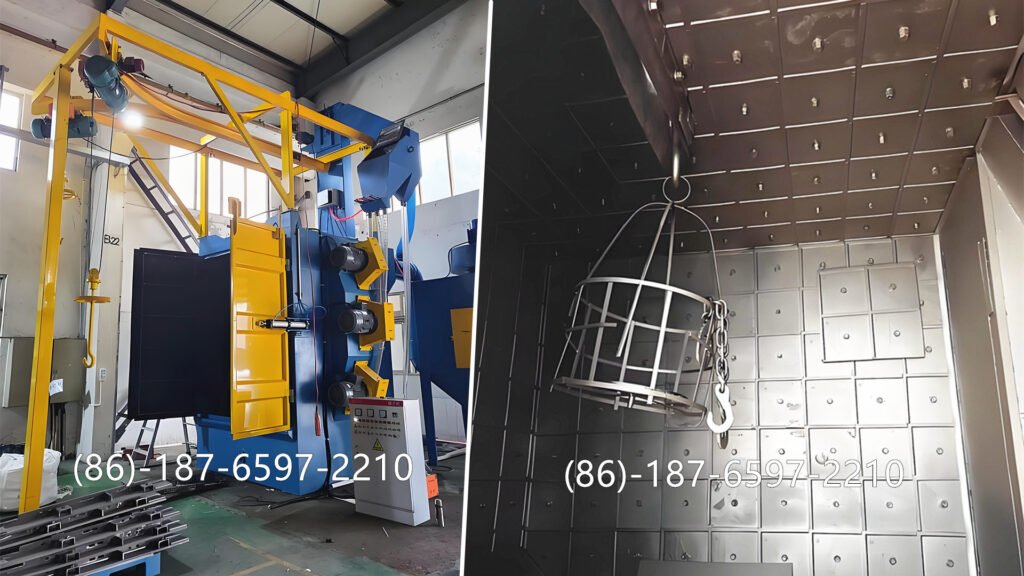
The main components generally include:
- Blast chamber
- Hook and lifting mechanism
- Blast wheels
- Abrasive circulation and recovery system
- Abrasive separator
- Dust collector
- Electrical control system
- Safety protection devices
A well-designed system coordinates these components to deliver repeatable cleaning performance without unnecessary energy or abrasive consumption.
2. Why Is a Hook Shot Blasting Machine Cost-Effective?
The cost-effectiveness of a blasting machine depends on the complete cleaning process rather than one individual component.
2.1 Reduce Manual Cleaning Work
Manual grinding and cleaning require labor and depend heavily on operator skill.
For large castings or complicated metal components, manual cleaning may take considerable time, particularly when the workpiece contains ribs, corners, recesses or multiple surfaces.
A hook shot blasting machine automates the main abrasive cleaning process.
Operators primarily handle loading, unloading, process monitoring and inspection, depending on the level of automation.
This can reduce repetitive manual work and help improve production consistency.
2.2 Improve Cleaning Efficiency
High-speed abrasive particles remove surface contaminants through repeated impact.
The cleaning result depends on several factors:
- Blast wheel power and design
- Abrasive flow rate
- Abrasive type and size
- Workpiece rotation
- Wheel position
- Blasting time
- Initial surface condition
A suitable combination of these parameters helps reduce unnecessary blasting time.
However, increasing blast wheel power does not automatically improve efficiency. The abrasive stream must reach the surfaces that require cleaning.
2.3 Reduce Workpiece Damage
A hook-type machine suspends workpieces rather than tumbling them in a rotating belt or drum.
This is beneficial for parts that are heavy, irregular or susceptible to damage from repeated collision.
Reduced part-to-part contact can help lower the risk of impact damage and reduce the need for additional inspection or rework.
The actual result depends on the hanging arrangement, workpiece stability and loading density.
2.4 Improve Abrasive Utilization
Abrasive is one of the ongoing operating expenses of a shot blasting machine.
A properly configured recovery system collects used abrasive and sends it through a separator. Reusable particles return to the blasting process, while dust and unsuitable particles are removed.
This reduces the need to replace the entire abrasive charge after each cycle.
Actual abrasive consumption depends on the abrasive type, contamination, separator performance, blasting intensity and workpiece condition.
2.5 Improve Production Stability
Consistent machine settings help maintain more repeatable surface preparation.
This is important when parts must meet a specified cleanliness grade before painting, coating or another manufacturing process.
A stable process can reduce avoidable rework and make production planning easier.
3. Technical Parameters of a Cost-Effective Hook Shot Blasting Machine
The following table provides preliminary engineering reference ranges for equipment selection. These are not guaranteed specifications for a particular machine model.
| Parameter | Preliminary Reference Range |
|---|---|
| Hook load capacity | Approximately 100–2,000 kg per hook, depending on design |
| Hook diameter | Approximately 600–1,500 mm, depending on workpiece dimensions |
| Blast wheel quantity | Common configurations include 1–4 wheels |
| Blast wheel motor power | Approximately 7.5–30 kW per wheel |
| Abrasive flow rate | Approximately 80–250 kg/min per wheel, depending on wheel design |
| Blasting time | Approximately 3–30 minutes per cycle, depending on application |
| Dust collector airflow | Approximately 2,000–15,000 m³/h, subject to system calculation |
| Abrasive type | Steel shot, steel grit or another compatible medium |
| Hook drive | Selected according to load and rotation requirements |
| Control system | Manual, semi-automatic or PLC-controlled |
| Loading method | Manual, crane-assisted or automated |
| Chamber dimensions | Customized to the workpiece envelope |
| Workpiece size | Customized |
| Electrical supply | Configured for the installation site |
Important: Final parameters must be confirmed according to actual workpiece dimensions, maximum load, production target, surface preparation requirement and equipment design.
The machine’s rated capacity should not be confused with its actual hourly output. Production calculations must include loading, unloading, blasting and inspection time.
4. How to Reduce Hook Shot Blasting Machine Operating Costs
For most industrial buyers, the initial purchase price is only one part of the total cost.
Operating expenses generally include:
- Electricity
- Abrasive replacement
- Wear parts
- Dust collector filters
- Maintenance labor
- Equipment downtime
- Workpiece rework
- Loading and unloading labor
The following measures help control these expenses.
4.1 Select the Correct Blast Wheel Power
The blast wheel is one of the main power-consuming components.
Selecting a larger wheel or installing more wheels than necessary can increase the initial equipment price and connected electrical load.
However, selecting insufficient blasting capacity can also increase costs because the machine may require longer cycles or fail to achieve the required cleaning result.
The correct selection should consider:
- Workpiece material
- Contamination thickness
- Required cleaning grade
- Surface area
- Target production capacity
- Abrasive flow requirements
The goal is to achieve the required result within the target cycle, not simply to maximize motor power.
4.2 Optimize Abrasive Flow Rate
Abrasive flow must match the blast wheel design and the cleaning requirement.
Insufficient flow can reduce cleaning efficiency.
Excessive or poorly controlled flow may waste energy and abrasive without producing a proportional improvement in the finished surface.
During commissioning, the manufacturer should establish suitable operating parameters and document the settings used for acceptance testing.
4.3 Maintain Correct Abrasive Separation
The separator removes dust, broken particles and other unsuitable material from reusable abrasive.
Poor separation can cause several problems:
- Increased abrasive loss
- Reduced cleaning performance
- Unstable abrasive flow
- Additional dust
- Faster wear of some machine components
Regularly inspect the separator, screens, airflow arrangement and abrasive circulation path.
4.4 Replace Wear Parts at the Right Time
Typical wear parts include:
- Blast wheel blades
- Blast wheel liners
- Chamber liners
- Abrasive gates
- Elevator buckets
- Conveyor components
Worn blades can affect abrasive distribution and reduce blasting efficiency.
Waiting until a component fails completely can result in secondary damage and longer downtime.
A preventive maintenance schedule should therefore be based on operating hours, inspection results and actual wear conditions.
4.5 Reduce Loading and Unloading Time
Blasting time is only one part of the production cycle.
Consider the following simplified example:
| Process Stage | Example Time |
|---|---|
| Loading | 5 minutes |
| Blasting | 12 minutes |
| Unloading | 4 minutes |
| Inspection and handling | 3 minutes |
| Total cycle | 24 minutes |
These are illustrative values, not guaranteed production data.
If the complete cycle takes 24 minutes, the theoretical output is 2.5 cycles per hour before accounting for interruptions, shift changes, maintenance and other production losses.
This example shows why reducing non-blasting time can be as important as optimizing the blast wheel.
For higher-volume production, a double-hook configuration or suitable automated handling system may help reduce waiting time, depending on the machine design.
5. Calculate the Total Cost Per Workpiece
One useful way to compare shot blasting machines is to calculate the estimated cost per processed workpiece.
The basic formula is:
Cost per Workpiece = Total Operating Cost ÷ Number of Accepted Workpieces
Total operating cost over a defined period can include:
- Electricity
- Abrasive consumption
- Wear parts
- Filter replacement
- Direct operating labor
- Maintenance
- Rework and downtime costs
For example, assume a plant processes 800 accepted workpieces per month.
If the total monthly operating cost is USD 4,000:
Cost per Workpiece = USD 4,000 ÷ 800 = USD 5.00
This is an illustrative calculation, not a market price or a claim about any specific machine.
If a new configuration reduces the monthly cost to USD 3,600 while maintaining the same accepted output:
New Cost per Workpiece = USD 3,600 ÷ 800 = USD 4.50
The estimated saving is USD 0.50 per workpiece, or USD 400 per month.
Before accepting such a calculation, verify that both scenarios use comparable surface quality, production volume, labor accounting and maintenance assumptions.
What Should Be Included in an ROI Calculation?
For equipment investment decisions, calculate:
Annual Net Operating Savings = Annual Cost Before Installation − Annual Cost After Installation
Then estimate:
Simple Payback Period = Initial Investment ÷ Annual Net Operating Savings
This simplified calculation excludes financing, taxes, depreciation and the time value of money.
Use actual production and cost data whenever possible. A machine that reduces electricity consumption but also reduces production capacity may not deliver the expected financial benefit.
6. Select the Right Abrasive to Control Consumable Costs
Abrasive selection affects cleaning performance, surface condition and ongoing operating expenses.
Steel Shot
Steel shot is commonly used for general wheel blasting applications.
It may be suitable for:
- General rust removal
- Casting cleaning
- Scale removal
- Applications requiring repeated abrasive impact
Steel Grit
Steel grit may be selected where a more aggressive cutting action is required.
Potential applications include:
- Heavy scale removal
- More demanding surface preparation
- Applications requiring a particular surface profile
The correct abrasive depends on the machine, workpiece material, contamination and required finish.
Abrasive Size and Hardness
Abrasive size and hardness influence impact behavior and cleaning performance.
The manufacturer should recommend a suitable abrasive specification rather than selecting the material based on price alone.
Using unsuitable abrasive may increase consumption, reduce productivity or produce a surface condition that does not meet the project requirement.
7. International Surface Preparation Standards
A cost-effective blasting process must still achieve the required surface condition.
For steel surfaces prepared before painting or protective coating, buyers commonly reference ISO 8501-1:2007.
The standard defines rust grades and preparation grades through written descriptions and representative photographs. ISO currently lists the 2007 edition as published and indicates that a replacement revision is under development.
Commonly referenced blast-cleaning grades include:
| Grade | General Description |
|---|---|
| Sa 1 | Light blast cleaning |
| Sa 2 | Thorough blast cleaning |
| Sa 2½ | Very thorough blast cleaning |
| Sa 3 | Blast cleaning to visually clean steel |
The required grade must be specified by the project or coating specification. Not every workpiece needs the same preparation level.
For projects requiring near-white metal blast cleaning, SSPC-SP 10/NACE No. 2-2024 is another relevant reference. It defines requirements for preparing carbon steel using dry abrasive blast cleaning and includes criteria for the resulting visible surface condition.
These standards describe surface preparation requirements. They do not guarantee that every hook shot blasting machine will achieve the specified result under all operating conditions.
The actual result depends on:
- Initial rust or scale condition
- Workpiece material
- Abrasive type and condition
- Blast wheel arrangement
- Abrasive flow
- Blasting time
- Workpiece geometry
- Inspection method
For coating applications, other requirements such as surface profile and non-visible contaminants may also need to be checked according to the coating specification.
Purchasing recommendation: Confirm the required surface preparation grade before ordering the machine, and agree on the workpiece, process conditions and acceptance method before factory testing.
8. Hook Shot Blasting Machine vs. Tumble Shot Blasting Machine
Choosing the correct machine type can prevent unnecessary equipment and operating costs.
| Comparison Item | Hook Shot Blasting Machine | Tumble Shot Blasting Machine |
|---|---|---|
| Large workpieces | Generally more suitable | Limited by chamber and loading capacity |
| Heavy castings | Suitable when lifting capacity is adequate | Depends on machine design and part weight |
| Fragile components | Often preferable due to reduced tumbling | Part-to-part impact may be a concern |
| Small bulk parts | Possible with suitable hanging arrangements | Often suitable for bulk batch processing |
| Workpiece handling | Hook, crane or automated lifting | Loading into a tumbling chamber |
| Cleaning coverage | Depends on hook rotation and wheel arrangement | Depends on tumbling and abrasive access |
| Typical production mode | Batch or automated handling | Batch |
| Main selection factor | Workpiece size, weight and geometry | Part size, quantity and ability to tumble |
A hook machine is often the better option for heavy or irregular workpieces that cannot be safely tumbled together.
A tumble machine may be more economical for large quantities of small, robust components.
The correct decision depends on the actual workpiece and production process.
9. Customized Configuration for Different Metal Cleaning Applications
A cost-effective machine should be configured according to the type of workpiece.
Foundry Castings
For cast iron or steel castings, the design should consider casting sand, scale, part weight and complicated geometry.
Important factors include:
- Hook capacity
- Workpiece spacing
- Blast wheel coverage
- Abrasive separation
- Wear-resistant chamber protection
Welded Steel Structures
Welded structures may require cleaning before painting or protective coating.
The manufacturer should consider the dimensions of the structure, weld locations, lifting points and required surface preparation grade.
Valves and Pump Components
Valve bodies and pump castings often contain ribs, recesses and irregular surfaces.
Workpiece hanging and blast wheel positioning should be reviewed to reduce shadow areas.
Automotive and Machinery Parts
Production lines processing repeated workpiece types may benefit from fixed hanging arrangements and repeatable process settings.
For higher production volumes, automatic handling can be evaluated to reduce manual labor and non-blasting time.
10. Factory Direct Supply: What Should Buyers Check?
When purchasing directly from a hook shot blasting machine manufacturer, evaluate the engineering proposal rather than focusing only on the quoted price.
Technical Configuration
Confirm:
- Chamber dimensions
- Maximum workpiece size
- Hook capacity
- Blast wheel quantity and power
- Abrasive recovery arrangement
- Separator configuration
- Dust collector capacity
- Control system
- Safety interlocks
Production Performance
Ask the supplier to explain the production calculation.
Confirm whether the quoted capacity includes loading, blasting, unloading and inspection.
Where possible, request a factory test using actual workpieces.
Maintenance and Spare Parts
Ask for a recommended spare-parts list covering blades, liners, elevator buckets, filters and other applicable wear components.
Check whether the manufacturer can supply the parts and provide technical guidance throughout the machine’s service life.
Documentation and Acceptance
The quotation and contract should define the machine scope, technical parameters, inspection requirements, warranty and delivery conditions.
For customized equipment, a clear acceptance plan helps prevent disputes over cleaning quality and production capacity.
11. Hook Shot Blasting Machine Troubleshooting Guide
| Problem | Possible Cause | Recommended Action |
|---|---|---|
| Uneven surface cleaning | Incorrect workpiece position or poor abrasive coverage | Review hook arrangement and blast wheel direction |
| Long blasting cycle | Unsuitable abrasive, insufficient flow or excessive contamination | Check abrasive condition, flow and process settings |
| High abrasive consumption | Poor separation or abrasive leakage | Inspect separator, seals and abrasive recovery |
| Low cleaning efficiency | Worn blast wheel blades | Inspect and replace worn components |
| Excessive dust leakage | Inadequate extraction or poor chamber sealing | Check dust collector airflow and chamber seals |
| Unstable hook rotation | Drive problem, imbalance or overload | Stop the machine and inspect the drive and load |
| Excessive vibration | Mechanical wear or rotating component imbalance | Isolate the equipment and inspect the cause |
| Frequent component replacement | Incorrect settings or unsuitable wear parts | Review operating parameters and component specifications |
| Low hourly output | Excessive handling time or long cycle | Review loading, unloading and blasting sequence |
Before performing maintenance, isolate the relevant energy sources and follow the manufacturer’s safety procedures. Never open the blasting chamber while the blast wheels are running.
12. What Information Is Required for an Accurate Quotation?
To recommend a suitable cost-effective hook shot blasting machine, a manufacturer needs clear information about the workpieces and production requirements.
Workpiece Information
- Workpiece name
- Material
- Maximum dimensions: length × width × height
- Maximum weight per piece
- Average weight per piece
- Workpiece photographs or drawings
- Initial surface condition
Production Requirements
- Pieces per hour or tonnes per shift
- Batch size
- Working hours per day
- Required surface preparation grade
- Target cycle time
- Loading and unloading method
Factory Requirements
- Available installation space
- Electrical supply: voltage, frequency and phase
- Dust extraction requirements
- Installation country
- Any site-specific safety or environmental requirements
Commercial Requirements
- Standard or customized design
- OEM or ODM requirements
- Required delivery schedule
- Spare-parts package
- Installation and commissioning
- Warranty and technical support
Providing these details allows the manufacturer to evaluate the chamber size, hook capacity, blast wheel arrangement, abrasive recovery and automation requirements.
It also reduces the risk of selecting a machine that is either undersized for production or unnecessarily expensive.
13. Frequently Asked Questions
What makes a hook shot blasting machine cost-effective?
A cost-effective machine achieves the required cleaning result and production capacity while controlling energy consumption, abrasive losses, wear-part replacement, labor and downtime.
How can I reduce abrasive consumption?
Maintain suitable abrasive flow, keep the separator correctly adjusted, repair abrasive leakage and replace broken or unsuitable abrasive when required. Abrasive consumption should be evaluated alongside cleaning performance.
Does a higher-power blast wheel always improve productivity?
No. Higher power may help in some applications, but actual productivity depends on wheel design, abrasive flow, workpiece geometry, blasting time and loading arrangements.
What is the typical blasting cycle?
The cycle depends on the workpiece and process. A preliminary planning range may be several minutes to around half an hour, but the actual cycle should be confirmed through engineering evaluation and testing.
Can a hook shot blasting machine achieve Sa 2½?
It may be possible when the machine is properly configured for the application. The result depends on the initial surface condition, abrasive, blast wheel arrangement, process settings and inspection criteria. Confirm performance using the applicable project specification and agreed acceptance test.
Is a hook machine more economical than a tumble machine?
It depends on the workpieces. Hook machines are generally more suitable for large, heavy or irregular parts that should not be tumbled. Tumble machines may be more economical for large batches of small, robust components.
What affects the purchase price?
Key factors include hook capacity, chamber dimensions, blast wheel quantity and power, abrasive recovery, dust collection, automation, wear-resistant components and the agreed supply scope.
How can I compare two suppliers fairly?
Compare equivalent technical specifications, production assumptions, abrasive recovery systems, dust collection, wear parts, warranty, spare parts and acceptance criteria. Do not compare only the headline machine price.
Conclusion: Optimize the Complete Cleaning Process
A cost-effective hook shot blasting machine should do more than remove rust or casting sand.
It should deliver the required surface condition with a stable cycle time, reasonable abrasive consumption and manageable maintenance costs.
For industrial buyers, the most important selection factors are:
- Correct hook capacity
- Suitable blast wheel configuration
- Effective abrasive recovery
- Proper dust collection
- Reasonable loading and unloading time
- Appropriate wear-resistant components
- Clear production and acceptance criteria
The best machine is not necessarily the one with the lowest purchase price or the highest motor power.
It is the machine that meets your production requirements while keeping the total cost per accepted workpiece under control.
Get a Cost-Effective Hook Shot Blasting Machine Quote
Are you looking to reduce metal cleaning costs and improve production efficiency?
Send us your workpiece details for a preliminary equipment evaluation.
B2B Inquiry Form
1. Workpiece:
2. Material:
3. Maximum Size (L × W × H):
4. Maximum Weight per Piece:
5. Average Weight per Piece:
6. Required Production Capacity:
7. Initial Surface Condition:
8. Required Surface Preparation Grade:
9. Loading Method:
10. Factory Power Supply:
11. Available Installation Space:
12. Installation Country:
Based on your requirements, the machine configuration can be evaluated for hook capacity, blast wheel power, abrasive recovery, dust collection and production efficiency.
Factory Direct Supply | Customized Configuration | Abrasive Recovery | Technical Support
Contact our team to discuss your application and request a project-specific quotation.