
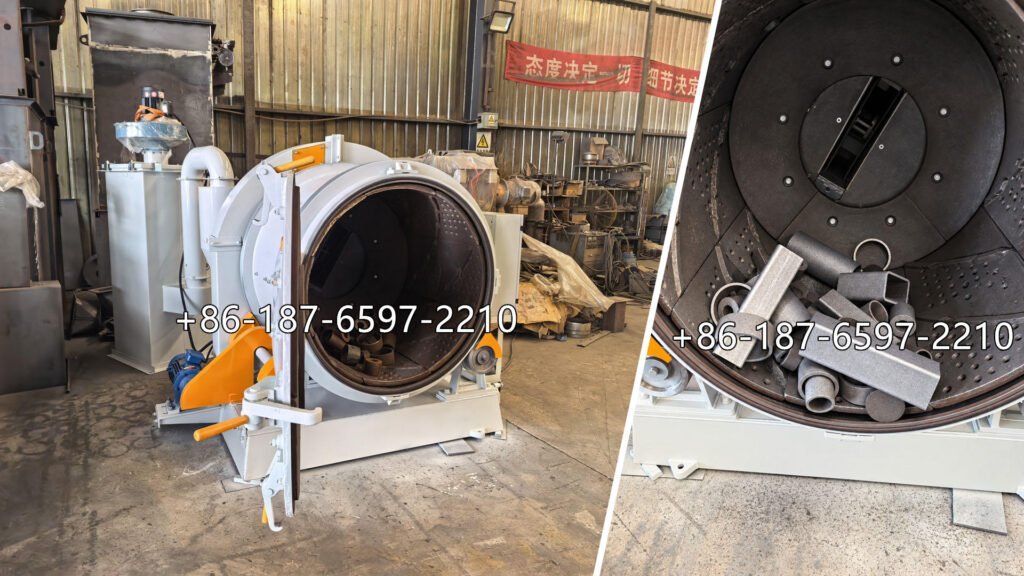
Choosing the right rotary drum shot blasting machine is not just about drum size or motor power. It is about matching the machine to your workpiece weight, batch volume, surface condition, required cleaning grade, and daily production target.
For foundries, forging plants, automotive component manufacturers, and metalworking workshops, a rotary drum shot blasting machine provides an efficient way to remove rust, oxide scale, molding sand, and surface contaminants from suitable small and medium-sized metal parts.
However, different machines have different loading capacities, blast wheel configurations, abrasive circulation systems, and unloading methods. A machine that works well for small castings may not be suitable for heavy forgings or fragile components.
This guide explains how to select the right rotary drum shot blasting machine, compare technical parameters, estimate production requirements, and avoid common purchasing mistakes.
If you are comparing shot blasting machine manufacturers for a new production line or equipment replacement project, use the following selection criteria to narrow down the right configuration before requesting a quotation.
1. What Is a Rotary Drum Shot Blasting Machine?
Rotary drum shot blasting machine is a batch-type surface treatment system. Metal workpieces are loaded into a rotating drum or barrel, where controlled tumbling exposes different surfaces to high-speed abrasive particles thrown by a centrifugal blast wheel.
During operation, the drum rotates at a controlled speed while the abrasive impacts the workpieces. The machine then collects and recirculates reusable abrasive through a separation system, while the dust collector removes dust and fine particles.
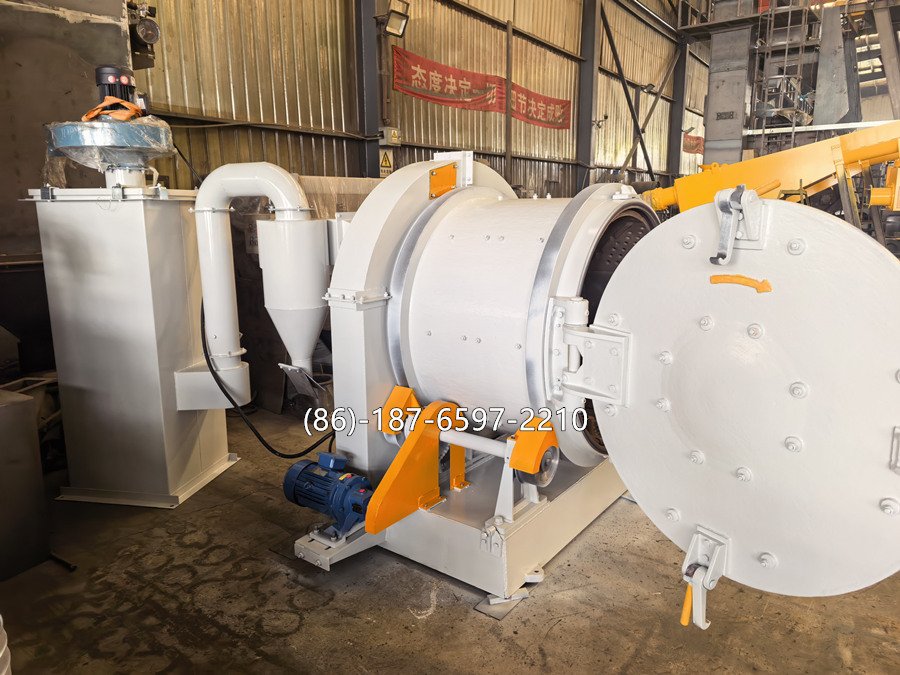
A typical system includes:
- Rotary drum: Holds and moves the workpieces during blasting.
- Blast wheel: Accelerates and projects abrasive onto the workpiece surfaces.
- Abrasive recovery system: Collects and returns reusable abrasive to the blasting process.
- Elevator and separator: Transport and separate reusable abrasive from dust and broken particles.
- Dust collector: Removes airborne dust from the blasting chamber.
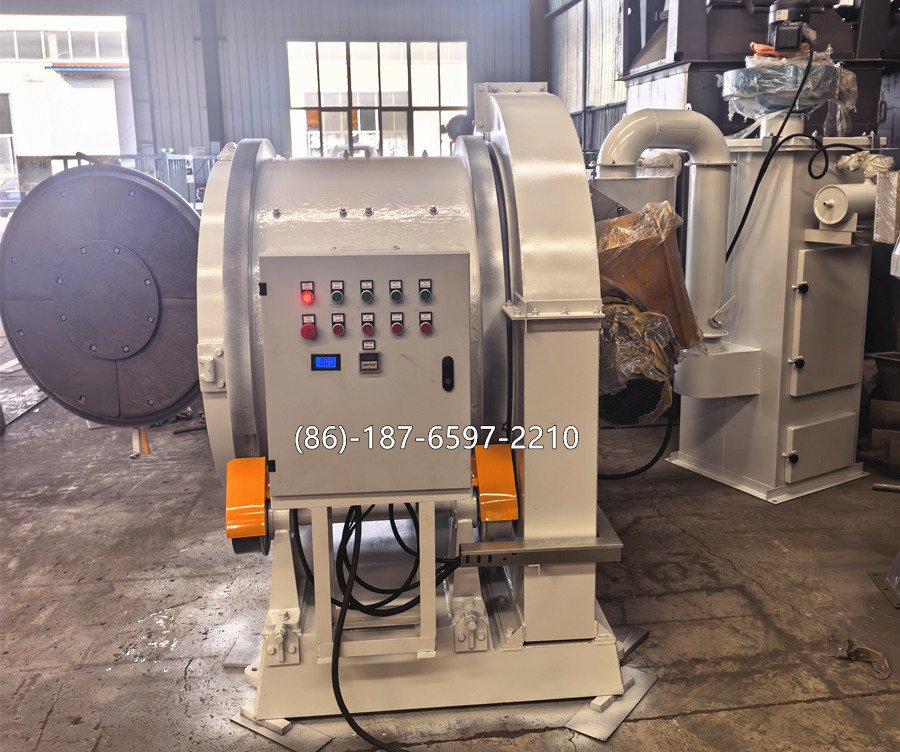
- Electrical control system: Controls the operating sequence, safety interlocks, and optional automatic functions.
Depending on the model, the machine may use a metal drum, a perforated barrel, or a belt-type tumbling arrangement. These designs should not be treated as interchangeable because their workpiece handling methods and suitability differ.
For example, a continuous rotary drum system may be suitable for bulk processing, while a conventional rubber-belt tumble blaster is often used for batch cleaning of smaller components. The correct design depends on the actual workpieces and production process.
2. Which Industries Need a Rotary Drum Shot Blasting Machine?
Rotary drum shot blasting machines are commonly used where many small or medium-sized metal components need repeatable surface cleaning.
| Industry | Typical workpieces | Main cleaning purpose |
|---|---|---|
| Foundry | Cast iron and steel castings | Remove molding sand, scale, and surface residues |
| Forging | Forged metal components | Remove oxide scale and surface contamination |
| Automotive parts | Selected gears, brackets, and small metal components | Prepare surfaces for subsequent processing |
| Hardware manufacturing | Metal fittings and hardware components | Remove rust and improve surface cleanliness |
| Machinery manufacturing | Selected machined or fabricated parts | Remove loose scale and surface contaminants |
| Heat treatment | Suitable steel components | Remove heat-treatment scale |
The machine is most suitable when the workpieces can tumble without unacceptable damage.
Important: Fragile castings, precision-finished surfaces, long shafts, large structural parts, and components that may interlock require a separate suitability assessment. A hook-type, rotary table, or roller conveyor shot blasting machine may be more appropriate.
3. How to Choose the Right Rotary Drum Shot Blasting Machine
3.1 Match the Loading Capacity to Your Actual Batch
The first parameter to check is the allowable workpiece loading capacity.
A machine with a large nominal capacity does not automatically deliver higher productivity. If the parts are bulky, the drum may reach its effective volume limit before reaching its rated weight. If the parts are too heavy, the drum or loading system may exceed its design limits.
Before selecting a model, determine:
- Total workpiece weight per batch.
- Average weight of each individual part.
- Maximum workpiece dimensions and diagonal.
- Bulk volume of the loaded parts.
- Required cleaning time and unloading time.
For example, if a production batch weighs 300 kg, a machine rated for 300 kg may not provide enough practical operating margin for every part type. The actual batch size must also account for workpiece geometry, tumbling behavior, and the manufacturer’s permitted loading conditions.
Do not select a machine based on batch weight alone.
3.2 Check the Maximum Weight and Size of One Workpiece
Individual workpiece limits are different from total batch capacity.
A drum may accommodate several hundred kilograms of small castings but still be unsuitable for one oversized or heavy component.
Check the following dimensions before ordering:
- Maximum individual workpiece weight.
- Maximum length, width, height, and diagonal.
- Minimum opening or clearance required for loading.
- Risk of parts becoming wedged together.
- Risk of collision damage during tumbling.
For irregular castings, the shape and center of gravity also affect how the parts move inside the drum.
If the workpieces contain narrow openings, deep recesses, or complex internal geometry, a trial blast may be necessary to verify cleaning coverage.
3.3 Select the Correct Blast Wheel Power and Abrasive Flow
Blast wheel power affects the machine’s ability to deliver abrasive energy, but power alone does not determine cleaning performance.
Two machines with the same motor rating can produce different results because of differences in wheel design, abrasive flow rate, blade condition, wheel speed, abrasive type, and workpiece movement.
When comparing machines, request the following information:
- Blast wheel motor power and quantity.
- Rated abrasive flow rate in kg/min.
- Wheel rotation speed and control method.
- Recommended abrasive type and size.
- Expected cleaning time for your actual workpieces.
A higher abrasive flow rate may reduce cleaning time for suitable applications, but it can also increase wear and power demand. The configuration should be selected according to the required cleaning result and production target, rather than choosing the largest motor available.
3.4 Choose a Suitable Drum Structure
The drum structure determines how the workpieces move and how well the machine handles repeated loading cycles.
Metal drum or barrel: Suitable for applications where a durable, wear-resistant container is required. Material thickness, wear protection, and internal geometry must be selected for the workpiece and abrasive conditions.
Perforated rotary drum: Can support abrasive passage and separation of smaller particles, depending on the design. The opening size and component geometry must be compatible to prevent workpieces from becoming trapped.
Rubber-belt tumble system: Commonly used for batch treatment of suitable small and medium-sized parts. It allows controlled tumbling but may not be appropriate for sharp-edged, excessively heavy, or heat-sensitive workpieces.
Ask the manufacturer to confirm the drum material, wear protection, loading arrangement, discharge method, and permitted workpiece characteristics.
3.5 Evaluate Abrasive Recycling and Dust Collection
A rotary drum shot blasting machine is not just a drum and a blast wheel. Its abrasive circulation and dust collection systems directly affect long-term operating performance.
The abrasive recovery system should collect reusable abrasive efficiently and separate it from dust, broken media, and other contaminants. Poor separation can reduce blasting consistency and increase abrasive consumption.
The dust collector must be selected according to the machine enclosure, airflow requirements, dust characteristics, and applicable workplace environmental regulations.
During technical evaluation, request:
- Dust collection airflow in m³/h.
- Filter type and filtration arrangement.
- Abrasive elevator and separator capacities.
- Abrasive replenishment requirements.
- Wear-part replacement intervals and maintenance access.
Do not compare dust collectors by motor power alone. The actual airflow, filtration performance, pressure losses, and system configuration are more meaningful selection factors.
3.6 Decide Whether Manual or Automatic Loading Is Required
Manual loading may be practical for smaller batches and lower production volumes. However, as production increases, loading and unloading can become the bottleneck even when blasting capacity is sufficient.
Possible configurations include:
- Manual loading and unloading.
- Mechanical loading assistance.
- Hydraulic loading systems.
- Automatic discharge conveyors.
- PLC-based sequence control.
- Integration with upstream and downstream production equipment.
When calculating productivity, include loading, blasting, discharge, inspection, and any required rework. A short blasting cycle does not necessarily mean a short total production cycle.
4. Rotary Drum Shot Blasting Machine Technical Parameters
The following table provides representative reference data from published rotary drum shot blasting machine specifications. These figures are useful for preliminary comparison, not as a guaranteed specification for every manufacturer.
Representative model comparison
| Parameter | Smaller drum class | Larger drum class |
|---|---|---|
| Example model | Q3110B series | Q3113B series |
| Drum diameter | 1,000 mm | 1,300 mm |
| Loading capacity | 300 kg/batch | 600 kg/batch |
| Maximum individual workpiece weight | 15 kg | 30 kg |
| Published productivity | 600–1,500 kg/h | 2,500–3,500 kg/h |
| Blast wheel abrasive flow | 120 kg/min | 160 kg/min |
| Drum speed | About 3 r/min | About 2.5 r/min |
| Published power excluding dust collection | 9.7–11.9 kW | 14.5–16.3 kW |
| Dust collection airflow | 800–2,000 m³/h | 2,000–2,800 m³/h |
These published specifications show why the complete technical data sheet matters. The larger drum has a greater rated loading capacity, but the appropriate choice still depends on the workpiece dimensions, material, surface condition, and required output.
Production-rate caution: Published productivity figures are model- and application-dependent. Do not treat them as guaranteed production rates for your parts. Request a trial test or written performance confirmation based on your workpiece samples and cleaning requirements.
Parameters to confirm before ordering
In addition to the reference values above, ask the manufacturer to specify:
- Effective drum volume and usable loading space.
- Maximum permitted batch weight and individual part weight.
- Maximum workpiece dimensions.
- Blast wheel power, quantity, and abrasive flow.
- Total installed power, including auxiliary equipment.
- Dust collector airflow and filter configuration.
- Abrasive type, size, initial charge, and replenishment method.
- Overall dimensions, maintenance clearance, and foundation requirements.
- Electrical supply, control system, and safety interlocks.
- Guaranteed cleaning result and acceptance method.
These details help prevent misunderstandings between a standard machine specification and the final equipment configuration.
5. How to Estimate the Required Production Capacity
The required machine capacity should be based on the total quantity of parts that must be cleaned within a shift.
A useful preliminary calculation is:
Required production rate = Daily workpiece quantity ÷ Available production hours
For example, if a factory needs to process 4,000 kg of castings during an 8-hour shift:
4,000 kg ÷ 8 h = 500 kg/h.
This means the machine and the complete operating process must achieve an average output of at least 500 kg/h during the available shift.
However, this is only a first estimate. The selected machine must also allow for loading, unloading, downtime, cleaning variations, and other production interruptions.
If the factory operates two shifts, the batch size, cleaning cycle, and maintenance schedule may be more important than simply selecting the machine with the highest advertised hourly output.
For accurate selection, evaluate three figures together:
- Required daily output.
- Actual cleaning time per batch.
- Total cycle time, including loading and discharge.
A practical trial using representative workpieces is the most reliable way to verify production performance before purchase.
6. International Standards for Shot Blasting and Surface Preparation
International standards can help define the required surface condition and abrasive quality. They should be used alongside the equipment manufacturer’s technical design and the customer’s inspection requirements.
ISO 8501-1: Visual Assessment of Steel Surface Cleanliness
ISO 8501-1 defines visual cleanliness grades for steel substrates, including Sa 1, Sa 2, Sa 2½, and Sa 3 for abrasive blast cleaning.
For steel surfaces that will be painted or coated, Sa 2½ is often specified when a very thorough blast-cleaning result is required. Under this grade, visible oil, grease, and dirt must be absent, and mill scale, rust, previous coatings, and other foreign matter must be removed apart from limited traces.
The required grade should be stated in the purchase specification and verified on the actual workpiece. See the ISO 8501-1 surface cleanliness reference.
Important: ISO 8501-1 is a surface-cleanliness assessment standard, not a machine model selection standard. A rotary drum shot blasting machine does not automatically achieve Sa 2½ on every material or component. The result depends on the initial surface condition, abrasive, blasting parameters, geometry, and process validation.
ISO 8504-2: Abrasive Blast-Cleaning Methods
ISO 8504-2 addresses abrasive blast-cleaning methods used in surface preparation. It is relevant when establishing a preparation procedure for steel substrates before coating.
The process should be evaluated together with the required cleanliness grade and surface profile. A visually clean surface does not by itself establish that the specified roughness or coating performance requirements have been met.
ISO 11124 Series: Metallic Blast-Cleaning Abrasives
The ISO 11124 series covers specifications for metallic blast-cleaning abrasives. Abrasive selection should consider particle type, size, hardness, durability, and compatibility with the workpiece.
For a rotary drum shot blasting machine, the abrasive must also be compatible with the blast wheel, separator, and workpiece handling system. The wrong media can increase wear, damage components, or produce an unsuitable surface finish.
Reference: ISO 11124-1 — Metallic Blast-Cleaning Abrasives.
Purchasing recommendation: Specify the applicable standard and revision, required cleanliness grade, any surface profile requirement, and the inspection method in the technical agreement. Confirm the current edition with the project specification before final approval.
7. Common Purchasing Mistakes to Avoid
| Common mistake | Possible result | Recommended action |
|---|---|---|
| Selecting by drum diameter alone | Insufficient usable capacity | Confirm both batch weight and effective volume |
| Ignoring individual part weight | Drum or handling system overload | State maximum weight per component |
| Choosing the highest motor power | Higher cost without the required performance benefit | Match wheel power and abrasive flow to the application |
| Overlooking dust collection | Excessive dust leakage or poor visibility | Verify airflow and filtration requirements |
| Using an unsuitable abrasive | Surface damage or inconsistent cleaning | Confirm media type, size, and hardness |
| Ignoring loading and unloading time | Actual output below target | Calculate the complete operating cycle |
| Assuming a standard model meets every requirement | Unexpected limitations during production | Request a workpiece test and written technical confirmation |
The most cost-effective machine is not necessarily the machine with the lowest purchase price. It is the one that achieves the required cleaning quality and production output with manageable abrasive consumption, maintenance, and operating costs.
8. Why Consider a Customized Rotary Drum Shot Blasting Machine?
Standard machines are a good starting point when the workpieces fall within established loading and dimensional limits. However, foundries and component manufacturers may require changes to meet their specific production conditions.
Depending on the design, a customized rotary drum shot blasting machine may include:
- Modified drum dimensions or loading capacity.
- Different blast wheel power or wheel quantity.
- Customized drum material and wear protection.
- Automatic loading and discharge.
- PLC control and production sequence integration.
- Dust collection and abrasive separation matched to the application.
- Special electrical configurations for the destination market.
Customization should be based on measurable production requirements rather than adding options without a clear benefit.
For example, if the existing machine meets the cleaning target but cannot achieve the required daily output, the bottleneck may be loading and unloading rather than blast wheel power. An automatic handling system may provide more value than simply increasing motor size.
A suitable manufacturer should explain the design choices, identify operating limitations, and provide a clear list of standard and optional components.
9. Rotary Drum vs. Other Shot Blasting Machines
The correct machine type depends on the shape, size, weight, and production method of your workpieces.
| Machine type | Best suited for | Main consideration |
|---|---|---|
| Rotary drum shot blasting machine | Suitable small and medium-sized bulk components | Parts must tolerate tumbling |
| Rubber-belt tumble shot blaster | Batch cleaning of suitable small castings and components | Avoid excessive part weight, sharp edges, and interlocking |
| Hook-type shot blasting machine | Larger, heavier, or more delicate components that can be suspended | Requires suitable hanging and handling arrangements |
| Rotary table shot blasting machine | Components requiring controlled positioning during blasting | Table size, loading capacity, and part coverage |
| Roller conveyor shot blasting machine | Steel plates, beams, profiles, and other long products | Requires compatible dimensions and continuous-feed production |
If your factory mainly cleans small castings in batches, a rotary drum machine may be a practical choice. If you process long steel plates or structural profiles, a roller conveyor machine is usually a more appropriate starting point.
For components that cannot safely tumble, evaluate hook-type or rotary table equipment instead.
10. Frequently Asked Questions
Q1: What is the difference between a rotary drum and a tumble belt shot blasting machine?
Both systems process suitable parts in batches, but their workpiece handling structures differ. A rotary drum uses a rotating barrel or drum, while a tumble belt machine uses a moving belt to turn and expose the parts. The best choice depends on part size, weight, shape, wear characteristics, and required production output.
Q2: What is the typical loading capacity of a rotary drum shot blasting machine?
Published examples include machines rated at approximately 300 kg and 600 kg per batch. Larger or customized configurations may be available. The final capacity must be confirmed against the actual workpiece volume, individual part weight, and handling requirements.
Q3: How much output can a rotary drum shot blasting machine achieve per hour?
Published examples range from approximately 600–1,500 kg/h for some smaller models to 2,500–3,500 kg/h for some larger models. These are manufacturer-published figures, not universal guarantees. Actual throughput depends on the workpieces, initial contamination, cleaning requirements, cycle time, and loading arrangement.
Q4: Can a rotary drum shot blasting machine achieve Sa 2½?
It may achieve the required cleanliness grade on suitable steel components when the abrasive, machine configuration, and process parameters are correctly selected. Sa 2½ must be verified against ISO 8501-1 using the agreed inspection procedure. Do not assume the grade will be achieved on every workpiece without testing.
Q5: Which abrasive should be used?
Steel shot, steel grit, and other compatible media may be considered depending on the material and cleaning objective. Selection depends on the required surface condition, surface profile, workpiece hardness, blast wheel design, and abrasive recovery system. Confirm the recommended media specification with the manufacturer.
Q6: How can I reduce operating costs?
Focus on abrasive recycling efficiency, appropriate wheel power, correct media selection, wear-part life, dust collector maintenance, and loading efficiency. Stable process settings and preventive maintenance can help reduce downtime and avoid unnecessary abrasive consumption.
Q7: Can the machine be customized?
Yes, depending on the manufacturer’s engineering capabilities. Possible options include different drum dimensions, loading arrangements, blast wheel configurations, automatic discharge, PLC controls, and dust collection systems. Provide your workpiece data and production target to determine which changes are necessary.
Q8: What information is needed to obtain an accurate quotation?
Prepare the workpiece material, maximum part dimensions, maximum individual weight, batch weight, required daily output, initial surface condition, required cleanliness grade, and preferred automation level. Photos, drawings, and representative samples help the manufacturer evaluate suitability more accurately.
11. Get the Right Rotary Drum Shot Blasting Machine for Your Production Line
Choosing the right rotary drum shot blasting machine starts with your workpieces, not the machine catalogue.
A properly selected system should meet your batch capacity, individual part limits, cleaning requirements, production schedule, and maintenance expectations. It should also include a suitable abrasive recovery system, dust collection arrangement, and safe loading and discharge method.
Before placing an order, confirm the machine configuration against your actual parts and request a clear technical specification.
Request a Customized Rotary Drum Shot Blasting Machine Quotation
To help our engineering team evaluate your application, please provide the following information:
- Workpiece material: Cast iron, carbon steel, alloy steel, or other material.
- Workpiece dimensions: Maximum length, width, height, and diagonal.
- Maximum individual weight: kg per piece.
- Batch loading weight: kg per batch.
- Production target: kg/h, kg/shift, or pieces/day.
- Surface condition: Rust, oxide scale, molding sand, or other contamination.
- Required cleaning grade: For example, Sa 2½ where applicable.
- Automation requirement: Manual loading, mechanical loading, or automatic discharge.
- Destination country and electrical supply: To confirm the appropriate configuration.
Send your workpiece photos or drawings together with your production target. The machine configuration can then be evaluated according to the required capacity, blast wheel arrangement, abrasive circulation, dust collection, and handling system.
Looking for a reliable rotary drum shot blasting machine manufacturer? Request a technical evaluation and quotation based on your actual workpieces rather than selecting a machine by price or nominal capacity alone.