
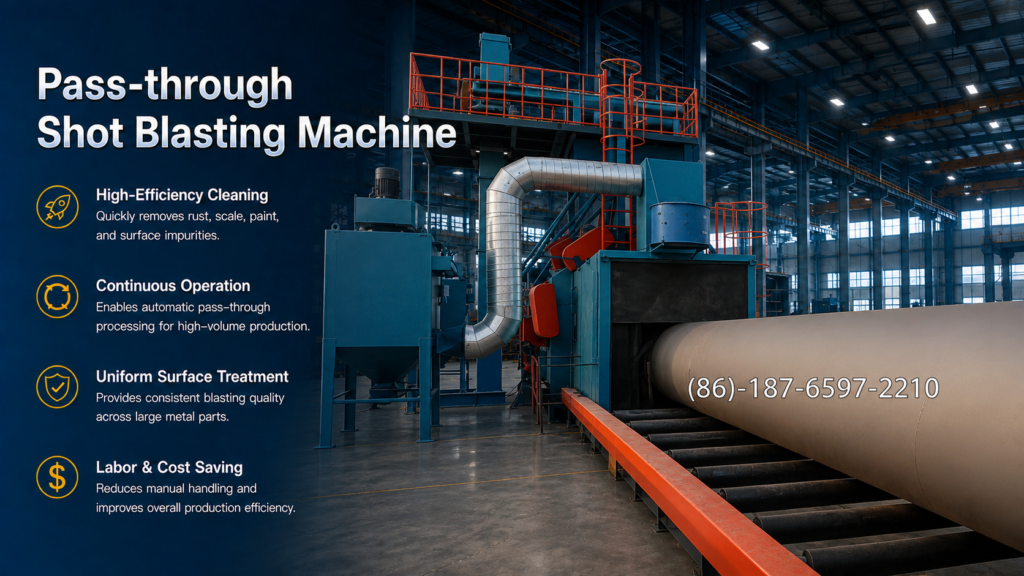
If your factory processes steel plates, structural steel, pipes, profiles, fabricated components, castings, or other large metal workpieces, batch blasting can quickly become a production bottleneck.
The problem is simple:
Load → Blast → Unload → Reload
Every extra handling step costs time, labor, and production capacity.
A Pass Through Shot Blasting Machine solves this problem by creating a continuous blasting process.
Workpieces enter from one side, pass through an enclosed blasting chamber, receive controlled abrasive impact from multiple blast wheels, and exit from the opposite side ready for the next production stage.
The result is a much more streamlined process:
Loading → Continuous Conveying → Shot Blasting → Abrasive Recovery → Dust Separation → Discharge
For high-volume manufacturers, this can turn surface preparation from a manual bottleneck into an automated production process.
What Is a Pass Through Shot Blasting Machine?
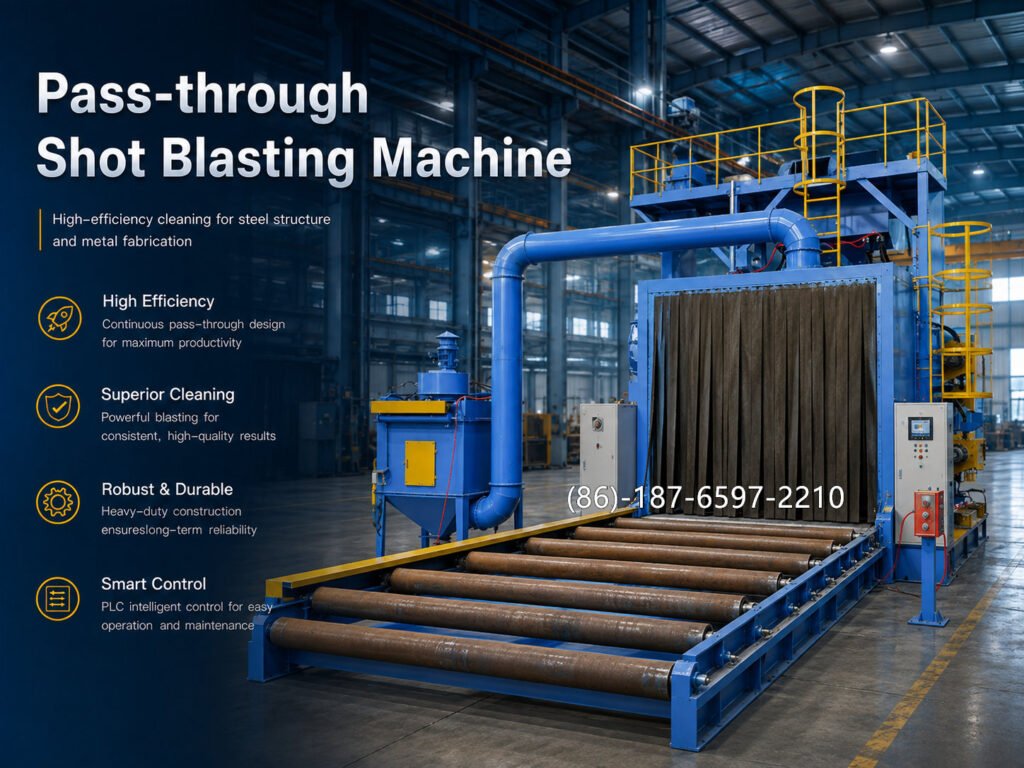
Pass Through Shot Blasting Machine is a continuous abrasive blasting system in which workpieces enter through an inlet opening and leave through an outlet after passing through the blasting chamber.
Depending on the machine configuration, workpieces can be transported by:
- Roller conveyor
- Mesh belt
- Chain conveyor
- Specialized hanging system
- Other continuous conveying mechanisms
Inside the chamber, high-speed blast wheels throw steel shot or grit onto the workpiece.
The abrasive impact removes:
- Rust
- Mill scale
- Oxide
- Foundry sand
- Welding residue
- Surface contaminants
- Existing coatings where the process is appropriately configured
The recovered abrasive is separated, cleaned, and returned to the blasting system.
How Does a Pass Through Shot Blasting Machine Work?
The working principle is straightforward, but every stage affects the final cleaning result.
Step 1: Workpiece Loading
The workpiece enters the machine through the loading section.
For continuous production, materials may be supplied from:
- Steel plate cutting lines
- Fabrication lines
- Casting lines
- Forging lines
- Pipe production lines
- Automatic handling systems
The workpiece dimensions and weight determine the conveyor design and chamber opening.
Step 2: Continuous Conveying
A powered conveyor moves the workpiece through the blasting chamber at a controlled speed.
This is one of the biggest differences between a pass-through system and a batch-type shot blaster.
The operator does not need to stop the machine for every batch.
Conveyor speed affects:
- Blasting exposure time
- Cleaning intensity
- Production throughput
- Abrasive consumption
A slower speed generally provides longer exposure, while a faster speed increases throughput.
The correct setting must be determined through process testing rather than simply choosing the highest possible speed.
Step 3: High-Speed Abrasive Blasting
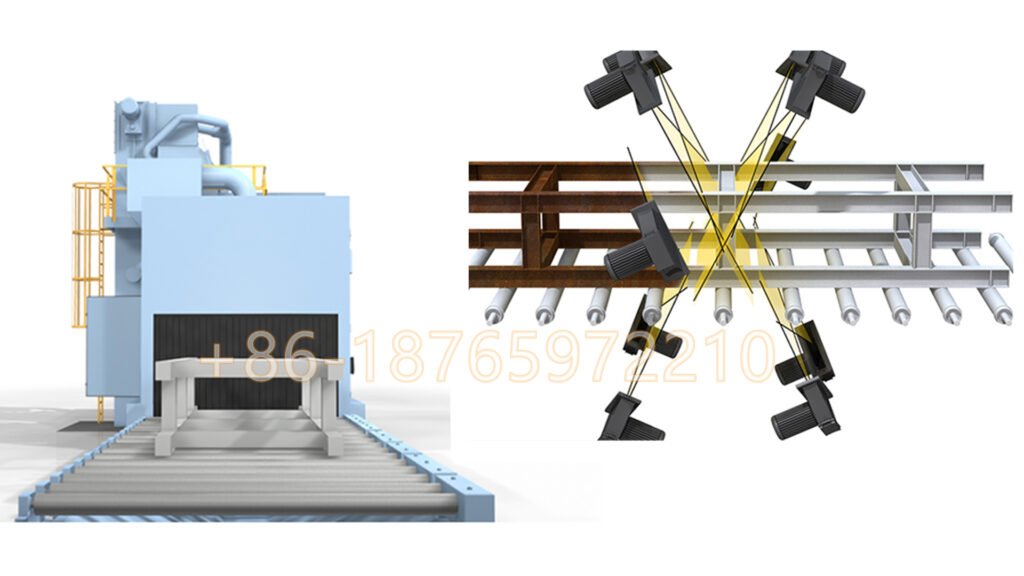
Once the workpiece enters the blasting zone, blast wheels accelerate abrasive media toward its surface.
Depending on the design, blast wheels may be positioned:
- Above the workpiece
- Below the workpiece
- On both sides
- At multiple angles
This arrangement provides more complete coverage of the target surfaces.
For steel plates and structural profiles, multi-wheel configurations are particularly useful because they allow different areas of the workpiece to be exposed to controlled abrasive streams.
Step 4: Surface Contaminant Removal
When abrasive particles impact the workpiece, their kinetic energy breaks away unwanted surface material.
Typical contaminants include:
Mill Scale → Rust → Oxide → Foundry Sand → Welding Residue → Coating Residue
The exact cleaning result depends on:
- Abrasive type
- Abrasive size
- Blast wheel speed
- Abrasive flow
- Conveyor speed
- Workpiece condition
- Blast wheel positioning
This is why simply increasing blast wheel power does not automatically produce a better process.
Step 5: Abrasive Recovery
After striking the workpiece, the abrasive falls to the bottom of the blasting chamber.
A recovery system collects the abrasive and transports it through:
- Screw conveyors
- Bucket elevators
- Magnetic or air separation systems where applicable
- Abrasive storage hoppers
The reusable abrasive is returned to the blast wheels.
This closed-loop circulation reduces unnecessary abrasive loss.
Step 6: Abrasive Separation
Used abrasive contains more than reusable shot.
It can also contain:
- Dust
- Oxide particles
- Broken abrasive
- Paint residue
- Sand
- Fine contaminants
The separator removes these unwanted materials.
Proper separation helps maintain consistent abrasive quality and protects downstream components.
Step 7: Dust Collection
A dedicated dust collection system removes airborne particles generated during blasting.
Typical components include:
- Dust extraction ducts
- Pulse-jet bag filter or cartridge filter
- Exhaust fan
- Filter cleaning system
A properly sized dust collection system helps maintain stable machine operation and cleaner working conditions.
Step 8: Workpiece Discharge
After completing the blasting cycle, the cleaned workpiece exits the opposite side.
It can then proceed directly to:
- Painting
- Powder coating
- Galvanizing
- Welding
- Machining
- Assembly
- Inspection
This makes the pass-through design especially attractive for automated production lines.
Main Components of a Pass Through Shot Blasting Machine
| Component | Function |
|---|---|
| Loading Conveyor | Feeds workpieces into the machine |
| Roller/Mesh Conveyor | Moves workpieces through the blasting chamber |
| Blast Wheels | Accelerate abrasive media |
| Blast Chamber | Contains the blasting process |
| Wear Liners | Protect chamber walls |
| Screw Conveyor | Collects used abrasive |
| Bucket Elevator | Returns abrasive to the separator |
| Separator | Removes dust and broken abrasive |
| Abrasive Hopper | Stores reusable abrasive |
| Dust Collector | Removes airborne dust |
| Control Cabinet | Controls machine operation |
| PLC + HMI | Automatic process monitoring and control |
Typical Technical Parameters
Actual specifications should be engineered around the customer’s workpieces and production requirements. Representative ranges include:
| Parameter | Typical Range |
| Workpiece Width | 1,000–4,000 mm |
| Workpiece Height | 300–1,500 mm |
| Conveyor Speed | 0.5–5 m/min |
| Blast Wheel Power | 11–30 kW per wheel |
| Blast Wheel Quantity | 4–12+ |
| Abrasive Flow | 100–250 kg/min per wheel |
| Roller Diameter | 200–400 mm |
| Conveyor Load | Customized |
| Dust Collector Airflow | 4,000–20,000 m³/h |
| Control System | PLC + HMI |
| Abrasive | Steel Shot / Steel Grit |
Important: These are engineering reference ranges rather than fixed specifications for every machine. Final parameters should be confirmed through workpiece data, production calculations, and blasting tests.
What Can a Pass Through Shot Blasting Machine Process?
1. Steel Plates
Common applications include:
- Shipbuilding
- Steel fabrication
- Pressure vessels
- Storage tanks
- Bridges
- Heavy equipment
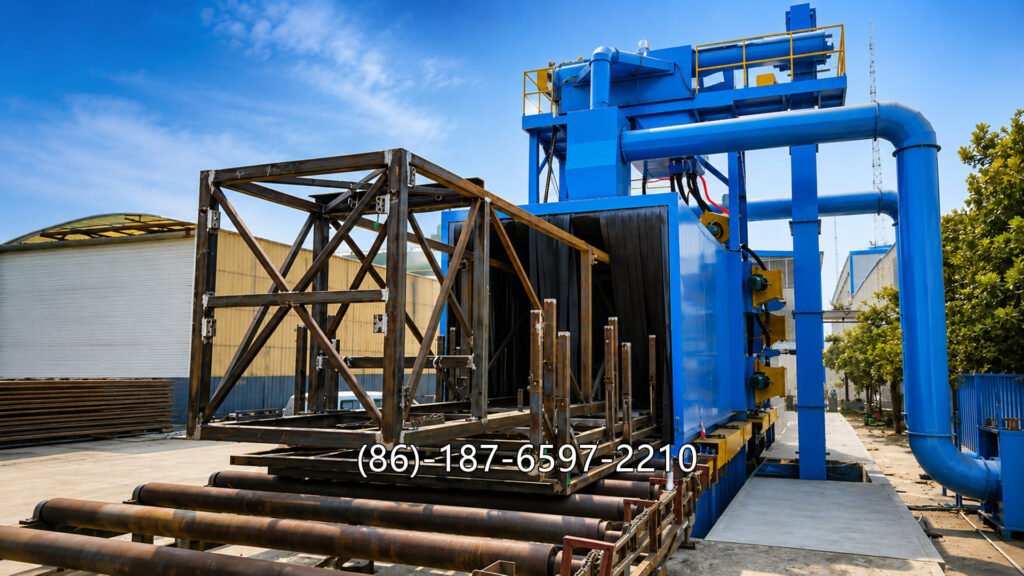
2. Structural Steel
Typical workpieces include:
- H-beams
- I-beams
- Channels
- Angles
- Steel frames
- Welded structures
3. Pipes and Profiles
Pass-through blasting is suitable for preparing pipe and profile surfaces before:
- Painting
- Anti-corrosion coating
- Welding
- Further fabrication
4. Large Castings
Large castings can be continuously conveyed through the blasting chamber where their surfaces are cleaned from:
- Foundry sand
- Oxide
- Scale
- Surface contamination
5. Forgings and Fabricated Components
The machine can be configured for a wide range of heavy industrial components where continuous handling provides a productivity advantage.
Key Benefits of Pass Through Shot Blasting
1. Continuous Production
This is the biggest advantage.
Instead of repeatedly loading and unloading batches, the machine supports a continuous material flow.
Higher throughput = better utilization of production capacity.
2. High Productivity
Production capacity can be optimized through:
- Conveyor speed
- Number of blast wheels
- Abrasive flow
- Workpiece spacing
- Automatic loading
For high-volume steel processing, this can significantly reduce surface preparation time.
3. Consistent Surface Preparation
Manual blasting can vary according to operator technique.
A pass-through system controls:
- Conveyor speed
- Abrasive flow
- Blast wheel operation
- Process time
This creates more repeatable surface preparation.
4. Reduced Labor Requirements
Automation reduces repetitive:
- Loading
- Positioning
- Cleaning
- Unloading
operations.
Operators can focus on process monitoring and quality control.
5. Lower Abrasive Waste
The abrasive circulation system continuously recovers and separates reusable media.
This helps reduce:
- New abrasive consumption
- Waste disposal
- Production interruptions
6. Better Preparation for Coating
Abrasive blasting can remove contaminants and create an appropriate surface profile for subsequent protective coatings.
The required cleanliness and profile should always be specified according to the coating system and project requirements.
ISO 8501-1 provides a framework for visually assessing preparation grades of steel surfaces, while ISO 8503-2 provides a comparator-based method for assessing surface profile on applicable blast-cleaned steel surfaces.
7. Easy Integration into Automated Production
A pass-through shot blasting machine can be integrated with:
- Automatic loading systems
- Steel cutting lines
- Welding lines
- Painting lines
- Drying ovens
- Conveyor systems
- Automatic inspection systems
This makes it suitable for modern high-throughput manufacturing.
Pass Through vs Batch Shot Blasting Machine
| Feature | Pass Through Shot Blasting | Batch/Tumble Shot Blasting |
| Production Mode | Continuous | Batch |
| Large Plates | Excellent | Not Suitable |
| Structural Steel | Excellent | Limited |
| Large Workpieces | Excellent | Limited |
| Small Castings | Application Dependent | Excellent |
| Throughput | High | Medium |
| Automation | Excellent | Good |
| Workpiece Handling | Conveyor | Batch Loading |
| Production Flow | Continuous | Intermittent |
| Best For | Large/High-Volume Parts | Small/Medium Components |
The Practical Rule
If your factory needs to process large workpieces continuously, a pass-through system is usually the more logical solution.
If you primarily process small castings in batches, a tumble-type machine may be more economical.
How to Choose the Right Pass Through Shot Blasting Machine
Factor 1: Workpiece Dimensions
Provide:
- Maximum width
- Maximum height
- Maximum length
- Maximum weight
- Minimum dimensions
These values determine the chamber opening and conveyor configuration.
Factor 2: Production Capacity
Calculate your actual requirement based on:
Required Throughput = Daily Production ÷ Effective Production Hours
Do not use theoretical 24-hour capacity when planning equipment.
Include:
- Loading
- Unloading
- Maintenance
- Shift changes
- Production interruptions
Factor 3: Surface Cleanliness
Your coating or production specification may require a defined preparation grade.
ISO 8501-1:2007 establishes preparation grades for steel surfaces, while a revised edition is currently under development.
Typical project requirements may reference:
- Sa 1
- Sa 2
- Sa 2½
- Sa 3
For many coating applications, Sa 2½ is frequently specified, but the correct grade should come from the customer’s coating specification rather than from the machine supplier alone.
Factor 4: Abrasive Selection
Common metallic abrasives include:
- Cast steel shot
- Steel grit
- Cut steel wire
- Stainless steel abrasive
The current ISO 11124 series provides specifications for metallic blast-cleaning abrasives. ISO 11124-1:2026 classifies metallic blast-cleaning abrasives, while individual parts address specific abrasive types.
Abrasive selection influences:
- Cleaning intensity
- Surface profile
- Wear rate
- Abrasive consumption
Factor 5: Blast Wheel Configuration
The number and position of blast wheels should match the workpiece geometry.
For example:
Steel Plate
Top + bottom blasting may be required.
Structural Steel
Multiple directional blast wheels can improve coverage of profiles and edges.
Large Castings
The blast pattern should be optimized around the actual geometry.
More blast wheels do not automatically mean better cleaning.
Correct blast coverage is more important than simply increasing installed power.
Factor 6: Dust Collection
The dust collector should be selected according to:
- Chamber dimensions
- Abrasive flow
- Workpiece contamination
- Dust generation
- Required filtration performance
An undersized system can cause excessive dust and maintenance problems.
Factor 7: Wear Protection
Ask the supplier about:
- Chamber liners
- Blast wheel blades
- Impellers
- Conveyor rollers
- Bearings
- Screw conveyor wear parts
Wear-resistant materials can significantly affect long-term operating costs.
Common Problems Caused by Incorrect Selection
Uneven Cleaning
Possible causes:
- Incorrect blast wheel positioning
- Excessive conveyor speed
- Poor abrasive distribution
- Incorrect abrasive size
Excessive Abrasive Consumption
Possible causes:
- Poor separator adjustment
- Dust leakage
- Excessive abrasive flow
- Incorrect abrasive specification
Low Production Capacity
Possible causes:
- Undersized chamber
- Insufficient blast wheel power
- Slow material handling
- Poor loading arrangement
Excessive Maintenance
Possible causes:
- Low-quality wear parts
- Incorrect abrasive
- Poor lubrication
- Inadequate preventive maintenance
How to Reduce the Total Cost of Ownership
Do not evaluate a pass-through shot blaster based only on its purchase price.
A better calculation is:
Total Cost of Ownership = Equipment + Energy + Abrasive + Wear Parts + Maintenance + Labor + Downtime
A machine with a higher initial price can provide a better return if it delivers:
- Lower abrasive consumption
- Longer wear-part life
- Higher throughput
- Better dust separation
- Lower downtime
- Easier maintenance
For B2B buyers, the most useful comparison is often cost per ton processed, not simply machine purchase price.
Maintenance Recommendations
Daily Inspection
Check:
- Blast wheel condition
- Abrasive level
- Conveyor operation
- Dust collector pressure
- Abnormal vibration
- Leakage
Weekly Inspection
Check:
- Wear liners
- Conveyor alignment
- Bearings
- Separator performance
- Screw conveyor
Monthly Inspection
Inspect:
- Blast wheel blades
- Motor and gearbox
- Electrical connections
- Dust filter condition
- Abrasive circulation system
A preventive maintenance schedule helps reduce unexpected downtime and protects production capacity.
Why Work with a Factory-Direct Manufacturer?
Choosing the manufacturer is as important as choosing the machine.
A professional supplier should provide:
Application Engineering
Equipment selection based on:
- Workpiece
- Material
- Dimensions
- Weight
- Production volume
- Surface requirements
Customized Machine Design
Including:
- Chamber dimensions
- Blast wheel arrangement
- Conveyor design
- Abrasive recycling
- Dust collection
- Automation
Complete Project Support
From:
Process Analysis → Engineering Design → Manufacturing → Factory Testing → Installation → Commissioning → After-Sales Service
This is especially important for overseas B2B projects where installation and technical support can directly affect the project schedule.
Buying Checklist
Before requesting a quotation, prepare:
- Workpiece name
- Material
- Maximum dimensions
- Minimum dimensions
- Maximum weight
- Average weight
- Production volume
- Required tons/hour
- Existing surface condition
- Required cleanliness grade
- Abrasive type
- Workshop dimensions
- Local voltage
- Automation requirements
Providing these details allows the manufacturer to calculate the correct machine configuration instead of sending a generic quotation.
Frequently Asked Questions
What is a Pass Through Shot Blasting Machine?
It is a continuous shot blasting system in which workpieces enter one side of the machine, pass through an enclosed blasting chamber, and exit from the opposite side after surface preparation.
What is the main advantage?
The main advantage is continuous production. It eliminates repeated batch loading and unloading and is therefore well suited to high-volume industrial production.
What materials can it process?
Typical applications include steel plates, structural profiles, pipes, fabricated steel components, large castings, and forgings.
Can it be fully automated?
Yes. Conveyor systems, PLC controls, automatic loading and unloading, abrasive recycling, dust collection, and downstream coating lines can be integrated.
Can it achieve Sa 2½?
A properly designed and operated abrasive blasting process can be configured to meet specified cleanliness requirements, but the actual achievable grade depends on the workpiece, abrasive, machine configuration, operating parameters, and process validation. ISO 8501-1 defines preparation grades for visual assessment of steel surfaces.
What abrasive should I use?
Steel shot and steel grit are common choices. The correct abrasive depends on the substrate, contamination, desired profile, machine configuration, and coating requirements. ISO 11124 provides specifications for metallic blast-cleaning abrasives.
Final Verdict
A Pass Through Shot Blasting Machine is more than a cleaning machine.
For the right production environment, it becomes an important part of the manufacturing line.
Its biggest advantages are:
- Continuous production
- High throughput
- Consistent surface preparation
- Automatic abrasive recycling
- Reduced labor
- Lower handling requirements
- Easy integration with painting and fabrication lines
But there is one important purchasing principle:
Do not choose a pass-through shot blaster by machine size or price alone. Choose it according to workpiece geometry, tons/hour, cleanliness requirements, abrasive consumption, and total cost of ownership.
That is the difference between simply buying equipment and investing in a profitable surface treatment system.
Get Your Customized Pass Through Shot Blasting Solution
Looking for a Pass Through Shot Blasting Machine Manufacturer for your steel fabrication, foundry, forging, pipe, or heavy equipment production line?
Send us:
1. Workpiece dimensions
2. Workpiece weight
3. Material
4. Production capacity
5. Required surface cleanliness
6. Abrasive type, if already specified
7. Workshop dimensions
8. Automation requirements
Our engineers can recommend:
- Blast wheel quantity and layout
- Chamber dimensions
- Conveyor configuration
- Abrasive recycling system
- Dust collector
- Control system
- Loading/unloading solution
- Complete production-line layout
Request a Factory-Direct Quote
Get a customized technical proposal, equipment configuration, plant layout, and competitive quotation for your Pass Through Shot Blasting Machine.