Factory Direct Roller Conveyor Shot Blasting Machine for Steel Plates & Structural Profiles
Buying a shot blasting machine is easy.
Buying the right machine for your actual steel production is the difficult part.
Many buyers start with one question:
What is your best price?
But for industrial surface preparation equipment, price alone does not tell you whether the machine can handle your production.
A roller conveyor shot blasting machine must be matched to:
Steel Size + Workpiece Weight + Surface Condition + Required Cleaning Grade + Production Capacity + Downstream Process
If these parameters are wrong, even a low-priced machine can become expensive.
The result may be:
Low production capacity
Incomplete rust or mill scale removal
Slow conveyor speed
High abrasive consumption
Excessive maintenance
Rework
Production bottlenecks
A factory direct roller conveyor shot blasting machine gives industrial buyers a more flexible path: the equipment can be configured around the actual steel plate or structural profile instead of forcing the production process to fit a fixed machine.
What Is a Roller Conveyor Shot Blasting Machine?
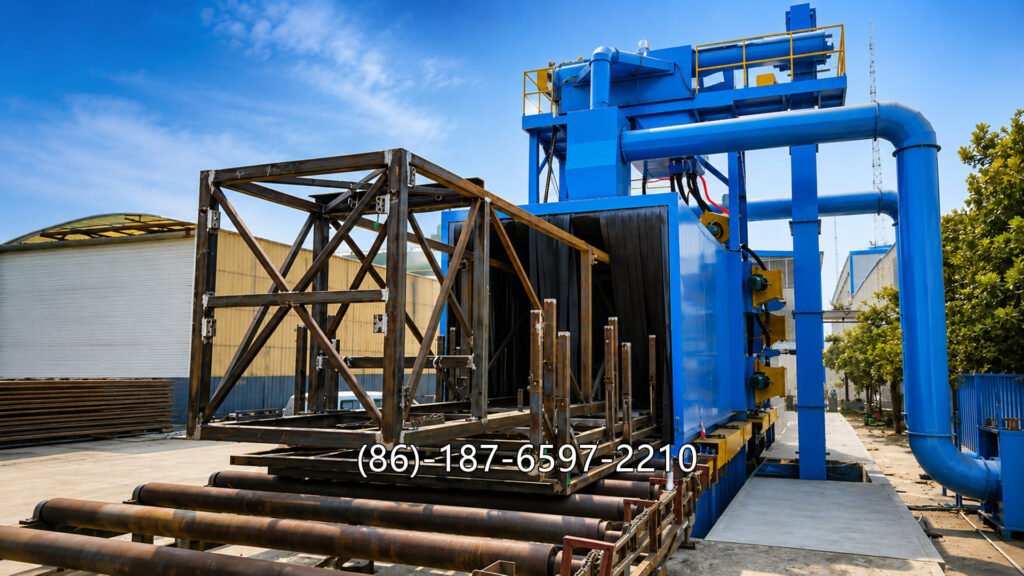
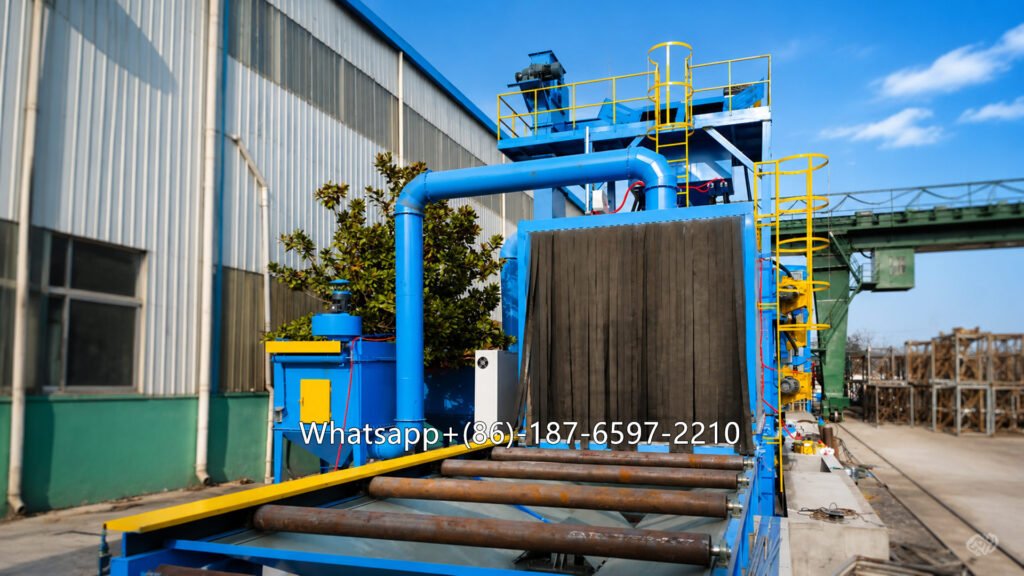
Roller conveyor shot blasting machine is a continuous surface preparation system designed for steel products that can move through a blasting chamber on powered rollers.
Typical workpieces include:
Steel plates
H-beams
I-beams
Steel channels
Angles
Pipes and structural sections
Welded steel structures
Fabricated profiles
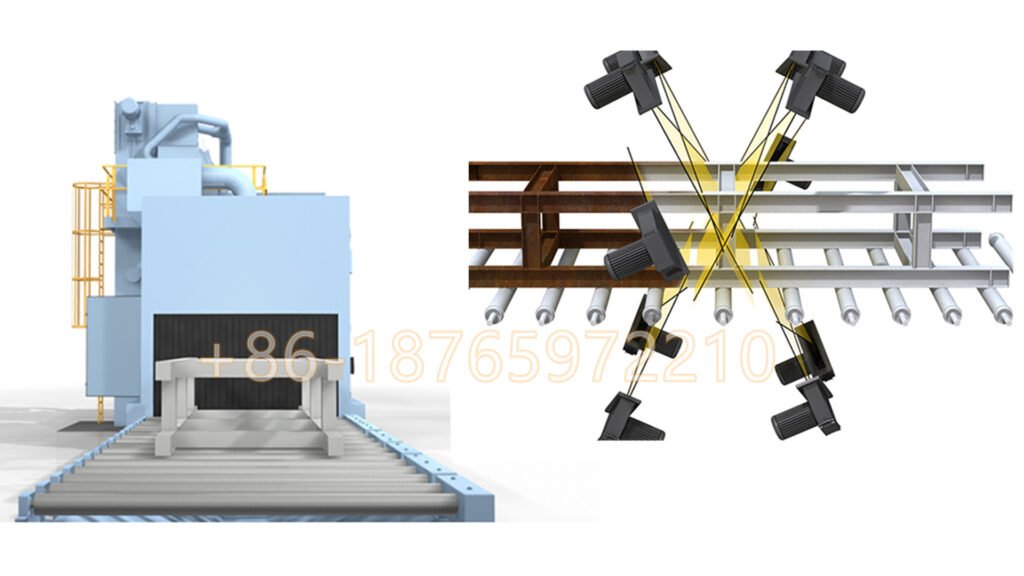
During operation, the workpiece enters the blasting chamber through the roller conveyor.
Multiple blast wheels project abrasive onto the steel surface.
The machine simultaneously performs several processes:
A continuous roller conveyor system is designed around material flow:
Loading
 ↓
Conveying
 ↓
Shot Blasting
 ↓
Surface Cleaning
 ↓
Discharge
 ↓
Next Process
For steel plate production and structural steel fabrication, reducing handling interruptions can improve overall line efficiency.
Key Benefits for Steel Plate Surface Preparation
High-Efficiency Mill Scale Removal
Hot-rolled steel plates often contain mill scale.
Before painting or coating, the surface may need to be prepared to the required specification.
Abrasive blasting can remove:
Mill scale
Rust
Oxide
Loose coating
Surface contamination
The final result depends on the complete blasting process rather than motor power alone.
Key parameters include:
Abrasive type
Abrasive size
Abrasive flow rate
Blast wheel configuration
Conveyor speed
Initial steel condition
Continuous Material Handling
Steel plates can move through the machine continuously.
This is useful for:
Steel service centers
Shipbuilding production
Structural steel plants
Pressure vessel fabrication
Heavy machinery manufacturing
The roller conveyor can also be designed to connect with upstream and downstream equipment.
Repeatable Surface Quality
Manual grinding can produce different results depending on the operator.
A controlled blasting process provides more consistent parameters.
For example:
Conveyor Speed = Controlled
Abrasive Flow = Adjustable
Blast Wheel Position = Fixed
Blasting Coverage = Designed
This helps improve process repeatability, particularly before coating operations.
Surface Preparation Standards: Sa 2, Sa 2½ and Sa 3
Steel surface preparation should not be described only as:
Clean.
Industrial coating systems often require a defined preparation grade.
ISO 8501-1 is commonly used for the visual assessment of surface cleanliness of steel substrates and includes blast-cleaning preparation grades such as:
Sa 2
Sa 2½
Sa 3
In practical terms, the required grade should be determined by the project specification and coating system.
Sa 2
Thorough blast cleaning.
Sa 2½
Very thorough blast cleaning and a commonly specified preparation level for demanding protective coating systems.
Sa 3
Blast cleaning to visually clean steel, generally specified when an extremely high level of visual cleanliness is required.
Engineering note: Sa grades are surface preparation grades, not machine models. The ability to achieve a target grade depends on the initial steel condition, abrasive, blast wheel configuration, exposure time and process control.
Surface Profile Matters Too
A steel surface can appear clean and still be unsuitable for the selected coating.
Why?
Because surface profile affects the mechanical interaction between the coating and the substrate.
Abrasive blasting creates a surface profile influenced by:
Abrasive shape
Abrasive size
Blasting velocity
Abrasive condition
Exposure time
Steel substrate
ISO 8503 covers surface roughness characteristics of blast-cleaned steel substrates.
ISO 8503-2 provides a comparator method for grading surface profile, while ISO 8503-5 covers the use of replica tape for determining surface profile.
A project may specify a target profile range, for example:
The usable abrasive is returned to the blasting system.
For metallic blast-cleaning abrasives, the ISO 11124 series covers specifications and classification, including requirements for cast-steel shot and grit.
Dust Collection Is Part of the Production System
A shot blasting machine without an appropriately designed dust collection system can create problems throughout the workshop.
Dust collection helps support:
Cleaner production areas
Better visibility
Protection of mechanical components
Improved operator working conditions
The dust collector should be selected according to:
Blasting chamber size
Abrasive flow
Air volume requirement
Machine openings
Material transfer points
Local environmental requirements
A larger dust collector is not automatically better.
The airflow must match the actual machine design.
Roller Conveyor Shot Blasting Machine vs. Other Types
Machine Type
Typical Application
Roller Conveyor Shot Blasting Machine
Steel Plate & Structural Profiles
Hanger Shot Blasting Machine
Complex Components & Fabrications
Tumble Belt Shot Blasting Machine
Small and Medium Batch Parts
Wire Mesh Belt Shot Blasting Machine
Continuous Small Components
Turntable Shot Blasting Machine
Heavy or Large Individual Parts
Pipe Shot Blasting Machine
Pipe Internal or External Surface
Floor Shot Blasting Machine
Large Flat Floor Surfaces
For long, flat and continuously produced steel materials, the roller conveyor configuration is often the most practical starting point.
Factory Direct Customization Options
A factory direct project can be configured according to your production requirement.
Possible options include:
Customized Working Width
Designed according to your maximum steel plate or structural profile width.
Customized Working Height
Suitable for H-beams, I-beams and fabricated structures.
Blast Wheel Quantity
Selected according to:
Required production capacity
Surface condition
Workpiece geometry
Conveyor System
Customized for:
Workpiece weight
Workpiece length
Material handling method
Dust Collection
Configured according to machine size and production environment.
PLC Automation
Optional functions may include:
Automatic start/stop
Conveyor speed adjustment
Fault monitoring
Interlock protection
Production data monitoring
Complete Production Line
The shot blasting machine can be integrated with:
Loading conveyors
Cross transfer systems
Roller conveyors
Painting equipment
Drying equipment
Material handling systems
What Information Do We Need for Machine Selection?
Before requesting a quotation, prepare the following information.
A lower purchase price does not necessarily mean lower operating cost.
The following components should be included in the maintenance plan.
Blast Wheel Wear Parts
Inspect:
Blades
Impeller
Control cage
Distributor
Wear liners
Conveyor Rollers
Check:
Bearings
Alignment
Wear
Drive system
Abrasive Separator
Monitor separation efficiency and abrasive quality.
Bucket Elevator
Inspect:
Buckets
Belt
Drive system
Alignment
Dust Collector
Check:
Filter elements
Pulse cleaning system
Dust discharge
Differential pressure
Preventive maintenance is generally more cost-effective than unplanned downtime.
How to Reduce Shot Blasting Operating Cost
The biggest operating savings often come from process control.
Maintain the Correct Abrasive Mix
Too many fine particles can reduce blasting efficiency.
Control Conveyor Speed
Avoid running unnecessarily slow or excessively fast.
Replace Worn Blast Wheel Components
Worn components can reduce abrasive throwing efficiency.
Adjust the Separator Correctly
Good separation helps retain usable abrasive.
Match the Machine to Actual Production
Oversized equipment may increase unnecessary investment.
Undersized equipment may create a bottleneck.
The goal is balance.
Frequently Asked Questions
What is a roller conveyor shot blasting machine used for?
It is mainly used for continuous cleaning and surface preparation of steel plates, H-beams, I-beams, channels and other structural steel products.
Can it remove mill scale from steel plate?
Yes. With the correct abrasive and blasting parameters, the machine can remove mill scale, rust and other surface contaminants.
Can a roller conveyor shot blasting machine achieve Sa 2½?
A properly configured blasting process can be designed to achieve Sa 2½ surface preparation requirements. Actual results depend on the initial surface condition, abrasive, machine configuration and operating parameters.
Can it process H-beams and I-beams?
Yes. The machine can be designed with an appropriate working height and blast wheel arrangement for structural profiles.
What abrasive is normally used?
Steel shot and steel grit are commonly used, depending on cleaning and surface profile requirements.
What production capacity can the machine achieve?
Capacity depends on the workpiece dimensions, surface condition, required cleanliness, blast wheel configuration and conveyor speed.
Can the machine be connected to a painting line?
Yes. Roller conveyor systems can be integrated with primer painting and other downstream surface treatment equipment.
How much does a roller conveyor shot blasting machine cost?
The price depends on machine dimensions, blast wheel quantity, production capacity, dust collection system, conveyor configuration and automation level.
For an accurate quotation, workpiece and production data are required.
Factory Direct Roller Conveyor Shot Blasting Machine: RFQ Template
Copy the following information into your inquiry:
Machine: Roller Conveyor Shot Blasting Machine
Workpiece: __________________
Maximum Width: ______ mm
Maximum Height: ______ mm
Maximum Length: ______ mm
Maximum Weight: ______ kg / ton
Surface Condition: __________________
Required Surface Grade: Sa 2 / Sa 2½ / Sa 3
Required Surface Profile: ______ μm
Production Capacity: ______ tons/hour or ______ m²/hour
Abrasive Preference: Steel Shot / Steel Grit / Other
Downstream Process: __________________
Power Supply: ______ V / ______ Hz / ______ Phase
Installation Country: __________________
Other Requirements: __________________
Get a Factory Direct Customized Solution
If your factory processes steel plates or structural profiles continuously, the shot blasting machine should be selected as part of your production system.
Send us:
Your steel dimension
Your production capacity
Your required surface preparation grade
We can then build the machine proposal around your actual application.
We’re here to help! Whether you need more information about our products or services, our team is ready to assist. Don’t hesitate to reach out—we’re just a message away!