
Introduction: How Does a Roller Conveyor Shot Blasting Machine Work?
If your production line handles steel plates, beams, pipes, fabricated structures, castings, forgings, or large metal components, manual surface cleaning quickly becomes a bottleneck.
The problem is not simply labor.
It is also:
- Uneven surface preparation
- Inconsistent blasting quality
- High abrasive consumption
- Difficult dust control
- Low production efficiency
- High labor costs
This is where a Roller Conveyor Shot Blasting Machine becomes valuable.
Unlike batch-type tumblast machines, a roller conveyor shot blasting system moves workpieces continuously through a blasting chamber. High-speed blast wheels project abrasive media onto the surface while the workpiece travels through the machine.
The result?
Continuous production + uniform surface cleaning + automatic abrasive recycling.
For manufacturers looking to increase throughput without adding excessive manual labor, understanding how the system works is the first step toward selecting the right configuration.
What Is a Roller Conveyor Shot Blasting Machine?
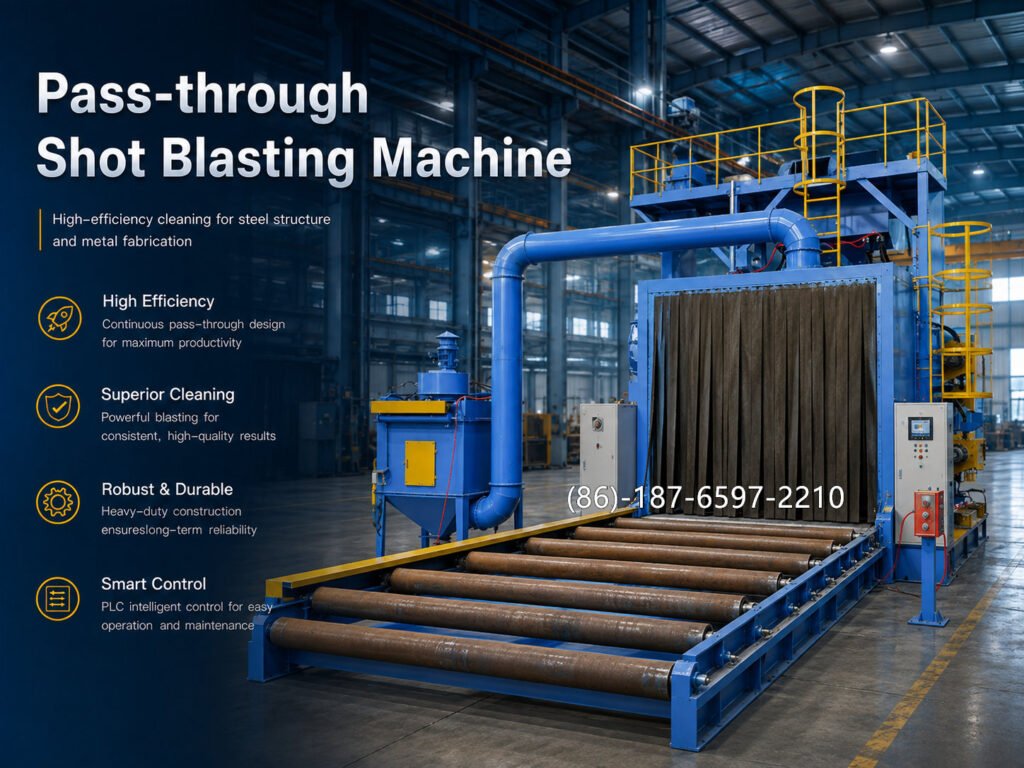
Roller Conveyor Shot Blasting Machine is a continuous surface treatment system that uses powered rollers to transport metal workpieces through one or more enclosed blasting chambers.
Inside the chamber, high-performance blast wheels accelerate steel shot or grit toward the workpiece.
The abrasive impact removes:
- Rust
- Mill scale
- Foundry sand
- Oxide layers
- Welding residue
- Paint and coatings
- Surface contaminants
After blasting, the abrasive is collected, separated from dust and debris, and automatically returned to the blast wheels.
This creates a continuous and highly efficient surface preparation process.
Roller Conveyor Shot Blasting Machine Working Principle
The complete working cycle can be divided into several stages.
1. Workpiece Loading
Steel plates, profiles, beams, pipes, castings, or fabricated components are placed onto the powered roller conveyor.
Depending on the production line, loading can be:
- Manual
- Crane-assisted
- Automatic
- Integrated with upstream equipment
The roller spacing and load capacity are selected according to workpiece dimensions and weight.
2. Continuous Roller Conveying
The powered rollers transport the workpiece through the machine at a controlled speed.
The conveyor speed directly influences blasting intensity.
Slower Conveyor Speed
Provides:
- Longer blasting exposure
- More abrasive impact
- Deeper cleaning
- Higher surface preparation intensity
Faster Conveyor Speed
Provides:
- Higher throughput
- Shorter processing time
- Lower abrasive exposure
The correct speed depends on material condition and required surface cleanliness.
3. High-Speed Shot Blasting
This is the core of the machine.
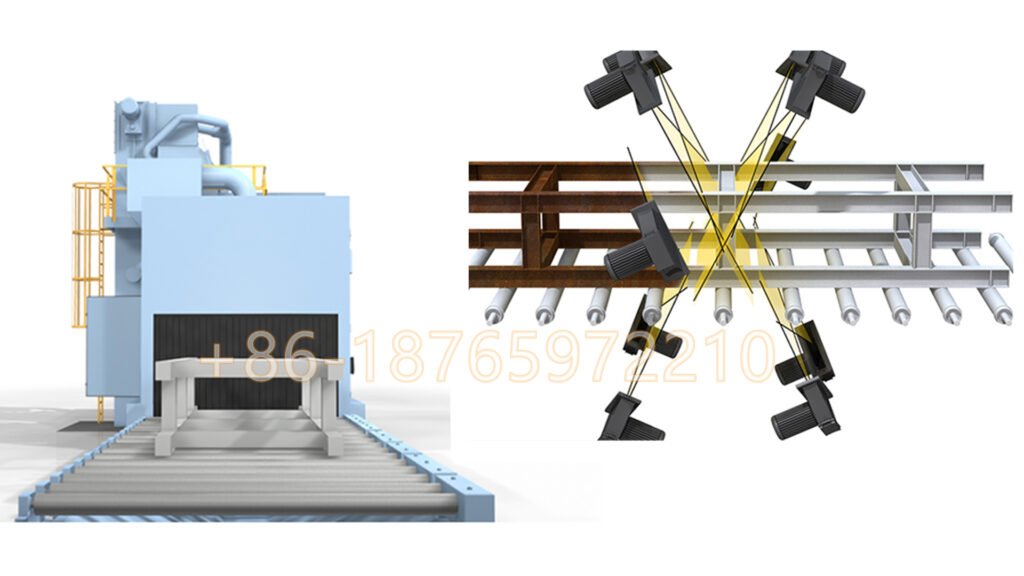
High-speed blast wheels rotate at controlled speeds and throw abrasive media toward the workpiece.
Depending on the machine design, blast wheels can be installed:
- Above the workpiece
- Below the workpiece
- On both sides
- At multiple angles
This arrangement provides comprehensive coverage of the required surfaces.
For steel plates and structural profiles, multi-directional blasting is especially important because different surfaces and edges require consistent treatment.
4. Abrasive Impact Removes Surface Contamination
When steel shot or grit hits the workpiece at high velocity, the impact breaks and removes unwanted surface layers.
Typical contaminants include:
Rust → Mill Scale → Oxide → Sand → Old Coating → Welding Residue
At the same time, abrasive blasting creates a controlled surface profile that can improve the adhesion of subsequent coatings.
For painted steel structures, this is particularly important because surface preparation directly affects coating performance.
5. Abrasive Recovery
After impact, the abrasive falls toward the bottom of the blasting chamber.
A recovery system collects the used abrasive and transfers it through:
- Screw conveyors
- Bucket elevators
- Separators
- Abrasive hoppers
The abrasive is then returned to the blasting system.
This closed-loop design significantly reduces abrasive waste.
6. Separation of Dust and Broken Abrasive
During blasting, abrasive particles gradually break down and become mixed with:
- Dust
- Oxide
- Paint residue
- Broken abrasive
- Fine sand particles
The separator removes unsuitable material from the reusable abrasive.
This is critical because poor abrasive separation can cause:
- Unstable blasting performance
- Excessive dust
- Higher abrasive consumption
- Increased wear on blast wheels
7. Dust Collection
A dedicated dust collection system extracts airborne particles from the blasting chamber.
A typical system may include:
- Pulse-jet bag filter
- Cartridge dust collector
- Exhaust fan
- Air ducts
- Automatic filter cleaning
Effective dust extraction helps maintain:
- Cleaner workshop conditions
- Better visibility
- More stable blasting
- Lower equipment contamination
- Improved environmental performance
8. Finished Workpiece Discharge
After passing through the blasting chamber, the cleaned workpiece exits through the discharge section.
It can then proceed directly to:
- Painting
- Powder coating
- Galvanizing
- Welding
- Machining
- Assembly
- Inspection
This makes roller conveyor blasting particularly suitable for continuous manufacturing lines.
Main Components of a Roller Conveyor Shot Blasting Machine
A complete system normally consists of several major components.
| Component | Main Function |
|---|---|
| Roller Conveyor | Transports workpieces continuously |
| Blast Wheel | Accelerates abrasive media |
| Blasting Chamber | Contains the blasting operation |
| Wear Liners | Protect chamber walls from abrasive impact |
| Screw Conveyor | Collects and transports abrasive |
| Bucket Elevator | Lifts recovered abrasive |
| Air Separator | Removes dust and broken abrasive |
| Abrasive Hopper | Stores reusable abrasive |
| Dust Collector | Removes airborne dust |
| Control Cabinet | Controls machine operation |
| PLC + HMI | Enables automatic process control |
Typical Technical Parameters
The exact configuration should always be based on the workpiece and production target. Typical industrial ranges include:
| Parameter | Typical Range |
| Workpiece Width | 1,000–4,000 mm |
| Workpiece Height | 300–1,200 mm |
| Conveyor Speed | 0.5–5 m/min |
| Blast Wheel Power | 11–30 kW per wheel |
| Number of Blast Wheels | 4–12+ |
| Abrasive Flow Rate | 100–250 kg/min per wheel |
| Roller Diameter | 200–400 mm |
| Roller Load Capacity | Customized |
| Dust Collector Airflow | 4,000–20,000 m³/h |
| Control System | PLC + HMI |
| Abrasive Media | Steel Shot / Steel Grit |
Important: These figures are representative engineering ranges, not a universal specification. Actual parameters should be calculated from workpiece dimensions, material, surface condition, throughput, and required cleanliness grade.
What Materials Can Be Processed?
One of the biggest advantages of roller conveyor blasting is its ability to handle large and heavy workpieces.
Typical applications include:
Steel Plates
Used for:
- Shipbuilding
- Steel fabrication
- Storage tanks
- Bridges
- Pressure vessels
Structural Steel
Suitable for:
- H-beams
- I-beams
- Channels
- Angles
- Steel frames
Pipes and Profiles
Used for surface preparation before:
- Coating
- Painting
- Welding
- Anti-corrosion treatment
Castings and Forgings
The system can also process large castings and forged components where continuous or semi-continuous handling is preferred.
Key Benefits of Roller Conveyor Shot Blasting
1. Continuous Production
Unlike batch-type equipment, the workpiece does not need to be loaded, blasted, unloaded, and reloaded individually.
The process becomes:
Loading → Conveying → Blasting → Cleaning → Discharge
This significantly improves production flow.
2. Higher Productivity
Continuous conveying makes roller conveyor systems particularly suitable for high-volume manufacturing.
Production capacity can be increased by optimizing:
- Conveyor speed
- Blast wheel quantity
- Abrasive flow
- Workpiece spacing
- Loading and unloading
3. Consistent Surface Quality
Automatic blasting eliminates many variations associated with manual cleaning.
A controlled process provides more consistent:
- Surface cleanliness
- Blast intensity
- Exposure time
- Surface profile
4. Lower Labor Requirements
Once integrated into an automated production line, operators mainly monitor:
- Loading
- Machine status
- Abrasive level
- Dust collector condition
- Finished workpieces
This reduces repetitive manual cleaning operations.
5. Efficient Abrasive Recycling
The automatic abrasive circulation system recovers and reuses suitable shot.
This helps reduce:
- Abrasive consumption
- Waste generation
- Operating costs
6. Better Coating Preparation
A properly controlled abrasive blasting process creates a clean and appropriately textured surface for subsequent coating operations.
This can improve coating adhesion and contribute to longer coating service life.
For steel structures, cleanliness requirements should be specified according to the applicable project and coating standard rather than simply choosing the most aggressive blasting setting.
7. Easy Integration with Production Lines
A roller conveyor shot blasting machine can be integrated with:
- Shot blasting preheating systems
- Automatic loading machines
- CNC cutting lines
- Welding lines
- Painting lines
- Drying chambers
- Conveyor systems
This makes it a strong option for smart factory and automated production projects.
Roller Conveyor vs Tumble Shot Blasting Machine
| Feature | Roller Conveyor | Tumble Belt |
| Production Mode | Continuous | Batch |
| Large Steel Plates | Excellent | Not Suitable |
| Structural Steel | Excellent | Limited |
| Large Workpieces | Excellent | Limited |
| Small Castings | Good | Excellent |
| Production Volume | High | Medium |
| Automation | Excellent | Good |
| Workpiece Handling | Roller Conveyor | Tumbling |
| Surface Coverage | Controlled Directional | 360° Tumbling |
| Best Application | Large/Continuous Parts | Small/Medium Batch Parts |
Simple Buying Rule
Choose a Roller Conveyor Shot Blasting Machine when your production involves large, heavy, long, or continuously processed workpieces.
Choose a Tumble Shot Blasting Machine when you primarily process smaller castings and components in batches.
How to Choose the Right Roller Conveyor Shot Blasting Machine
Factor 1: Maximum Workpiece Size
Provide:
- Maximum width
- Maximum height
- Maximum length
- Maximum weight
These dimensions determine the chamber opening and conveyor specifications.
Factor 2: Required Production Capacity
Calculate:
Required Capacity = Daily Production ÷ Effective Operating Hours
Do not calculate capacity using theoretical machine running time alone. Include loading, unloading, maintenance, and production interruptions.
Factor 3: Required Surface Cleanliness
Determine whether your application requires:
- Sa 1
- Sa 2
- Sa 2½
- Sa 3
under the applicable abrasive blast-cleaning specification.
For many coating applications, Sa 2½ is commonly specified, but the final requirement should come from the coating system and project specification.
Factor 4: Abrasive Type
Common choices include:
- Cast steel shot
- Steel grit
- Stainless steel shot
- Cut wire shot
Abrasive selection affects:
- Cleaning intensity
- Surface profile
- Wear rate
- Abrasive consumption
Factor 5: Blast Wheel Configuration
More blast wheels do not automatically mean better performance.
The correct configuration depends on:
- Workpiece geometry
- Surface area
- Required cleanliness
- Production speed
- Abrasive flow
Factor 6: Dust Collection
The dust collector should be sized according to chamber volume, abrasive flow, dust generation, and required filtration performance.
Factor 7: Wear Protection
Look for:
- Replaceable chamber liners
- High-chromium wear plates
- Durable blast wheel blades
- Heavy-duty bearings
- Reinforced roller construction
These components strongly influence long-term operating costs.
Common Problems Caused by Incorrect Selection
Problem 1: Insufficient Cleaning
Possible causes:
- Conveyor speed too high
- Insufficient abrasive flow
- Incorrect blast wheel configuration
- Wrong abrasive size
Problem 2: Excessive Abrasive Consumption
Possible causes:
- Poor separator adjustment
- Dust leakage
- Incorrect abrasive size
- Excessive blasting intensity
Problem 3: Uneven Surface Quality
Possible causes:
- Incorrect blast wheel positioning
- Poor workpiece spacing
- Uneven conveyor speed
- Incorrect abrasive distribution
Problem 4: High Maintenance Costs
Possible causes:
- Poor-quality wear parts
- Incorrect abrasive selection
- Insufficient lubrication
- Inadequate preventive maintenance
How to Reduce Operating Costs
The purchase price is only one part of the investment.
Evaluate the Total Cost of Ownership (TCO):
TCO = Equipment Cost + Energy + Abrasive + Wear Parts + Maintenance + Labor + Downtime
A slightly more expensive machine can provide a better ROI if it offers:
- Longer blast wheel life
- Lower abrasive consumption
- Better dust separation
- More durable liners
- Higher production capacity
- Easier maintenance
This is why professional buyers should compare cost per ton processed, not simply equipment price.
Maintenance Tips
A preventive maintenance program should include:
Daily
- Check blast wheel condition
- Check abrasive level
- Inspect rollers
- Check dust collector pressure
- Remove accumulated debris
Weekly
- Inspect wear liners
- Check conveyor alignment
- Inspect bearings
- Check separator performance
Monthly
- Inspect blast wheel blades
- Check motor and gearbox
- Inspect screw conveyors
- Check electrical connections
Periodically
- Replace worn components
- Calibrate conveyor speed
- Inspect dust filter elements
- Check blast pattern
Preventive maintenance is usually much cheaper than emergency downtime.
Why Choose a Factory-Direct Roller Conveyor Shot Blasting Machine?
A professional manufacturer should provide more than a machine.
You should expect:
Engineering-Based Selection
The system is calculated according to:
- Workpiece dimensions
- Material
- Surface condition
- Production capacity
- Cleanliness requirements
Customized Layout
The manufacturer can design:
- Loading section
- Blasting chamber
- Conveyor route
- Abrasive recovery
- Dust collection
- Discharge section
according to your workshop.
Complete Technical Support
Including:
- Process consultation
- Equipment manufacturing
- Factory testing
- Installation guidance
- Commissioning
- Operator training
- Spare parts
- After-sales support
Buying Checklist
Before requesting a quotation, prepare these details:
- Workpiece name
- Material
- Maximum dimensions
- Minimum dimensions
- Maximum weight
- Average weight
- Required tons/hour
- Surface condition
- Required cleanliness grade
- Abrasive type
- Automation level
- Workshop dimensions
- Local power supply
The more accurate your production information, the more accurate the machine quotation will be.
Frequently Asked Questions
What is the main advantage of a roller conveyor shot blasting machine?
Its biggest advantage is continuous automated blasting. It is particularly effective for large, heavy, long, or high-volume workpieces.
Can it blast both sides of a steel plate?
Yes. Properly configured systems can use blast wheels positioned above and below the workpiece for comprehensive surface treatment.
Is it suitable for structural steel?
Yes. H-beams, I-beams, channels, angles, plates, and other fabricated steel profiles are common applications.
Can the machine be connected to a painting line?
Yes. Roller conveyor blasting systems can be integrated with downstream painting, coating, drying, and handling equipment.
What surface cleanliness can be achieved?
The required cleanliness depends on machine configuration, abrasive selection, operating parameters, and workpiece condition. Surface preparation should be specified according to the applicable project standard, such as ISO 8501-1.
Is the machine fully automatic?
It can be. PLC control, automatic loading, automatic unloading, conveyor synchronization, abrasive circulation, and dust collection can all be integrated into an automated production line.
Is a Roller Conveyor Shot Blasting Machine Right for Your Factory?
If your production requires continuous processing of steel plates, structural steel, fabricated components, pipes, large castings, or other heavy workpieces, a Roller Conveyor Shot Blasting Machine can deliver a major productivity advantage.
The strongest benefits are:
- Continuous production
- High throughput
- Consistent surface preparation
- Automatic abrasive recycling
- Lower labor requirements
- Better coating preparation
- Easy production-line integration
But the key is selecting the machine according to your actual workpiece and production data.
Do not buy based on machine price alone.
Buy based on cleaning performance + tons/hour + abrasive consumption + maintenance cost + total cost of ownership.
Get a Customized Roller Conveyor Shot Blasting Solution
Looking for a Roller Conveyor Shot Blasting Machine Manufacturer for your steel, foundry, forging, or fabrication operation?
Send us:
1. Workpiece size
2. Workpiece weight
3. Material
4. Required production capacity
5. Required surface cleanliness
6. Workshop dimensions
7. Automation requirements
Our engineers can evaluate your application and recommend:
- Blast wheel configuration
- Conveyor dimensions
- Machine capacity
- Abrasive circulation system
- Dust collector
- Automation configuration
- Complete production-line layout
Request Your Factory-Direct Quote
Get a customized technical proposal, machine configuration, plant layout, and competitive quotation for your Roller Conveyor Shot Blasting Machine.