
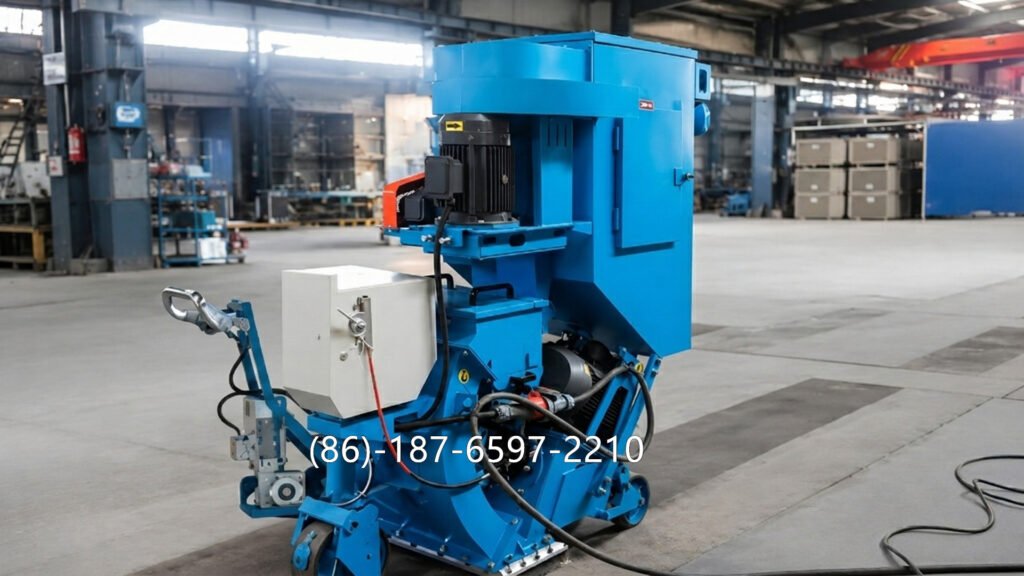
Improve surface preparation efficiency with an integrated floor shot blasting machine designed for industrial floors, steel plates, and concrete surfaces.
Rust, oxide scale, old coatings, concrete laitance, and surface contamination can seriously affect the quality of subsequent painting, coating, waterproofing, and bonding processes.
For factories, construction contractors, steel structure manufacturers, and industrial floor renovation companies, traditional grinding and manual cleaning often require considerable labor and time. These methods may also produce inconsistent surface preparation results, especially when treating large areas.
An integrated floor shot blasting machine offers a more efficient mechanical surface preparation solution. By combining abrasive projection, shot recovery, dust collection, and machine movement into an integrated system, the equipment can perform continuous surface treatment with reduced manual handling.
However, selecting the right machine requires more than comparing working width or motor power. Surface material, contamination level, required cleaning profile, walking speed, abrasive consumption, and dust collection capacity must all be considered.
This guide explains how integrated floor shot blasting equipment works, how to remove rust and scale efficiently, which technical parameters matter, and how to select the right configuration for your project.
If you are looking for a floor shot blasting machine manufacturer for industrial surface preparation, this article will help you evaluate the equipment before requesting a quotation.
1. What Is Integrated Floor Shot Blasting Equipment?
Integrated floor shot blasting equipment is a mobile mechanical surface preparation system designed to clean and profile relatively large, flat surfaces.
Unlike conventional separated systems that require independent shot blasting and dust collection equipment, an integrated design combines the main working components into a more compact machine arrangement.
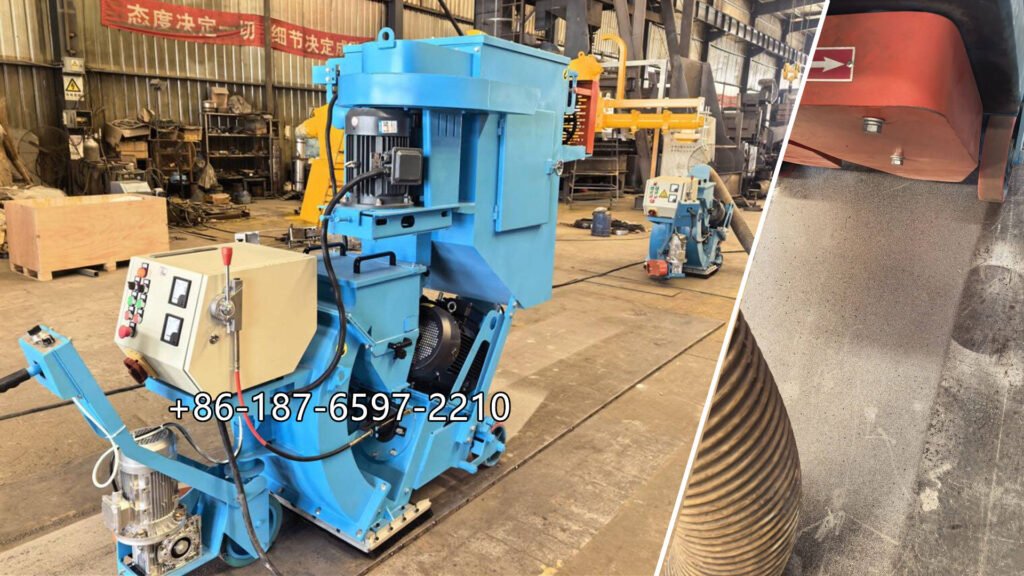
A typical integrated floor shot blasting machine includes:
- Centrifugal blast wheel: Accelerates and projects steel abrasive onto the working surface.
- Blast chamber: Controls the abrasive impact area and limits abrasive escape.
- Abrasive recovery system: Collects and returns reusable steel shot.
- Dust collection system: Separates dust and fine particles from reusable abrasive and extracts airborne contamination.
- Travel drive system: Controls the machine’s forward movement and working speed.
- Electrical control system: Controls the blast wheel, travel motor, and operating sequence.
During operation, steel shot is accelerated by the blast wheel and directed onto the surface. The abrasive impact removes rust, scale, old coatings, or weak surface layers, depending on the substrate and operating conditions.
The spent abrasive and removed contaminants are collected through the recovery system. Reusable steel shot is separated and returned to the blasting process, while dust is extracted by the dust collector.
This creates a controlled surface preparation cycle with less manual abrasive handling.
What makes an integrated design different?
A conventional separated floor shot blasting system may use a separate dust collector connected to the blasting machine through a duct or hose.
An integrated configuration brings key components together into a compact arrangement. Depending on the design, this can simplify transportation, installation, equipment positioning, and operation.
For mobile contractors and factories with limited installation space, this arrangement can be particularly useful.
2. What Materials and Contaminants Can a Floor Shot Blasting Machine Remove?
An integrated floor shot blasting machine can be used on suitable flat steel and concrete surfaces.
The correct configuration depends on the substrate, initial condition, and required surface preparation result.
2.1 Rust Removal from Steel Plates
Steel plates exposed to moisture and outdoor environments may develop surface rust.
Shot blasting projects steel abrasive onto the plate surface to remove rust and other loose contamination.
Typical applications include:
- Steel plate rust removal.
- Ship deck surface preparation.
- Bridge steel component maintenance.
- Steel structure renovation.
- Metal plate coating preparation.
For steel plate applications, the required cleanliness grade should be specified before selecting the abrasive and operating parameters.
2.2 Oxide Scale Removal
Hot-rolled steel and heat-treated components may contain oxide scale.
This scale can interfere with coating adhesion and subsequent surface treatment.
Mechanical abrasive blasting can remove suitable oxide scale and prepare the substrate for further processing.
The effectiveness depends on scale thickness, adhesion, steel condition, abrasive characteristics, and machine configuration.
For heavily scaled steel, the required working speed and number of passes should be verified through a practical test.
2.3 Concrete Floor Surface Preparation
Concrete surfaces often require preparation before applying epoxy coatings, polyurethane coatings, waterproofing systems, or industrial floor treatments.
A floor shot blasting machine can remove:
- Concrete laitance.
- Weak surface layers.
- Loose contaminants.
- Suitable existing coating residues.
- Surface deposits that interfere with coating adhesion.
It can also create a textured concrete surface to support subsequent coating or repair operations.
However, thick elastic coatings, deeply embedded contaminants, and uneven concrete surfaces may require additional preparation methods.
2.4 Old Coating and Surface Contamination Removal
Suitable coatings and surface contamination can be removed through abrasive impact.
The result depends on coating thickness, adhesion, hardness, and compatibility with mechanical blasting.
For thick or flexible coatings, a preliminary trial is recommended to determine whether shot blasting alone can achieve the required result.
3. Five Advantages of Integrated Floor Shot Blasting Equipment
3.1 Faster Surface Cleaning
The centrifugal blast wheel delivers abrasive particles at high speed, providing a mechanical cleaning action across the working width.
Compared with manual grinding or wire brushing, a properly selected floor shot blasting machine can cover large flat areas more efficiently.
Working width, travel speed, abrasive flow, and the number of blast wheels determine the practical cleaning capacity.
A wider machine may increase the area covered per pass, but only when the blast wheel configuration and dust collection system can support the required performance.
3.2 Integrated Abrasive Recovery
One important advantage is the automatic recovery and circulation of reusable steel shot.
During operation, abrasive is collected and returned to the blast wheel through the recovery and separation system.
This reduces the need for operators to manually collect and replenish abrasive continuously.
A properly maintained separator also helps remove broken abrasive and contaminants, supporting more stable blasting performance.
3.3 Effective Dust Collection
Dust generated during surface preparation must be controlled.
The integrated dust collection system extracts contaminated air from the blasting chamber and separates fine particles through filtration.
Depending on the machine design, the dust collector may use automatic pulse-jet or reverse-air cleaning.
Important parameters include:
- Dust collector airflow.
- Filter area and filter material.
- Filtration efficiency.
- Filter cleaning method.
- Dust discharge arrangement.
- Duct diameter and airflow resistance.
A suitable dust collection system helps reduce dust leakage and maintain a cleaner working environment.
Actual emissions and workplace exposure must still be evaluated against the applicable local regulations.
3.4 Compact Structure and Convenient Transportation
An integrated design can reduce the number of separate equipment units required at the job site.
This is useful for contractors who need to transport equipment between different industrial floor projects.
Depending on the model, the equipment may feature:
- Compact machine arrangement.
- Self-propelled travel.
- Adjustable travel speed.
- Integrated abrasive recovery.
- Connected dust extraction.
- Centralized electrical control.
For projects involving multiple locations, transportation dimensions, lifting points, and power requirements should be checked before purchase.
3.5 More Consistent Surface Preparation
Manual surface cleaning depends on operator technique, working pressure, and the time spent on each area.
Mechanical shot blasting provides more controlled abrasive impact and travel movement.
When the machine is properly adjusted, it can produce a more consistent surface preparation result across repeated working passes.
However, surface cleanliness and roughness must be verified. Machine operation alone does not guarantee a specified coating adhesion or surface profile.
4. How Does an Integrated Floor Shot Blasting Machine Work?
The machine operates through a coordinated blasting, recovery, separation, and dust extraction process.
Step 1: Surface Inspection
Before operation, inspect the working surface for oil, grease, loose materials, excessive moisture, cracks, and foreign objects.
Confirm that the substrate can withstand abrasive impact and machine movement.
Step 2: Abrasive Loading
Load the specified quantity of suitable steel shot into the machine’s abrasive circulation system.
The abrasive size should match the substrate and required surface preparation result.
Step 3: Blast Wheel Operation
After the machine’s safety conditions are confirmed, the blast wheel accelerates the abrasive and projects it onto the working surface.
The impact removes rust, oxide scale, laitance, and other suitable surface contaminants.
Step 4: Abrasive Recovery
The abrasive and removed contamination are collected through the recovery system.
Reusable steel shot is separated from dust and broken particles and returned to the abrasive storage and feeding system.
Step 5: Dust Collection
The dust collector extracts airborne particles generated during blasting.
The filter system captures dust, while the cleaning mechanism helps maintain filter performance.
Step 6: Continuous Machine Movement
The travel drive moves the machine along the working surface at the selected speed.
Operators control the travel path and overlap between adjacent passes to avoid untreated strips or inconsistent surface preparation.
Step 7: Surface Inspection
After blasting, inspect the treated surface for cleanliness, uniformity, and profile.
Where required, use suitable inspection instruments and follow the acceptance criteria specified for the coating or repair system.
5. Integrated Floor Shot Blasting Machine Technical Parameters
When purchasing integrated floor shot blasting equipment, the main parameters to compare include working width, blast wheel power, travel speed, abrasive consumption, dust collection, and total installed power.
The following table uses published integrated floor shot blaster specifications as a technical reference.
Representative integrated floor shot blaster specifications
| Parameter | MZRS-550Pro | MZRS-850Pro | MZRS-1000Pro |
|---|---|---|---|
| Working width | 550 mm | 850 mm | 1,000 mm |
| Blast wheel quantity | 2 | 2 | 2 |
| Blast wheel power | 2 × 11 kW | 2 × 15 kW | 2 × 18.5 kW |
| Blast wheel diameter | 220 mm | 220 mm | 220 mm |
| Travel motor power | 1.5 kW | 1.5 kW | 1.5 kW |
| Travel speed | 0.5–20 m/min | 0.5–20 m/min | 0.5–20 m/min |
| Concrete cleaning efficiency | ≥300 m²/h | ≥550 m²/h | ≥700 m²/h |
| Steel plate cleaning efficiency | ≥150 m²/h | ≥200 m²/h | ≥250 m²/h |
| Steel shot consumption | ≤100 g/m² | ≤100 g/m² | ≤100 g/m² |
| Dust removal motor power | 4 kW | 4 kW | 4 kW |
| Suction pipe diameter | 150 mm | 200 mm | 200 mm |
Important technical note: These figures are third-party published reference specifications, not Bestech guaranteed parameters. Cleaning efficiency is manufacturer-reported and depends on substrate condition, required surface profile, abrasive, and operating conditions. Dust collector airflow and complete electrical requirements should be confirmed in the final equipment specification.
Additional parameters to confirm before purchasing
The comparison table is only a starting point. Ask the manufacturer to provide:
- Blast wheel abrasive flow rate in kg/min.
- Initial abrasive loading quantity.
- Dust collector airflow in m³/h.
- Filter area and filtration arrangement.
- Total installed power.
- Electrical supply voltage and frequency.
- Machine weight and overall dimensions.
- Maximum working slope, if applicable.
- Recommended abrasive size and hardness.
- Required maintenance clearance and spare parts list.
These parameters help determine whether the proposed equipment can handle your project conditions.
6. How to Select the Right Working Width and Cleaning Capacity
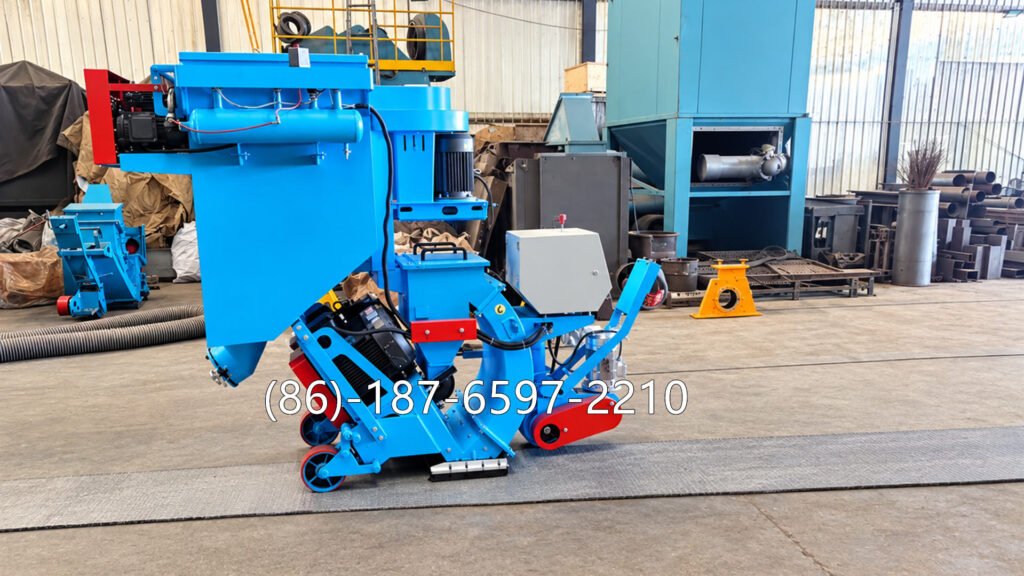
Working width is one of the most important parameters when selecting floor shot blasting equipment.
A wider machine covers more surface area per pass, but it also requires sufficient abrasive flow and dust extraction capacity.
6.1 Select Working Width According to Project Size
| Working width | Typical application |
|---|---|
| 270 mm | Small areas, narrow passages, and localized treatment |
| 550 mm | Medium-sized industrial floors and steel surfaces |
| 850 mm | Larger floor areas and higher production requirements |
| 1,000 mm | Large open surfaces and projects requiring wider coverage |
These are general application references. The final choice should also consider available space, machine weight, surface condition, and transportation requirements.
6.2 Calculate Required Cleaning Productivity
Use the following formula:
Required cleaning capacity = Total surface area ÷ Available working hours
For example, if a contractor needs to prepare 2,400 m² of concrete floor within an 8-hour shift:
2,400 m² ÷ 8 hours = 300 m²/h.
The machine must achieve an average practical production rate of at least 300 m²/h to meet this target.
However, the calculation should include:
- Machine setup and adjustment.
- Actual blasting time.
- Turning and repositioning.
- Overlapping passes.
- Edge and corner treatment.
- Abrasive replenishment.
- Inspection and cleanup.
The rated cleaning capacity is not necessarily the same as the actual project output.
For accurate selection, ask the supplier to evaluate the substrate and perform a representative test.
7. How to Choose the Right Abrasive for Floor Shot Blasting
Abrasive selection directly affects cleaning performance, surface profile, and operating cost.
Steel shot is commonly used in floor shot blasting machines because it can be recovered and reused through the circulation system.
However, abrasive size and characteristics must match the substrate and the required finish.
Common abrasive selection considerations
| Parameter | Selection consideration |
|---|---|
| Abrasive diameter | Determines the impact characteristics and surface treatment behavior |
| Abrasive hardness | Influences cleaning aggressiveness and wear |
| Particle shape | Affects surface profile and cleaning action |
| Abrasive durability | Influences recycling performance and consumption |
| Contamination level | Affects separator operation and abrasive quality |
For example, published floor shot blaster specifications commonly recommend steel shot around 1.2–1.5 mm or 1.5–1.8 mm, depending on the machine configuration.
These are reference sizes, not universal recommendations.
For concrete floors, the abrasive must be selected according to the required concrete surface profile and coating system.
For steel plates, abrasive selection should consider the required rust removal grade and subsequent coating requirements.
Do not select abrasive only according to particle diameter. Confirm compatibility with the blast wheel and abrasive recovery system.
8. International Standards for Floor and Steel Surface Preparation
Different substrates require different surface preparation references. Concrete and steel should not be evaluated using the same cleanliness standard.
8.1 ISO 8501-1: Steel Surface Cleanliness
ISO 8501-1:2007 specifies visual rust grades and preparation grades for steel substrates before the application of paints and related products.
Common abrasive blast-cleaning grades include:
- Sa 1: Light blast-cleaning.
- Sa 2: Thorough blast-cleaning.
- Sa 2½: Very thorough blast-cleaning.
- Sa 3: Blast-cleaning to visually clean steel.
Sa 2½ is commonly required for steel surfaces before protective coating applications.
The actual acceptance grade should be specified according to the coating system and project requirements.
Important: ISO 8501-1 applies to steel substrates. It is not a concrete floor surface profile standard, and a machine cannot automatically guarantee a particular grade without process verification.
Reference: ISO 8501-1 Official Standard.
8.2 ISO 8504-2: Abrasive Blast-Cleaning Methods
ISO 8504-2:2019 describes abrasive blast-cleaning methods used to prepare steel surfaces before coating.
It provides guidance on the equipment and procedures involved in abrasive blasting.
For steel plate rust removal, this reference is useful when establishing the surface preparation procedure.
The current applicable edition should be checked against the project specification, as revision work may be underway.
8.3 ICRI 310.2R: Concrete Surface Preparation
For concrete floor applications, ICRI 310.2R is an important reference for selecting and specifying concrete surface preparation methods before applying sealers, coatings, polymer overlays, and concrete repair materials.
It includes the Concrete Surface Profile (CSP) concept, which helps describe the texture required for different coating and repair systems.
The required CSP depends on the material being applied and the manufacturer’s recommendations.
A concrete floor shot blasting machine can create a textured surface, but the resulting profile must be checked against the project requirements.
9. Integrated Floor Shot Blasting Machine vs. Traditional Surface Preparation
Different preparation methods have different strengths and limitations.
| Preparation method | Advantages | Limitations |
|---|---|---|
| Manual grinding | Flexible for localized treatment | Labor-intensive and operator-dependent |
| Wire brushing | Suitable for light contamination | Limited removal of strongly bonded scale |
| Traditional abrasive blasting | Flexible for many steel components | May require a separate blasting enclosure and dust control |
| Floor shot blasting machine | Suitable for flat surfaces and continuous mechanical preparation | Requires a compatible substrate and accessible working area |
| Integrated floor shot blasting machine | Combines blasting, recovery, and dust collection in a compact system | Initial investment and maintenance requirements must be evaluated |
For large flat surfaces, an integrated floor shot blasting machine can reduce repeated manual handling and simplify the equipment arrangement.
For narrow corners, vertical surfaces, complex geometries, and heavily uneven substrates, additional equipment or preparation methods may still be required.
10. Common Problems and Troubleshooting Guide
Stable operation depends on the blast wheel, abrasive circulation, sealing system, travel drive, and dust collector working together.
The following table covers common issues during floor shot blasting operations.
| Problem | Possible cause | Recommended solution |
|---|---|---|
| Uneven cleaning pattern | Incorrect travel speed or abrasive flow | Adjust travel speed and inspect abrasive feeding |
| Rust or scale remains after blasting | Insufficient blasting intensity or excessive scale thickness | Verify abrasive condition, wheel performance, and number of passes |
| Excessive abrasive consumption | Damaged seals or abrasive leakage | Inspect sealing strips and recovery channels |
| Poor dust extraction | Blocked filters or insufficient airflow | Inspect filters, fan, ducts, and dust discharge |
| Abnormal blast wheel vibration | Uneven wear or damaged rotating components | Stop the machine and inspect the wheel assembly |
| Excessive dust leakage | Worn sealing components or improper chamber contact | Check seals and chamber alignment |
| Machine travel is unstable | Drive system or wheel movement problem | Inspect the travel motor, wheels, and control system |
| Low cleaning efficiency | Worn blades, incorrect abrasive, or unsuitable speed | Check blast wheel wear parts and process settings |
Daily maintenance checklist
Before starting work:
- Check the blast wheel and protective components.
- Inspect the abrasive circulation system.
- Check the steel shot level and condition.
- Inspect the dust collector and filter system.
- Confirm that sealing components are in good condition.
- Check travel drive operation.
- Test emergency stop and safety interlocks.
After operation:
- Remove accumulated dust according to the manufacturer’s procedure.
- Inspect abrasive leakage.
- Check for abnormal noise or vibration.
- Record operating hours and maintenance findings.
Always isolate the machine from electrical and mechanical energy before opening the blasting chamber or performing maintenance. Wait until all rotating components have stopped completely.
11. How to Reduce Operating Costs
A floor shot blasting machine should be evaluated by its total operating cost rather than purchase price alone.
Important cost factors include:
Abrasive consumption
Maintain the abrasive separator and prevent unnecessary media leakage.
Wear parts
Inspect blast wheel blades, control cages, liners, and seals regularly. Replace worn parts before they cause unstable blasting performance.
Dust collector maintenance
Clean or replace filters according to the manufacturer’s maintenance schedule. Poor filtration can reduce airflow and increase operating problems.
Machine travel speed
Set a suitable travel speed according to the surface condition and required preparation result.
Excessive speed may leave untreated areas, while unnecessarily slow operation can reduce productivity.
Preventive maintenance
Regular inspection helps identify problems before they cause major equipment downtime.
A well-maintained machine can provide more stable production performance and help control long-term maintenance costs.
12. Frequently Asked Questions
Q1: What is an integrated floor shot blasting machine used for?
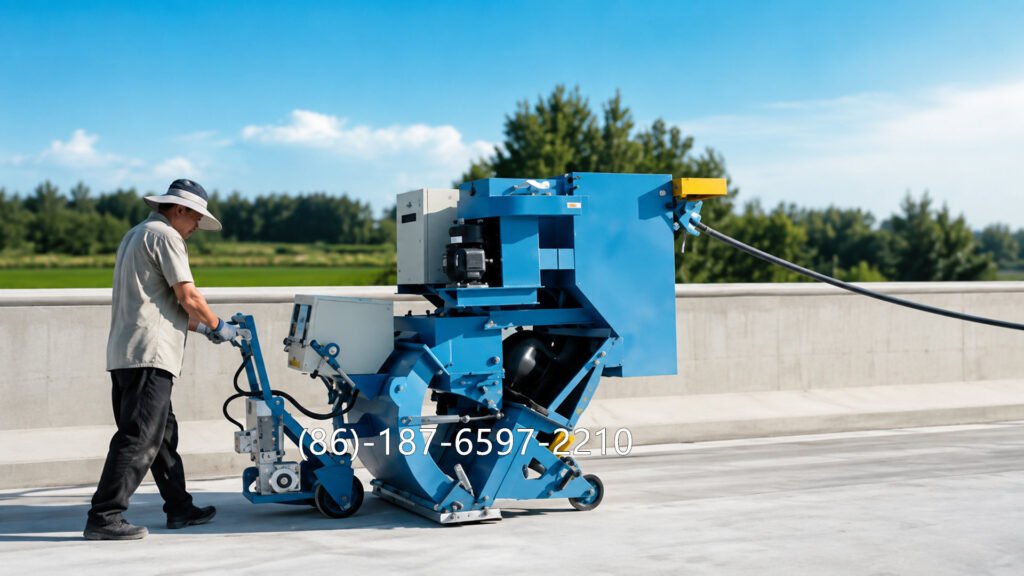
It is used for mechanical surface preparation of suitable flat concrete and steel surfaces. Typical applications include concrete floor renovation, rust removal, oxide scale removal, steel plate preparation, and coating pretreatment.
Q2: Can an integrated floor shot blasting machine remove heavy rust?
Yes, it can remove suitable rust deposits from steel surfaces. The actual result depends on rust thickness, adhesion, abrasive size, blast wheel performance, and travel speed. Heavily corroded surfaces may require additional passes or preliminary treatment.
Q3: Can it remove oxide scale from steel plates?
Yes. The abrasive impact can remove suitable oxide scale from steel plates. The required cleaning grade should be specified and verified according to the applicable steel surface preparation standard.
Q4: Can the machine be used for concrete floor renovation?
Yes. It can remove laitance, weak concrete surface layers, and suitable coating residues while creating a textured surface for subsequent coating or repair work.
The resulting concrete surface profile must match the requirements of the coating or repair material.
Q5: What working width should I choose?
Common working widths include 270 mm, 550 mm, 850 mm, and 1,000 mm.
A smaller width is suitable for narrow or localized areas, while wider configurations are generally considered for larger open surfaces.
The final selection depends on project area, required production output, substrate condition, and machine accessibility.
Q6: What is the difference between integrated and separated floor shot blasting equipment?
An integrated machine combines the main blasting, abrasive recovery, and dust collection components into a compact arrangement.
A separated system uses independently arranged equipment connected through ducts or other material handling components.
The integrated design can simplify transportation and setup, while a separated configuration may provide greater flexibility for some installations.
Q7: How much steel shot does the machine consume?
Consumption varies with surface condition, abrasive characteristics, machine sealing, separator performance, and operating parameters.
Some published integrated floor shot blaster specifications list consumption of up to 100 g/m². This should be treated as a manufacturer-specific reference, not a guaranteed consumption figure for every project.
Q8: Can the machine achieve Sa 2½ on steel plates?
A suitably configured machine may achieve Sa 2½ on compatible steel surfaces when operating conditions are properly selected.
The result must be verified using the applicable ISO 8501-1 inspection method. Do not assume the grade will be achieved on every steel plate without testing.
Q9: Can the equipment be customized?
Depending on the manufacturer, customization may include working width, blast wheel power, dust collection configuration, travel system, electrical supply, and machine structure.
The final configuration should be based on the substrate, project size, cleaning requirements, and destination market.
Q10: What information is needed to obtain an accurate quotation?
Provide the surface material, total working area, initial contamination, required cleaning result, preferred working width, available electrical supply, and expected daily production.
Photos and project drawings help the engineering team recommend a suitable machine configuration.
13. Get the Right Integrated Floor Shot Blasting Equipment for Your Project
Upgrading surface preparation equipment is an important investment for factories and contractors handling large steel and concrete surfaces.
An integrated floor shot blasting machine combines mechanical abrasive cleaning, shot recovery, dust extraction, and controlled travel movement in one equipment system.
The right machine can help remove rust, oxide scale, concrete laitance, and suitable surface contaminants more efficiently while improving process consistency and reducing unnecessary manual handling.
However, the machine must be matched to the actual substrate and project requirements.
Working width, blast wheel power, abrasive consumption, dust collector airflow, travel speed, and required surface profile should all be evaluated before purchasing.
Request a Customized Integrated Floor Shot Blasting Machine Quotation
To help our engineering team recommend a suitable configuration, please provide the following information:
- Surface material: Steel plate, concrete floor, steel deck, or other substrate.
- Working area: Total surface area in m².
- Surface dimensions: Length, width, and thickness where applicable.
- Initial surface condition: Rust, oxide scale, old coating, laitance, or contamination.
- Required cleaning result: Sa 2½ for applicable steel surfaces or specified concrete CSP.
- Required production capacity: m²/h or m²/day.
- Preferred working width: 270 mm, 550 mm, 850 mm, 1,000 mm, or customized.
- Power supply: Voltage and frequency.
- Application environment: Factory, construction site, shipyard, bridge deck, or industrial floor.
- Automation requirement: Standard mobile operation or customized configuration.
Send us your surface photos, project drawings, and expected daily working area.
Our engineering team can evaluate the suitable blast wheel configuration, abrasive circulation system, dust collector, working width, and travel speed according to your application.
Looking for an integrated floor shot blasting equipment manufacturer? Contact us for a technical solution and quotation based on your actual surface preparation requirements.