
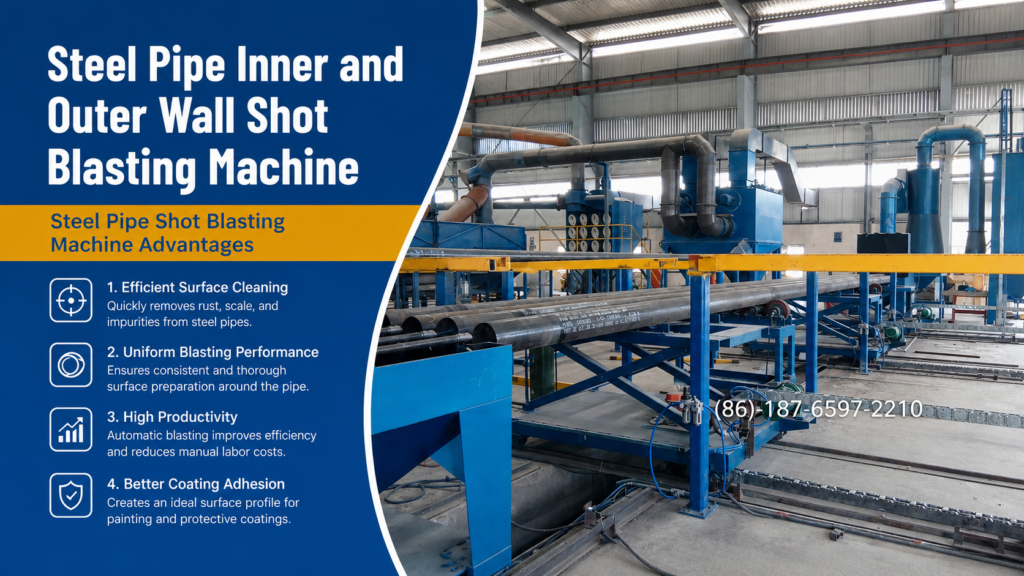
Cleaning steel pipes manually is easy to understand.
But it is difficult to scale.
One pipe may not be a problem.
Hundreds or thousands of pipes per day are a completely different story.
Manual grinding, wire brushing and other mechanical cleaning methods require significant labor. More importantly, the cleaning result can vary from operator to operator.
For steel pipe manufacturers, fabricators and coating companies, the real question is no longer:
It becomes:
“How can we clean more pipe in less time while maintaining consistent surface quality?”
This is exactly where a Steel Pipe Shot Blasting Machine becomes valuable.
By combining high-speed abrasive blasting, automatic conveying, abrasive recovery and dust collection, the machine transforms pipe surface preparation from a labor-intensive operation into a controlled industrial process.
The objective is simple:
Shorter Cleaning Time → Higher Throughput → More Consistent Surface Quality → Lower Labor Dependency
What Is a Steel Pipe Shot Blasting Machine?
Steel pipe shot blasting machine is industrial equipment designed to remove:
- Rust
- Mill scale
- Oxide
- Heat-treatment scale
- Welding residue
- Surface contaminants
from steel pipe surfaces using high-velocity metallic abrasive.
Depending on the application, the machine can be designed for:
External Pipe Blasting
Cleans the outside wall of steel pipes and tubes.
Internal Pipe Blasting
Cleans the internal bore of pipes.
Internal + External Blasting
Processes both surfaces within an integrated system.
Continuous Pipe Blasting
Designed for high-volume production with automatic feeding and conveying.
A typical process is:
Steel Pipe Loading
        ↓
Automatic Feeding
        ↓
Pipe Conveying / Rotation
        ↓
Shot Blasting
        ↓
Abrasive Recovery
        ↓
Abrasive Separation
        ↓
Dust Collection
        ↓
Clean Pipe Discharge
The result is not simply a cleaner pipe.
It is a more efficient production process.
Why Is Shot Blasting Faster Than Manual Pipe Cleaning?
This is the first question most production managers ask.
The answer is process consistency.
Manual cleaning depends heavily on:
- Operator skill
- Tool condition
- Contact pressure
- Working time
- Pipe diameter
- Rust thickness
Shot blasting replaces much of this manual effort with controlled abrasive impact.
Inside the blasting chamber, multiple blast wheels can continuously throw abrasive toward the pipe surface.
At the same time, the pipe can be conveyed or rotated to expose more of its surface.
This means the cleaning process can continue while the next pipe is prepared for loading.
Traditional Process
Load
 ↓
Manual Cleaning
 ↓
Inspection
 ↓
Rework
 ↓
Move Pipe
 ↓
Clean Next Pipe
Continuous Shot Blasting Process
Feed → Blast → Recover → Discharge
          ↓
       Continuous
That difference becomes increasingly important as production volume increases.
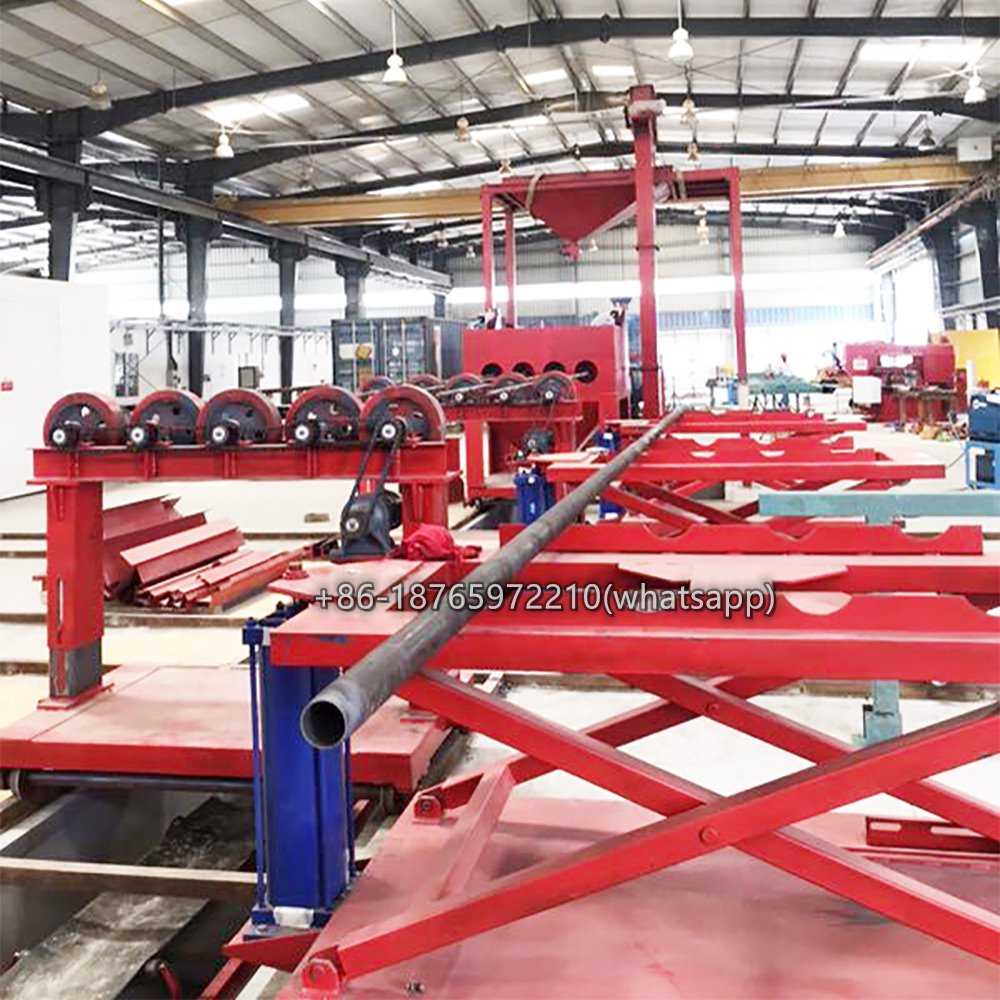
6 Ways a Steel Pipe Shot Blasting Machine Improves Production Efficiency
1. Reduces Cleaning Time
The most direct benefit is shorter surface preparation time.
High-speed abrasive impact can remove surface contaminants much faster than manual mechanical cleaning in many industrial applications.
The actual cycle time depends on:
- Pipe surface condition
- Pipe diameter
- Abrasive type
- Abrasive flow
- Blast wheel power
- Pipe rotation speed
- Conveyor speed
- Required surface preparation grade
The goal is not simply to maximize blasting intensity.
The goal is to find the optimum combination of:
Cleaning Quality + Throughput + Operating Cost
2. Increases Continuous Production Capacity
For factories processing large quantities of steel pipe, continuous conveying is a major advantage.
Instead of cleaning one batch and stopping the machine, pipes can move through the blasting system continuously.
For example:
Pipe A → Pipe B → Pipe C → Pipe D → Pipe E
This production method is particularly suitable for:
- Steel pipe manufacturers
- Pipe coating plants
- Structural steel manufacturers
- Oil and gas pipe processing
- Construction pipe suppliers
- Fabrication workshops
The exact throughput depends on the pipe dimensions and required cleaning level.
3. Improves Surface Consistency
A production line should not depend entirely on operator technique.
With a properly configured shot blasting machine, process parameters can be controlled.
Typical adjustable parameters include:
- Blast wheel speed
- Abrasive flow rate
- Pipe rotation speed
- Conveyor speed
- Blasting exposure time
- Abrasive type and size
Once the correct parameters have been established through testing, the same process can be repeated across production.
This makes quality control easier.
4. Reduces Manual Labor
Manual pipe cleaning can require operators to repeatedly:
- Move pipes
- Position pipes
- Grind surfaces
- Brush contaminants
- Inspect surfaces
- Rework incomplete areas
Automation can move much of this repetitive work into the machine.
Depending on the production line, automation may include:
- Automatic feeding
- Automatic pipe positioning
- Pipe rotation
- Automatic conveying
- Automatic discharge
- PLC control
- Sensor-based detection
Operators can then focus more on production monitoring and quality inspection.
5. Improves Abrasive Utilization
A properly designed shot blasting machine does not simply throw abrasive away.
The abrasive is recovered and reused.
Typical circulation:
Blast Wheel
    ↓
Abrasive Impact
    ↓
Collection Hopper
    ↓
Conveyor
    ↓
Bucket Elevator
    ↓
Separator
    ↓
Reusable Abrasive
    ↓
Storage Hopper
    ↓
Blast Wheel
During this process, the separator removes:
- Dust
- Broken abrasive
- Pipe scale
- Fine particles
- Other contaminants
The usable abrasive returns to the blasting system.
This helps maintain stable blasting performance and control abrasive consumption.
6. Creates a Better Surface for Coating
Cleaning and coating are closely connected.
If rust, mill scale or loose contaminants remain on the pipe, they can interfere with subsequent coating operations.
A properly prepared steel surface can provide better conditions for coating application.
ISO 8501-1 provides visual preparation grades for steel substrates.
Common blast-cleaning grades include:
- Sa 2
- Sa 2½
- Sa 3
For many industrial coating projects, Sa 2½ is commonly specified.
However:
Sa 2½ is not simply a machine specification.
The actual result depends on the complete blasting process.
That includes:
Abrasive + Blasting Intensity + Exposure Time + Pipe Speed + Initial Surface Condition
Internal vs. External Steel Pipe Shot Blasting
Before purchasing a machine, determine exactly which pipe surface needs to be cleaned.
This sounds obvious.
But it is one of the most common sources of incorrect equipment selection.
External Wall Shot Blasting
Designed to clean the outside surface of the pipe.
The pipe may be:
- Conveyed
- Rotated
- Rotated while conveyed
depending on the machine configuration.
Typical applications include:
- Steel pipes
- Structural tubes
- Welded pipes
- Large-diameter pipes
- Coating preparation
Internal Wall Shot Blasting
Designed specifically for cleaning the pipe bore.
The blasting system directs abrasive into the internal surface.
This requires consideration of:
- Internal diameter
- Pipe length
- Wall thickness
- Internal surface condition
- Required surface grade
For long pipes, the internal blasting system must also be designed for efficient abrasive recovery.
Internal + External Shot Blasting
For applications requiring complete pipe surface preparation, a combined system can be designed.
Pipe Feeding
      ↓
External Blasting
      ↓
Internal Blasting
      ↓
Abrasive Recovery
      ↓
Dust Collection
      ↓
Surface Inspection
This can reduce handling between separate internal and external cleaning operations.
Typical Steel Pipe Shot Blasting Machine Parameters
The following table provides typical engineering reference ranges, not fixed specifications for every machine.
| Parameter | Typical Range / Configuration |
|---|---|
| Machine Type | Steel Pipe Shot Blasting Machine |
| Blasting Mode | External / Internal / Combined |
| Pipe Diameter | Approx. 50–1500 mm |
| Pipe Length | Approx. 3–15 m |
| Pipe Rotation Speed | Approx. 2–20 rpm |
| Conveyor Speed | Approx. 0.5–5 m/min |
| Blast Wheel Quantity | Approx. 2–8 |
| Blast Wheel Power | Approx. 7.5–30 kW / wheel |
| Abrasive | Steel Shot / Steel Grit |
| Abrasive Flow | Approx. 100–300 kg/min / wheel |
| Abrasive Recovery | Automatic |
| Abrasive Separator | Air-Wash Type |
| Dust Collector | Bag Filter / Cartridge Filter |
| Control System | PLC + HMI |
| Speed Control | Variable Frequency Drive |
| Production Capacity | Customized |
Important Engineering Note
Final specifications should be calculated according to:
Pipe Diameter + Pipe Length + Wall Thickness + Pipe Weight + Surface Condition + Required Capacity + Surface Preparation Grade
A reliable supplier should confirm the configuration through technical calculation and, where necessary, sample testing.
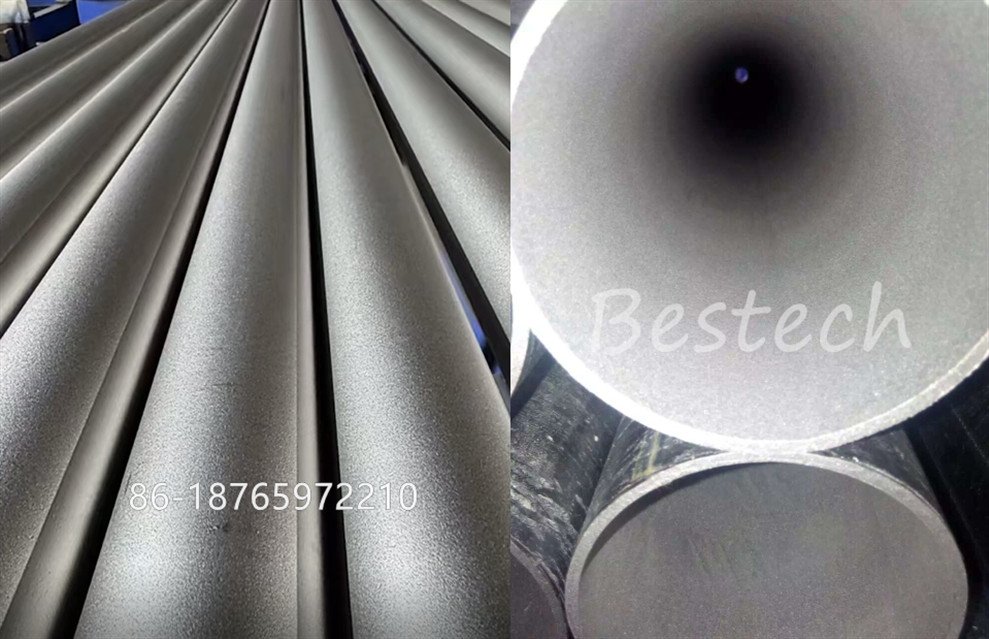
How to Calculate the Required Production Capacity?
Do not tell a supplier:
“I need a high-speed machine.”
Give measurable production data.
For example:
500 pipes/day
or:
100 meters/hour
or:
10 tons/hour
The calculation should consider the actual pipe dimensions.
A simplified production relationship is:
Production Capacity = Pipe Loading Rate × Pipe Weight × Operating Efficiency
But practical machine sizing also requires consideration of:
- Blasting exposure time
- Conveyor spacing
- Pipe diameter
- Pipe length
- Loading density
- Machine utilization
- Maintenance downtime
This is why two factories processing the same pipe diameter may still require different machine configurations.
What Determines Steel Pipe Shot Blasting Speed?
Several factors control cleaning speed.
1. Pipe Surface Condition
Heavy mill scale generally requires more aggressive treatment than light rust.
2. Abrasive Type
Steel shot and steel grit behave differently.
3. Abrasive Size
Different abrasive sizes affect impact and surface profile.
4. Blast Wheel Power
Higher power can increase blasting intensity, but more power is not automatically better.
5. Pipe Rotation
For external blasting, rotation helps expose different surface areas.
6. Conveyor Speed
Higher speed increases throughput but reduces blasting exposure time.
The correct machine balances all six.
Steel Shot vs. Steel Grit
Both are widely used metallic abrasives.
Steel Shot
Steel shot is generally spherical.
It is commonly selected for:
- General cleaning
- Scale removal
- Repeated abrasive circulation
- Controlled surface treatment
Steel Grit
Steel grit has an angular shape.
It is commonly selected where a more aggressive cutting action is required.
The correct choice depends on:
- Pipe material
- Initial surface condition
- Required cleanliness
- Desired surface profile
- Coating requirements
ISO 11124 provides specifications and classification for metallic blast-cleaning abrasives, including cast-steel shot and grit.
Surface Profile: Don’t Focus Only on Cleanliness
A clean pipe is not necessarily a correctly prepared pipe.
If the pipe will be painted or coated, surface profile may also be important.
The ISO 8503 series addresses surface roughness characteristics of blast-cleaned steel substrates.
Relevant references include:
- ISO 8503-2 — Comparator method
- ISO 8503-5 — Replica tape method
Surface profile is influenced by:
- Abrasive shape
- Abrasive size
- Abrasive hardness
- Blasting velocity
- Exposure time
- Steel substrate
Therefore, if your coating specification includes a profile requirement, include it in the machine RFQ.
How to Reduce the Operating Cost of a Pipe Shot Blasting Machine
A high-production machine does not automatically mean low operating cost.
Look at the complete process.
Optimize Conveyor Speed
Too slow:
Higher cleaning time + lower output
Too fast:
Insufficient cleaning + possible rework
Find the operating point where the required surface quality is achieved at the highest practical throughput.
Maintain Abrasive Quality
The separator should continuously remove unwanted fines and contaminants.
Poor abrasive quality can reduce blasting efficiency.
Inspect Blast Wheel Wear Parts
Worn components can affect abrasive distribution and blasting performance.
Regular inspection can help maintain consistent operation.
Maintain the Recovery System
Blocked or poorly maintained recovery equipment can increase:
- Abrasive loss
- Downtime
- Dust
- Maintenance cost
Avoid Unnecessary Oversizing
An oversized machine may increase:
- Purchase cost
- Installed power
- Maintenance requirements
- Spare parts consumption
The best machine is not the biggest machine.
It is the machine correctly matched to the production requirement.
Steel Pipe Shot Blasting Machine vs. Manual Cleaning
| Factor | Shot Blasting Machine | Manual Cleaning |
|---|---|---|
| Production Mode | Continuous / Automatic | Manual |
| Cleaning Speed | High | Low–Moderate |
| Surface Consistency | High when properly configured | Operator-dependent |
| Labor Requirement | Lower | Higher |
| Abrasive Recovery | Automatic | Usually limited |
| Production Capacity | High | Limited |
| Process Control | High | Lower |
| Line Integration | Excellent | Limited |
| Large-Volume Production | Suitable | Difficult to scale |
For low-volume maintenance work, manual cleaning may still be practical.
For high-volume industrial production, automated shot blasting becomes much more attractive.
Common Buying Mistakes
Mistake 1: Buying Based on Price Only
The machine with the lowest quotation may have:
- Lower blast wheel power
- Smaller capacity
- Basic dust collection
- Less automation
- Lower-grade wear protection
Compare the complete configuration.
Mistake 2: Providing Only Pipe Diameter
A supplier also needs:
- Pipe length
- Wall thickness
- Weight
- Production capacity
- Surface condition
- Cleaning requirement
Mistake 3: Ignoring Internal Diameter
For internal pipe blasting, the bore diameter is critical.
Two pipes with the same external diameter can have completely different internal blasting requirements.
Mistake 4: Asking Only About Blast Wheel Power
Power alone does not determine cleaning performance.
Evaluate:
Power + Wheel Arrangement + Abrasive Flow + Exposure Time + Pipe Movement
Mistake 5: Ignoring Factory Testing
A machine can look excellent in a catalog.
The real test is your pipe.
Whenever possible, ask the manufacturer to test actual customer workpieces.
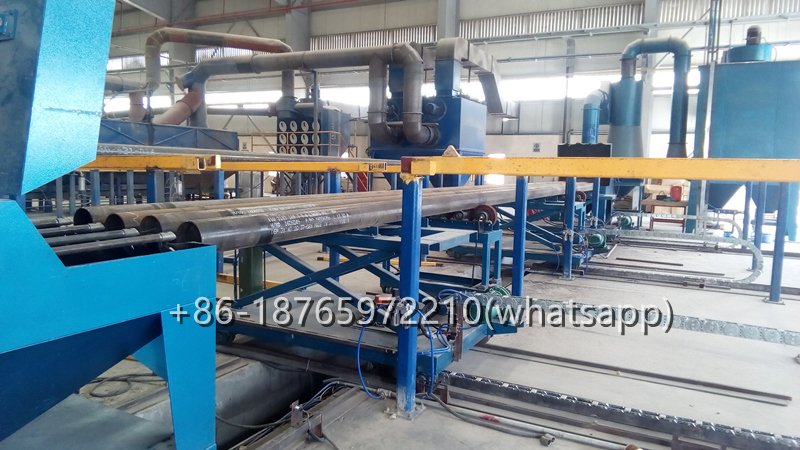
Factory Acceptance Test for a Steel Pipe Shot Blasting Machine
For customized equipment, a factory acceptance test can verify the main functions before shipment.
Mechanical Test
Check:
- Pipe conveying
- Pipe rotation
- Blast wheel operation
- Roller operation
- Machine vibration
Abrasive System Test
Check:
- Abrasive feeding
- Abrasive recovery
- Separation
- Abrasive circulation
Electrical Test
Check:
- PLC
- HMI
- Sensors
- Emergency stop
- Safety interlocks
- Motor protection
Surface Treatment Test
Use actual customer pipes whenever possible.
Customer Pipe
      ↓
Initial Surface Inspection
      ↓
Abrasive Selection
      ↓
Trial Blasting
      ↓
Surface Inspection
      ↓
Parameter Adjustment
      ↓
Final Test
This provides much stronger evidence than comparing machine photos alone.
How to Choose the Right Steel Pipe Shot Blasting Machine?
Before requesting a quotation, answer these questions.
1. What is the pipe diameter range?
Example:
Ø50–Ø500 mm
2. What is the pipe length?
Example:
6 m / 9 m / 12 m
3. What is the maximum pipe weight?
Example:
500 kg / pipe
4. Do you need internal or external blasting?
External / Internal / Both
5. What is the production target?
Example:
20 pipes/hour
or:
100 m/hour
6. What is the current surface condition?
- Rust
- Mill scale
- Oxide
- Welding residue
7. What surface grade is required?
- Sa 2
- Sa 2½
- Sa 3
- Other
8. What happens after blasting?
- Painting
- Coating
- Galvanizing
- Welding
- Inspection
These answers determine the machine configuration.
RFQ Template
Copy this form and send it directly to a shot blasting machine manufacturer.
Steel Pipe Shot Blasting Machine RFQ
Pipe Type: __________________
Material: __________________
External Diameter: ______ mm
Internal Diameter: ______ mm
Wall Thickness: ______ mm
Pipe Length: ______ mm
Maximum Pipe Weight: ______ kg
Average Pipe Weight: ______ kg
Required Capacity: ______ pipes/hour
or: ______ m/hour
or: ______ tons/hour
Current Surface Condition: __________________
Required Surface Grade: Sa 2 / Sa 2½ / Sa 3 / Other
Surface Profile Requirement: ______ μm
Blasting Requirement: External / Internal / Both
Loading Method: Manual / Automatic
Unloading Method: Manual / Automatic
Control System: Standard / PLC + HMI
Power Supply: ______ V / ______ Hz / ______ Phase
Installation Country: __________________
Other Requirements: __________________
What Should Be Included in a Supplier Quotation?
Do not request only:
“Machine price.”
Request a complete technical quotation.
The quotation should clearly identify:
- Machine model
- Pipe diameter range
- Pipe length range
- Maximum pipe weight
- Blast wheel quantity
- Blast wheel power
- Abrasive flow
- Conveyor speed
- Pipe rotation system
- Abrasive separator
- Dust collector
- PLC/HMI
- Electrical components
- Wear-resistant liners
- Spare parts
- Installation support
- Commissioning
- Warranty
- Delivery time
- Factory acceptance test
This makes supplier-to-supplier comparison much easier.
Recommended Customization Options
A professional steel pipe shot blasting system can be customized around the actual production process.
Pipe Diameter Range
Designed according to minimum and maximum pipe diameter.
Pipe Length
Conveying and blasting chamber dimensions are selected according to pipe length.
Heavy-Duty Conveying System
Designed according to pipe weight and loading frequency.
External Blasting System
Blast wheels are positioned to achieve effective external coverage.
Internal Blasting System
Internal blasting equipment can be configured according to the pipe bore and length.
Automatic Feeding System
Suitable for continuous production lines.
Variable Conveyor Speed
Allows adjustment of blasting exposure time.
PLC + HMI Control
Possible functions include:
- Automatic operation
- Speed adjustment
- Pipe detection
- Fault monitoring
- Safety interlocking
- Production monitoring
Frequently Asked Questions
How does a steel pipe shot blasting machine reduce cleaning time?
It uses high-speed abrasive impact and automated conveying to continuously remove rust, mill scale and other contaminants, reducing dependence on manual cleaning.
Can a steel pipe shot blasting machine clean both sides of a pipe?
Yes. Separate external, internal or combined internal-and-external configurations can be designed.
What surface grade can be achieved?
Depending on the pipe condition and process parameters, the system can be configured for requirements such as Sa 2, Sa 2½ or Sa 3.
What abrasive is normally used?
Steel shot and steel grit are common choices for industrial steel surface preparation.
Can the machine process long steel pipes?
Yes. The conveying system can be designed according to pipe length. Long-pipe applications require careful consideration of support, conveying and abrasive recovery.
Is automatic loading available?
Yes. Automatic loading and unloading systems can be integrated according to the production line.
Can the pipe rotate during blasting?
Yes. Rotation can be used in suitable external blasting configurations to improve surface exposure.
How much does a steel pipe shot blasting machine cost?
There is no single standard price. Cost depends on pipe diameter, length, weight, production capacity, blasting mode, blast wheel configuration, dust collection and automation.
Should I test my pipes before ordering?
Yes. For a customized machine, sample testing with actual workpieces is one of the best ways to confirm the proposed process.
Technical Standards & References
ISO 8501-1
Preparation of steel substrates before application of paints and related products — Visual assessment of surface cleanliness.
This standard provides visual preparation grades for steel surfaces, including commonly referenced blast-cleaning grades such as Sa 2, Sa 2½ and Sa 3.
ISO 8503-2
Preparation of steel substrates before application of paints and related products — Surface roughness characteristics of blast-cleaned steel substrates.
Provides a comparator method for assessing the surface profile of blast-cleaned steel.
ISO 8503-5
Preparation of steel substrates before application of paints and related products — Surface roughness characteristics of blast-cleaned steel substrates — Replica tape method.
Provides a method for determining surface profile using replica tape.
ISO 11124-1
Preparation of steel substrates before application of paints and related products — Specifications for metallic blast-cleaning abrasives — General introduction and classification.
Provides classification information for metallic blast-cleaning abrasives.
ISO 11124-3
Specifications for high-carbon cast-steel shot and grit.
Provides specifications relevant to high-carbon cast-steel shot and grit used for metallic blast-cleaning.
Final Takeaway: Faster Cleaning Is Only the Beginning
The real value of a steel pipe shot blasting machine is not simply removing rust faster.
It is creating a more controllable production process.
Manual Cleaning
→ High Labor Dependency
→ Variable Efficiency
→ Inconsistent Results
→ Difficult to Scale
Automatic Shot Blasting
→ Continuous Processing
→ Controlled Blasting Parameters
→ More Consistent Surface Preparation
→ Automatic Abrasive Recovery
→ Easier Production-Line Integration
For high-volume steel pipe processing, the right machine can turn surface preparation from a production bottleneck into a controlled manufacturing step.
But remember:
Do not choose the machine by model number or blast wheel power alone.
Choose it according to:
Pipe Diameter
Pipe Length
Pipe Weight
Internal / External Blasting Requirement
Production Capacity
Surface Condition
Required Surface Grade
Downstream Coating Process
Get a Customized Steel Pipe Shot Blasting Solution
Have a steel pipe project?
Send the manufacturer:
Pipe Drawing or Photos
External & Internal Diameter
Pipe Length
Wall Thickness
Maximum Pipe Weight
Required Production Capacity
Current Surface Condition
Required Surface Grade
The manufacturer can then recommend the appropriate:
- Blast wheel configuration
- Internal/external blasting system
- Pipe conveying system
- Pipe rotation system
- Abrasive recovery system
- Dust collector
- PLC control system
- Automation level
Don’t just ask, “How much is the machine?”
Ask:
How many meters can it process per hour?
What surface quality can it achieve?
How much abrasive does it consume?
How much manual labor does it replace?
Can it integrate with my existing production line?
That is how to evaluate the real value of a Steel Pipe Shot Blasting Machine.
Faster Cleaning. Higher Throughput. More Consistent Surface Preparation.
Build the blasting system around your pipe — not the other way around.