
A foundry does not lose money only because of expensive raw materials. Unstable sand preparation can also increase molding defects, rework, downtime, labor costs, and production waste.
For green sand foundries, the rotor sand mixing machine is one of the key machines used to prepare molding sand before it enters the molding process. A properly configured rotor mixer can improve sand mixing uniformity, moisture distribution, additive dispersion, and batch-to-batch consistency.
If you are looking for a factory direct high efficiency rotor sand mixing machine, the important question is not simply how many kilowatts the mixer has.
The real question is:
Can the machine consistently produce qualified molding sand at your required tons per hour and operating cost?
This guide explains the working principle, technical parameters, mixing process, automation options, safety standards, factory testing, and B2B purchasing points you should check before ordering a rotor sand mixer.
Quick Answer: What Is a High Efficiency Rotor Sand Mixing Machine?
A high efficiency rotor sand mixing machine is a foundry sand mixer designed to intensively mix molding sand with water, bentonite, additives, or other process materials.
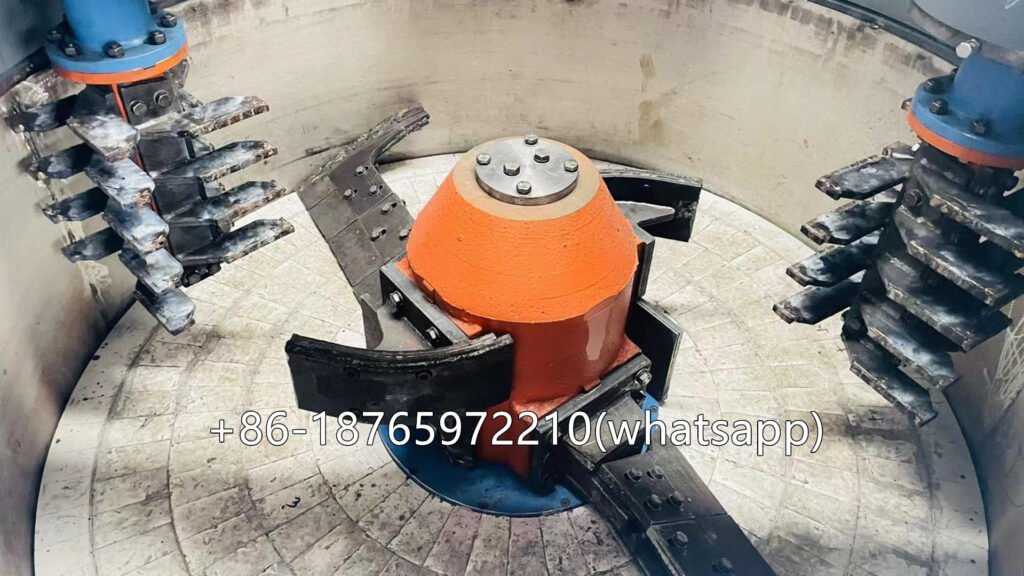
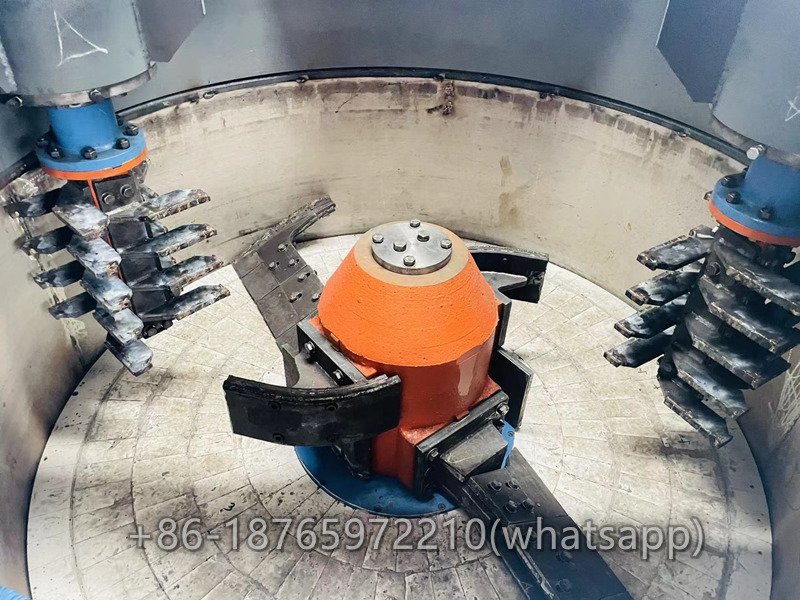
In a typical batch mixing process, the sand is loaded into the mixing chamber, while the rotor and mixing tools create intensive movement of the sand bed. Water and additives can be introduced during the mixing cycle to improve distribution.
ISO 23062:2022 defines a sand mixer as machinery in which sand with bonding agents is mixed and conveyed to the discharge gate, covering both batch and continuous types.
For green sand preparation, the practical objective is not simply “mixing.”
It is:
Stable sand properties → stable mold quality → fewer casting problems → lower production cost.
Why Choose a Factory Direct Rotor Sand Mixing Machine?
Buying directly from the manufacturer can provide several practical advantages when the machine requires customization.
1. Direct Technical Communication
You can discuss:
- Sand type
- New/reclaimed sand ratio
- Batch weight
- Required output
- Mixing cycle
- Moisture control
- Bentonite addition
- Water dosing
- Automation level
- Discharge arrangement
- Installation space
This is more useful than selecting a standard machine only from a catalog.
2. Custom Configuration
A factory-direct supplier can configure the mixer according to the actual process instead of forcing every foundry to use the same configuration.
Possible options include:
- Different batch capacities
- Different motor powers
- Automatic water dosing
- Additive dosing systems
- PLC control
- HMI operation
- Pneumatic discharge
- Hydraulic discharge
- Feeding conveyor
- Sand cooler integration
- Reclaimed sand feeding
- Automatic weighing system
3. Factory Acceptance Testing
For B2B equipment purchases, the factory test is important.
Before shipment, the supplier can test:
- Rotor rotation
- Motor current
- Mixing cycle
- Discharge operation
- Water dosing
- PLC functions
- Safety interlocks
- Abnormal noise and vibration
- Actual sand mixing performance
For large production projects, buyers should define the FAT requirements before placing the order.
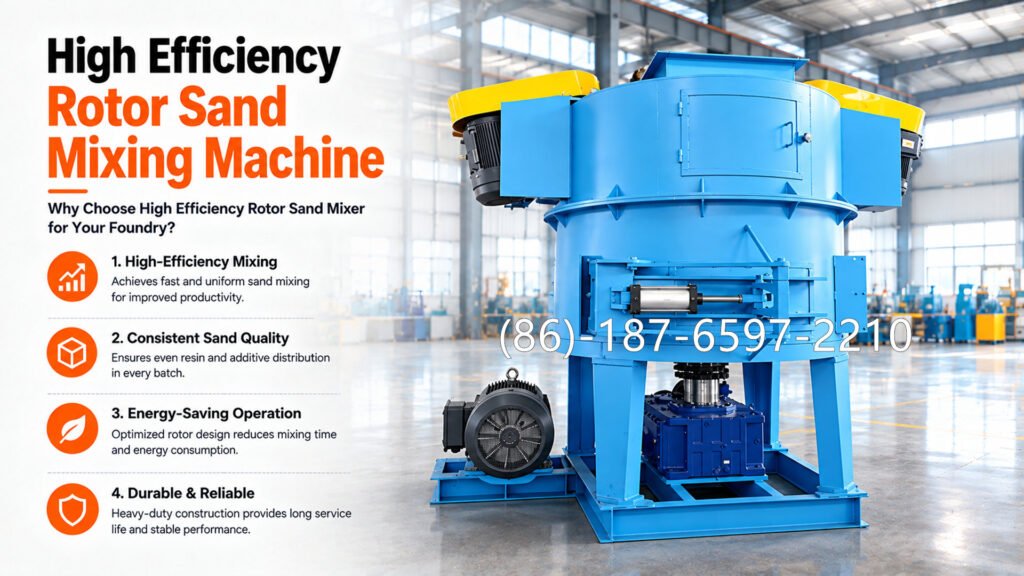
High Efficiency Rotor Sand Mixer: What Does “High Efficiency” Really Mean?
“High efficiency” should not simply mean a larger motor.
A useful engineering evaluation should consider:
Qualified sand output ÷ total operating cost
The main performance factors include:
- Mixing uniformity
- Mixing cycle time
- Effective batch capacity
- Water distribution
- Additive distribution
- Reclaimed sand condition
- Rotor and liner design
- Motor loading
- Discharge time
- Automatic dosing accuracy
- Operator involvement
- Maintenance requirements
For example, a mixer with a very large theoretical batch capacity may not provide high production if its actual mixing cycle is too long.
A More Useful Capacity Calculation
A simple production estimate can be made from:
Hourly production ≈ Effective batch weight × 60 ÷ Total cycle time
Where:
Total cycle time = Loading + Mixing + Discharge + Necessary process adjustment
For example, if the effective batch is 1,000 kg and the complete cycle is 5 minutes:
1,000 × 60 ÷ 5 = 12,000 kg/h
or approximately:
12 tons/hour
This is why buyers should request the effective production capacity under actual operating conditions, rather than only asking for the maximum batch size.
Typical Technical Parameters of Rotor Sand Mixing Machine
The following are typical engineering reference ranges for this type of equipment. Actual specifications should be confirmed according to sand characteristics, batch size, required output, mixing recipe, and production cycle.
| Parameter | Typical Range / Configuration |
|---|---|
| Machine Type | High Efficiency Rotor Sand Mixing Machine |
| Application | Green Sand Preparation |
| Sand Type | New Sand / Reclaimed Sand / Blended Sand |
| Mixing Method | Rotor Intensive Mixing |
| Batch Capacity | Approx. 100–1,500 kg/batch |
| Production Capacity | Approx. 2–20 tons/hour |
| Main Motor | Approx. 11–55 kW |
| Mixing Time | Approx. 2–8 min/batch |
| Water Dosing | Manual / Automatic |
| Additive Dosing | Manual / Automatic |
| Control System | Electrical / PLC + HMI |
| Discharge | Mechanical / Pneumatic / Hydraulic |
| Installation | Stand-Alone / Production Line |
| Sand Temperature Control | Process Dependent |
| Customization | Available |
Important: These values are reference ranges rather than universal specifications. The final machine should be sized from your actual sand, batch weight, required output, mixing time, additive system, and molding-line requirements.
How Does a Rotor Sand Mixing Machine Work?
The basic process can be divided into several stages.
Step 1: Sand Loading
New sand, reclaimed sand, or a specified mixture is fed into the mixing chamber.
A typical green sand system may use:
- New silica sand
- Reclaimed molding sand
- Bentonite
- Water
- Carbonaceous additives
- Other process additives
The actual recipe depends on the casting process and foundry sand system.
Step 2: Rotor Starts Mixing
The rotor rotates inside the mixing chamber and creates intensive movement of the sand.
The purpose is to expose more sand particles to the added materials.
Step 3: Water Addition
Water can be added manually or through an automatic dosing system.
Automatic water dosing can help reduce operator-to-operator variation because the amount of water is controlled according to the programmed recipe or process feedback.
Step 4: Additive Distribution
Bentonite and other additives need to be distributed throughout the sand.
Poor distribution can create local differences in moisture or binder/additive concentration.
Step 5: Mixing and Homogenization
The rotor continues mixing until the required process condition is reached.
Mixing time should be established through actual sand testing rather than simply using a fixed value for every foundry.
Step 6: Discharge
The finished sand is discharged to:
- Sand cooler
- Belt conveyor
- Bucket elevator
- Intermediate hopper
- Molding machine
- Sand storage system
Why Mixing Uniformity Matters in Green Sand Foundries
Green sand preparation directly affects molding performance.
Poorly mixed sand may cause problems such as:
- Uneven moisture
- Inconsistent compactability
- Poor mold strength
- Mold surface defects
- Sand adhesion
- Casting dimensional variation
- Increased scrap
- Difficult process adjustment
The mixer therefore needs to provide repeatable results rather than simply moving a large quantity of sand.
A good production target is:
Same recipe + same batch size + controlled mixing cycle = repeatable sand properties
This is particularly important for automatic molding lines.
Rotor Sand Mixing for New Sand and Reclaimed Sand
Many foundries use a combination of new and reclaimed sand.
The actual ratio depends on:
- Casting alloy
- Casting size
- Mold quality requirements
- Reclamation efficiency
- Sand temperature
- Existing sand system
- Bentonite activity
- Loss on ignition
- Moisture requirements
A rotor mixer can be configured to handle blended sand streams, but the mixer should not be selected independently from the reclamation and cooling process.
A more complete process may look like:
Shakeout → Sand Separation → Reclamation → Cooling → Storage → Weighing → Rotor Mixing → Molding
If reclaimed sand enters the mixer at unstable temperature or moisture, simply increasing motor power will not solve the process problem.
Rotor Mixer + Sand Cooler: A Better Sand Preparation System
For continuous foundry production, the mixer and sand cooler should be considered as one process.
A typical system can include:
- Shakeout
- Magnetic separation
- Sand reclamation
- Screening
- Sand cooling
- Sand storage
- Automatic weighing
- Rotor mixing
- Water/additive dosing
- Finished sand delivery
- Molding line
This configuration allows the foundry to control the complete sand preparation process instead of treating the mixer as an isolated machine.
Automatic Water Dosing for Rotor Sand Mixer
Water is one of the most important variables in green sand preparation.
Manual water addition may be acceptable for small production, but larger foundries often benefit from automatic dosing.
An automatic system can include:
- Water tank
- Water pump
- Flow meter
- Solenoid valve
- Control valve
- PLC
- Recipe management
- HMI display
The control strategy can be designed around batch weight and process requirements.
However, automatic dosing does not automatically guarantee correct moisture.
The actual process should still be verified through appropriate foundry sand testing.
PLC and HMI Control
A PLC-controlled rotor sand mixing machine can make repeated production easier to manage.
Typical HMI functions include:
- Batch weight setting
- Mixing time setting
- Water quantity setting
- Additive dosing
- Rotor start/stop
- Discharge control
- Alarm display
- Recipe management
- Production counter
- Maintenance reminders
For a fully automatic line, the mixer can communicate with:
- Sand hoppers
- Weighing systems
- Conveyors
- Sand coolers
- Molding machines
- Central control systems
This allows the mixer to become part of the complete foundry sand preparation system.
How to Reduce Rotor Sand Mixer Operating Costs
A high-efficiency mixer should be evaluated by more than purchase price.
Consider the following:
1. Reduce Mixing Time
If the required sand quality can be achieved in a shorter cycle, the same machine can potentially produce more sand per hour.
2. Control Water Addition
Over-wetting can create additional correction work and unstable molding conditions.
3. Optimize Reclaimed Sand Usage
Stable reclaimed sand quality can reduce dependence on new sand.
4. Monitor Rotor Wear
Worn mixing tools can affect mixing performance and increase maintenance requirements.
5. Reduce Unnecessary Empty Running
Automatic control can coordinate feeding, mixing, and discharge to reduce idle time.
6. Track Energy per Ton
Instead of asking only:
“How many kW is the motor?”
ask:
“How many kWh are required per ton of qualified molding sand?”
This is a much more useful production indicator.
Rotor Wear Parts: What Should Buyers Check?
Rotor mixers work with abrasive sand, so wear protection is an important part of machine selection.
Typical wear components may include:
- Rotor blades
- Mixing tools
- Wear plates
- Chamber liners
- Scraper components
- Discharge components
- Bearings and seals
Ask the supplier:
- What material is used for wear parts?
- Are wear parts replaceable?
- How long is the typical service interval?
- Are spare parts stocked?
- Can replacement parts be supplied separately?
- Is the rotor design optimized for easy maintenance?
A machine with a low initial price can become expensive if wear parts are difficult to replace.
Common Rotor Sand Mixer Problems and Troubleshooting
| Problem | Possible Cause | Recommended Check |
|---|---|---|
| Uneven sand moisture | Poor water distribution | Check water nozzle, flow rate and mixing cycle |
| Long mixing time | Incorrect batch loading or worn tools | Check loading ratio and rotor condition |
| High motor current | Overloading or foreign material | Check batch weight and chamber |
| Excessive vibration | Rotor imbalance or bearing issue | Inspect rotor and bearings |
| Sand sticking | Excess moisture or incorrect recipe | Check moisture and sand temperature |
| Poor additive distribution | Incorrect dosing or insufficient mixing | Check dosing system and cycle |
| Slow discharge | Discharge mechanism problem | Inspect gate and pneumatic/hydraulic system |
| Abnormal noise | Bearing or wear component damage | Stop machine and inspect mechanical parts |
| Inconsistent batch quality | Unstable sand input | Check reclaimed/new sand condition |
The most important troubleshooting principle is:
Do not adjust the mixer before checking the incoming sand condition and actual recipe.
Safety Requirements for Rotor Sand Mixing Machines
Safety should be considered during design, installation, operation, maintenance, and troubleshooting.
ISO 23062:2022 covers foreseeable significant hazards for foundry molding/coremaking machinery and associated equipment and specifically includes machinery used to condition and/or reclaim foundry sands. It also identifies the sand mixer within its terminology.
Typical safety functions should include:
- Guarding of moving parts
- Emergency stop
- Access-door interlock where applicable
- Safe discharge design
- Motor overload protection
- Electrical protection
- Maintenance access
- Warning labels
- Lockout/tagout procedures
- Safe cleaning procedures
ISO 23062 also notes that electrical hazards are addressed by IEC 60204-1:2016.
The final safety design should be assessed according to the applicable regulations and standards for the destination market.
ISO 9001:2026 and Factory Quality Control
For buyers purchasing industrial machinery internationally, supplier quality management is another important consideration.
ISO 9001:2026 is the current sixth edition of ISO 9001 and was published in September 2026. It provides requirements for establishing, implementing, maintaining, and continually improving a quality management system.
For a rotor sand mixer manufacturer, a structured quality system can support control of:
- Incoming materials
- Welding quality
- Machining
- Assembly
- Electrical installation
- Purchased components
- Inspection
- Factory testing
- Documentation
- Corrective actions
ISO 9001 certification itself is not mandatory, so buyers should verify the supplier’s actual quality documentation and production controls rather than relying only on the existence of a certificate.
CE Compliance for European Buyers
For machinery placed on the EU market, buyers should discuss the applicable EU machinery legislation and conformity assessment requirements with the supplier.
Regulation (EU) 2023/1230 is the current EU Machinery Regulation. Its consolidated version identifies CE marking as the manufacturer’s indication that machinery conforms with applicable Union harmonisation legislation and sets requirements for conformity assessment and the EU Declaration of Conformity.
Therefore, instead of asking only:
“Is this machine CE certified?”
ask the supplier for:
- Applicable conformity assessment route
- EU Declaration of Conformity, where applicable
- Risk assessment
- Technical documentation information
- User manual
- Safety information
- CE marking details
- Electrical documentation
The exact compliance route depends on the machinery configuration and applicable legislation.
Factory Acceptance Test Before Shipment
For an overseas B2B order, FAT should be clearly defined.
A practical rotor mixer FAT can include:
Mechanical Inspection
- Rotor rotation
- Mixing chamber
- Wear liners
- Discharge gate
- Bearings
- Transmission
Electrical Inspection
- Motor rotation
- Current
- Control cabinet
- Emergency stop
- Sensors
- Interlocks
Process Test
- Batch loading
- Mixing cycle
- Water dosing
- Additive dosing
- Discharge
- Abnormal-condition testing
Documentation
- Operation manual
- Electrical drawings
- Spare-parts list
- Maintenance instructions
- Test report
- Compliance documentation where applicable
For a customized machine, FAT is particularly valuable because it allows problems to be identified before the equipment is shipped.
How to Select the Right Rotor Sand Mixing Machine
Do not select a rotor mixer only from the advertised maximum capacity.
Start with these eight questions:
1. What is your required output?
For example:
5 tons/hour? 10 tons/hour? 20 tons/hour?
2. What is your batch size?
The required batch weight determines the useful mixer volume.
3. What type of sand are you mixing?
- New sand
- Reclaimed sand
- New + reclaimed sand
- Green sand
- Other molding materials
4. What additives are used?
Provide the actual process recipe whenever possible.
5. What is the required mixing cycle?
A 2-minute cycle and an 8-minute cycle result in very different production capacity.
6. Is automatic water dosing required?
Small manual systems and automatic molding lines have different requirements.
7. Is PLC control required?
For automated production, PLC + HMI is normally more practical.
8. Will the mixer connect to other equipment?
Provide the complete process flow.
Factory Direct OEM Rotor Sand Mixing Machine
A factory-direct OEM supplier can customize the machine according to the buyer’s process.
Possible OEM options include:
- Batch capacity
- Rotor design
- Motor power
- Chamber dimensions
- Wear-resistant materials
- Water dosing
- Additive dosing
- PLC
- HMI
- Automatic weighing
- Discharge system
- Feeding system
- Sand cooler connection
- Conveyor connection
- Molding-line communication
- Electrical standard
- Local voltage
For overseas projects, provide the supplier with the complete process flow rather than only a machine name.
What Information Should You Send for a Rotor Sand Mixer Quotation?
To receive a meaningful quotation, send the following information:
Application: Green sand molding / other
Required output: ___ tons/hour
Batch size: ___ kg/batch
New sand: ___ %
Reclaimed sand: ___ %
Sand temperature: ___ °C
Target moisture: ___ %
Additives: ___
Required mixing time: ___ min
Automatic water dosing: Yes / No
PLC + HMI: Yes / No
Discharge method: ___
Existing equipment: ___
Available installation space: ___
Power supply: ___ V / ___ Hz / ___ Phase
Destination country: ___
Required standards: ___
This information allows the manufacturer to select a more appropriate rotor mixer configuration.

Factory Direct Does Not Mean “One Machine Fits All”
This is an important point when comparing suppliers.
Two factories may both require a 10-ton/hour rotor sand mixer, but their machines may need different configurations because of:
- Different sand temperature
- Different reclaimed sand percentage
- Different moisture requirements
- Different additives
- Different molding machines
- Different batch sizes
- Different mixing cycles
- Different automation levels
Therefore, the correct purchasing approach is:
Process requirement → Batch calculation → Mixer configuration → Testing → Final quotation
not:
Catalog model → Price → Purchase
FAQ: Rotor Sand Mixing Machine
What is a rotor sand mixing machine used for?
It is used to mix foundry sand with water, bentonite, reclaimed sand, and other process additives to prepare molding sand for casting production.
Is a rotor mixer suitable for reclaimed sand?
Yes, rotor mixers can be configured for new sand, reclaimed sand, or blended sand. The actual configuration should consider reclaimed sand temperature, moisture, grain condition, and additive requirements.
What is the capacity of a rotor sand mixer?
Typical engineering reference ranges can be approximately 100–1,500 kg/batch and 2–20 tons/hour, depending on machine size and process conditions.
Can the water dosing be automatic?
Yes. Automatic water dosing can be integrated using a tank, pump, flow meter, valves, sensors, and PLC control.
Can the rotor mixer connect to a molding line?
Yes. It can be integrated with weighing systems, conveyors, sand coolers, storage hoppers, and automatic molding lines.
How long does the mixing cycle take?
A typical reference range may be approximately 2–8 minutes per batch, but the actual cycle should be determined by sand type, recipe, batch size, and required sand properties.
Can the machine be customized?
Yes. Factory-direct manufacturers can customize capacity, motor power, dosing systems, discharge, control system, dimensions, and production-line interfaces.
How should I compare two rotor sand mixer suppliers?
Compare:
- Effective output
- Mixing cycle
- Batch capacity
- Motor loading
- Water dosing
- Wear-part design
- Automation
- FAT procedure
- Spare parts
- Documentation
- After-sales support
- Total operating cost
Do not compare price alone.
Why Buy a Factory Direct Rotor Sand Mixing Machine?
For foundries that need a customized sand preparation solution, factory-direct purchasing can provide a more direct engineering connection between the equipment manufacturer and the end user.
The most important points are not simply:
Low Price
or
High Motor Power
The real value comes from:
Stable Mixing + Correct Capacity + Accurate Dosing + Easy Maintenance + Reliable Automation
A properly configured rotor sand mixing machine can become an important part of a stable green sand preparation system.
Final Checklist Before Ordering
Before issuing the purchase order, confirm:
☑ Required tons/hour
☑ Effective batch capacity
☑ Complete mixing cycle
☑ New/reclaimed sand ratio
☑ Water dosing method
☑ Additive dosing method
☑ Rotor and wear-part material
☑ Motor power
☑ PLC/HMI configuration
☑ Discharge system
☑ Safety protection
☑ FAT requirements
☑ Spare parts
☑ Installation requirements
☑ Electrical standard
☑ User manual
☑ Technical drawings
☑ Applicable compliance documents
☑ Warranty terms
☑ Delivery schedule
The final question to ask your supplier:
“Can you test my actual sand and show me the mixing result, cycle time, and effective production capacity before shipment?”
That question is often more valuable than simply asking for the lowest machine price.